All posts by Dr. Mike

Dr. Mike, Day Laborer

Shelter-in-place and social isolation are two terms that were new to me but have become familiar phrases in the last few weeks. I’m a person who feels that every event can be a learning opportunity, including our current viral crisis.

In an earlier post, I explored my continued awareness that despite being an introvert, I need people in my life. The first few weeks of shelter-in-place were tough as the only real contacts that I had were with my immediate family, and they had their activities and interests.  Julie was working, Kathryn was adjusting to life back in the USA, and Will and Grace were attending classes online. 

I didn’t feel like doing much of anything, and I spent most of my energy trying to put together a survival plan for the family.  Where could we get toilet paper?  Did we have enough soap? How could I make DIY hand sanitizer and disinfectants?  Emergency planning was all that I could do.

I was prevented from doing things that I loved as I was isolating indoors.  I couldn’t go on a camping adventure with Violet, the campervan.  I couldn’t take myself on a photography safari, and there wasn’t much to write about as my daily life had been reduced to the mundane.  

One of my favorite retirement activities before the pandemic was hanging out with my friend, Tom.  We have always gotten along well, and we saw each other often. We were keeping up with each other electronically, but for whatever reason, that wasn’t cutting it for me.  I mentioned to Tom that I was feeling frustrated and bored, and he suggested that I stop by his backyard for a socially distant barbecue, which I did.  I was surprised by how much better I felt with the addition of a little bit of normalcy. 

Tom recently purchased an older townhome close to downtown Naperville that had never been updated.  He planned to gut the place entirely and to reconfigure the interior into a more modern and efficient space.  He was going to demolish the interior on his own to save funds for the actual remodel. Tom is an experienced contractor who knows the protocols for such a task; however, he is only one person. I was concerned that he would injure himself by tackling all aspects of this enormous job alone. I was determined to help, but my efforts were met by family concerns for my safety due to the coronavirus.  I felt that their worries were unfounded as I would be wearing a respirator and gloves during the demolition process.  Besides, I would take other precautions, like bringing my homemade hand sanitizer to the job site.

I knew that one of my primary functions would be as a photographer to document the process.  We write a weekly construction blog, and photos always make the posts better.  However, this would not reduce Tom’s chance of injury. Multitasking presented the most significant injury risk to my friend. He would be inherently safer if he could concentrate on a single task rather than trying to do everything by himself.  

I have been hanging around construction sites for some time, and I am starting to get an understanding of the construction process. However, knowledge isn’t the same thing as skill.  

During most of my life, I have been thrust into leadership positions. This is likely because I’m responsible, organized, and I have good problem-solving skills.  As a physician, I was a chief resident, co-founder of a successful psychiatric practice, and served as a medical director in several positions. I am comfortable in leadership roles, but leadership was not needed here. I needed to be a follower, a gofer, a grunt. The most helpful thing that I could do for my friend was to become a day laborer.

Some of you may think that it is beneath a physician to do such things, but I disagree with this idea completely. I am many things beyond a doctor, and I feel that all honest work is honorable.  

Tom’s townhouse is an easy walk from my home, and I have been going there in the mornings to do whatever was needed.  I have pried tacking strips off of floors, taken countless loads of refuse to the dumpster, and even sawed through a pipe or two.  My actions have allowed Tom to concentrate on methodically stripping the interior down to the studs.

My stated goal was to help my friend and to increase his safety. However, I also have benefited from my actions. I’m getting a little exercise, I have social contact, and I am continuing to learn by observation.  Hosts on DIY TV shows often state how much fun it is to deconstruct before they construct something.  Frankly, I think their statements are total crap.  The process is physically challenging, filthy, and potentially dangerous.  However, the method also serves as a classroom for an uninformed person, such as myself.  Each layer of the interior has to be removed and properly disposed of.  Appliances have to be recycled, ceilings and walls have to be cut away, insulation discarded, plumbing fixtures removed, and electrical connections isolated. Deconstructing a house is another way of learning how to construct a house, and I find that process very fascinating. By participating in the process, I have gotten a master’s class in home construction.

Soon tradespeople will descend on the property.  Plumbers, electricians, carpenters, and others. I’ll help in whatever way that I can, but, likely, I’ll mostly be photographing and writing about the construction experience in Tom’s blog. However, after all of these years, I know most of Tom’s subcontractors, and they usually don’t mind my picture taking and obsessive questions. 

When I first met Tom, he was surprised that I was always asking questions. “Why do you want to know that it is useless information to you?” He would ask.  I would always respond that there was no such thing as useless information.  Over the years, I have put to use some of that “useless” information, but for me, the process of learning is reason enough to learn. 

I choose to be a competent human being. To me, that means that I am more than just a title or job description. I’m glad that I have had the training to adjust complicated pharmacological cocktails for schizophrenic patients.  However, I’m also happy that I have the knowledge base to make a meal from scratch for my family, fix a friend’s computer, or put together a solar-powered electrical system for Violet the campervan. Each activity has worth, as does picking up clumps of insulation and tossing them into a dumpster. It gives me pleasure to think that in some small way, I am helping my friend.  Every slab of wallboard that I chucked is one less that he had to do.  To me, a friend is someone who is there for you when you need them.  Tom has certainly been there for me, and I enjoy returning the favor.

During this terrible time, it is easy to feel sorry for ourselves.  To think that we are being cheated, or put upon by the world.  This is a perfect recipe for sadness.  I would suggest that it is better to think about what you have instead of what you are missing.  Extend yourself to someone else and try to be supportive of them. I’m not Mother Theresa. Yes, I feel that I’m helping a friend, but I’m also getting quite a bit in return from the interaction.  The result of helping someone has made me happier.  We live in a world of “me,” and with it, we see higher rates of depression, anxiety, and addiction.  In my career, I saw individuals who were always looking for ways to feel better about themselves.  They judged their happiness with their latest purchase.  They would blame others for their unhappiness and take no responsibility for their own dysfunctional behaviors. These patients were almost impossible to help as they expected someone else to do their work.  Their lives could have been transformed by taking some of their self-absorbed energy and “spending” it to make someone else’s burden lighter. During this crisis time, we all need to work together. There is strength in numbers; if we stand alone, we will become dust in the wind.

Tom’s construction blog post can be found at: HTTP://gizmohomecraft.com

The original 1970s kitchen.
The wall between the kitchen and living room.
Original appliances taken to a recycler.
Mike in demolition garb.
The bathrooms will be completely remodeled.
Walls between the kitchen and living room and the kitchen and dining room removed.
getting rid of a sea of “blown-in” insulation.
Stripped down to the studs.

An Introvert Reacts To Shelter-In-Place During the COVID-19 Pandemic.

I always thought that there was something different about me.  I enjoy people, but being around large groups exhausts me.  I prefer having a few friends rather than many connections.  

Early in my medical career, I was certain that something was wrong with me.  Many of my colleagues used friendships to make work connections and to build their practices.  They would form relationships with referring docs and therapists to ensure a steady stream of patients to their office door. 

I would observe their business acumen. However, the thought of doing something similar was impossible for me.  Pretending to like someone was not in my emotional playbill.  I remember when the medical director of my clinic asked me to invite a new doctor over for dinner, as he seemed to be uncomfortable and unhappy in his new job. Apparently, I was supposed to make him feel more at ease. I did what I was told and invited him over.  The new doc seemed significantly more uncomfortable than I was, and any questions that I asked were met, at best, with a one-word answer. Eventually, that doctor not only left our practice but also the state. I think he was packing his bags well before I served him our wild rice casserole, but the memory of that dinner still gives me a shutter.

Over time I understood that I wasn’t defective, I was an introvert.  I form very strong relationships with a few people and I’m a loyal and true friend.  My close circle doesn’t exhaust me in the least and I miss those connections when I don’t see them. However, I’m also very comfortable being alone and I can’t remember the last time that I was truly bored when I was by myself.  I always can find something to do. 

Like many introverts, I can be a functional extrovert.  Put me in a social situation or ask me to give a lecture and I don my extrovert cape and perform.  That last word was chosen deliberately, as my actions are an act. I know how extroverts behave and I do likewise. In many instances, I’ll enjoy these situations, but after a few hours I’ll need to have alone time to regroup and recharge. 

I discovered that I was an introvert many years ago. However, I continue to learn about my personality and my personal needs. Over the last few years, I have traveled solo in Violet, my campervan.  I have enjoyed these trips, but I have often wished that I had someone with me to share the adventure. When I say “someone” I mean someone in my close circle of connections. Being an introvert doesn’t mean that I always want to be by myself.

Although I accepted the fact that I was an introvert, It always seemed that I was shortchanged. My extroverted doctor colleagues had the sales advantage.  They could use their personal traits to attract business, I had to rely on the quality of my work and word of mouth to do the same.  

My extroverted neighbors easily intermingled with each other, partied together, and even traveled together. I would wave to them from the driveway and quickly return to the comfort of my house.  

My extroverted friends always seemed to have a hundred people to see and a million places to go. This was never the case for me.

My friend Tom is an extrovert and has the ability to connect with just about anyone.  It seems that anywhere I go with him he runs into someone he knows who automatically wants to stop what they are doing and have a conversation with him. It is interesting to me that a super extrovert and a quiet introvert would become best friends.

Over time I have not only accepted being an introvert, but I have also come to value it. I may form fewer relationships, but they are deeper and more meaningful. I may spend more time alone, but I always find something to do.  I am a continual learner and explorer, and I like the fact that I have the time to study new things and skills.

When COVID-19 resulted in shelter-in-place rules I thought would be fine.  What would be better for an introvert than being locked up in their house!  However, my assessment wasn’t accurate.

During the first few weeks of being sheltered-in-place, I found that I was feeling irritable and down. I initially attributed these feelings to the obvious.  The stock market, which was the source of my income, was dropping.  In addition, basic supplies that ranged from toilet paper to flour were impossible to buy.  I was feeling afraid and insecure. However, after a week I accepted the situation and let go of the anxiety around it.  However, I was still feeling unsettled. I didn’t feel like learning new things, or writing, or taking photos, or doing just about anything.  It was a difficult time, but also a time for introspection.

Julie was home as were three of my kids, and that was good.  We did do things together, but they were also involved in their own activities. I reflected on what was missing and it was clear that I was concerned about and missing other people in my life.  I decided to come up with a plan.  I’m close to my two sisters and during this time I would call them every day.  I would also have more regular contact with my oldest daughter, Anne.  She has a busy life so daily contact would be a burden to her, but we could certainly talk once or twice a week.  I increased my calls to my childhood friend, John.  We have always been close as brothers, but like many brothers, the time that we spent together has shrunk through the years. I decided that I would call John at least once a week.  I also reached out to my friend Ralph.  Ralph is still in the workforce and busy seeing patients, but I wanted him to know that he was important to me.

My friend Tom presented as a special case.  Prior to the pandemic, I saw Tom almost every day.  During the first week we were still in regular electronic contact, but I was still missing him.  Tom just bought a townhome that is in need of total rehab.  In efforts to reduce his cost, he is doing a lot of the initial work by himself. I’m certainly not a construction guy but I have been hanging around Tom for many years and I have observed a thing or two.  I also knew that demolishing the interior of his townhome would require that I wear PPE which would also provide virus protection.  I could help my friend and have a little social interaction all at the same time!  I like win/win scenarios.  

Lastly, I kept up other social connections with friends and family via Zoom, Facetime, and emails. 

I believe that being an introvert has made it easier for me to shelter-in-place. However, life is not about absolutes. I do need social contacts and I do value those people that I am close to. My efforts to connect with those people who are important to me have been met positively by the recipients.  I’m happy that I am as important to my connections as they are to me. 

During these difficult times, it is important to recognize who we are and what we need. We need to look at what has made us happy in our normal lives and we need to replicate those things to the best of our ability during these difficult times. When I say replicate I don’t mean duplicate. Shelter-in-place orders are there for a reason.  Be creative and explore ways to “normalize” your life.

Making a COVID “Crib”

The COVID-19 pandemic brought many changes to our household, and one of the most significant ones was that our empty nest of two transformed into a full house of 5 adults. In a week, three of our adult children returned home for the duration.  Before their leaving, they had been transitioning to independence.  However, with shelter-in-place as the law of the land, our home has once again become a place of family time.

We are fortunate as our kids are good-natured and considerate.  However, it was an adjustment for all of us to have everyone return to the mothership during a lockdown. We have kept many of our traditions.  I have been doing a lot of cooking with the kids, and Julie has been playing a variety of games with them.  We enjoy each other’s company and conversation, and we all eat dinner together.  I believe that our living situation works as we are respectful of each other’s privacy. Each of us has claimed a zone in the house that we call our own. Julie alternates between the living room and the family room couch.  Kathryn cocoons in her room. Grace has claimed a large chair in the family room, and Will is fond of my old Telepsych studio space in the basement. My zone is the chair in my study.  

My study is a small room that is located in front of our house.  You enter it by taking a left from the foyer.  The place is squarish and has wood paneling around the lower third of the walls.  Directly opposite of the door are built-in bookcases, which are overstuffed with books.  Directly in front of the bookshelves is a large brown leather recliner-style chair.  Next to the chair is a small table holding a traditional brass lamp.  To the right of the chair are two large multi-pane double-hung windows.  The wall directly in front of the bookcase has a desk with a powerful computer and two monitors and wall shelves that contain speakers, a printer, and other functional items.  The remaining wall has my prized roll top desk. The room is crowded but cozy.

My usual working spot in the room is at the computer desk, where I sit in a mesh style office chair.  It is there that I edit photos and videos, watch YouTube videos, and write.  However, this is not the right place for the extended time that a shelter-in-place order commands. 

My go-to chill-out spot is the big brown leather recliner.  That recliner has become my COVID crib.  The chair is supportive, but it also has soft overstuffed goodness. I can position myself in a variety of poses that range from a traditional sit to hanging my legs across the arms as if I was reclining in a chaise lounge. My chair zone offers me everything that I could need for hours of education and entertainment.  If I twist to the right, I can quickly look out the window to the sidewalk and street beyond.  With the lockdown, my neighbors have taken to walking, and there is a never-ending stream of people and puppies marching past my house.  The little table is the perfect spot to hold a cup of coffee, a pen, my iPhone, and the cool Apple earbuds that I got for my birthday.  My phone equipped with the earbuds serves as a communication center for voice calls, FaceTime calls, Zoom calls, and text messages.  My regular computer is too bulky for my lap, but thankfully I also have a tiny MacBook which I use for my Starbucks writing adventures.  That little device is perfect for surfing. The MacBook connects me to social media, the news, and YouTube. I pair the computer with an inexpensive lap desk for an excellent writing system. In fact, I’m writing this post with that very setup.  

Mornings will typically find me sitting in my chair with a cup of steaming hot coffee beside me on the little table.  I like to grind whole beans in a Breville coffee grinder, so it is super fresh and vibrant.  My Bunn coffee pot has a thermal carafe which allows for hours of hot refills. Morning is the time when I check the latest news and catch up on Facebook and the world. 

Afternoon is the perfect time for people watching.  All I have to do is swivel my body slightly to the right for full access to the sidewalk and street.  I live at the end of a T-intersection giving me a comprehensive view of my neighborhood.

In the evening, I enjoy the spot as I call friends and family, write, and think.

Dear readers, to be clear, I am not spending every moment in my chair.  However, it is there for me at any time of the day that I need it.  During a crisis time, it provides me with the comfort and familiarity that I need to get through the day. It is a spot that is functional enough to do real work and cozy enough for a little nap.

I think that it is essential for each of us to have a zone that we can claim as our own.  It doesn’t have to be a room; it can be a location in a room. My site is my overstuffed chair, which I have outfitted to contain items that make it a functional spot.  I hope you have a similar place in your COVID crib. If not, considering creating one.

It may only be a chair to you, but for me, it is my COVID crib. And yes, the green stuff is homemade hand sanitizer.

Our Easter During A Shelter-In-Place COVID-19 Pandemic.

I have celebrated Easter Sunday in the same way for decades. The morning starts with a candy hunt by the kids, followed by a light brunch. We then attend a late morning church service. I rush home from church to make my “signature” cheesy chivy potatoes, which is my contribution to our family’s Easter party. We then pile into our car and drive off to my sister’s house in a nearby suburb. Along the way, I pick up flowers for my two godchildren.

For Easter, my sister and brother-in-law supply their house and a lot of the food. However, most of us are assigned a dish-to-pass. We typically are given the same dish to make year after year, which is how cheesy chivy potatoes became my signature dish. You may think that the recipe sounds disgusting, but many family members have told me that they look forward to it every Easter. Chessy Chivy Potatoes are not haute cuisine. 


Mike’s Recipe for Cheesy Chivy Potatoes

  1. Make a whole bunch of mashed potatoes.
  2. Stir in a lot of cheese. This can be any combination of meltable cheeses. Over the years, I have used sharp cheddar, American slices, and even Velveta. 
  3. Add chives to taste. I’ll sometimes saute fresh chives, but I have also used the dried bottled stuff. They both taste the same.

I bring a large pan of the potatoes, and I’ll often leave the party with an empty scrapped casserole dish. Our Easter meal is Midwestern… ham, potatoes, jello molds, rolls/butter, sweet potatoes, Easter lamb pound cake… you get the picture. We do have a few vegetarians in our group, so there are also some vegetarian-friendly foods added to the menu.

My sister’s Easter party is always a highlight for me. Everyone is eager to mingle and chat, the weather is typically beautiful enough for a walk, and the food is comforting. By 8 PM, I’m ready to head home. Easter Sunday concludes quietly, often by watching one of those classic Easter movies. However, all that changed with the COVID-19 pandemic, as many weeks ago, my sister canceled the event due to the virus.

As a family, we decided to do something for Easter, but we weren’t sure what that “something” would be. Our plans slowly formed as the day approached.

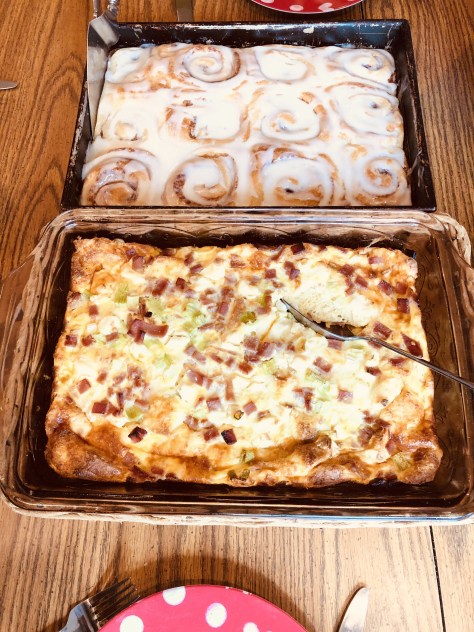
Julie made a brunch style egg dish, the kind where you mix bread, eggs, ham, and cheese and let the combination sit overnight in the fridge. It puffs up into a delicious souffle style casserole when you bake it the next day. Also, she proved some Rhodes cinnamon rolls. These start as frozen pucks that you place in a 9 x 13 pan overnight. By morning they are doubled in size and ready for the oven. There is nothing like the smell of baking cinnamony bread to wake you up in the morning. Add some strong hot coffee for a perfect start to the holiday.

Hot Cinnamon Rolls and Overnight Egg Dish

We didn’t buy any Easter candy; I didn’t think that this was a big deal as our kids are adults. I was wrong. This was rectified by Grace and Kathryn, who took a quick trip to Walgreen’s candy aisle the day before.  

Enough Easter candy to make anyone sick.

Later Sunday morning, we went to church…online. Our church had started a streaming ministry to lock-ins, and so they were ready to broadcast when Illinois’ shelter-in-place order came through. I cued up the stream on a Macbook and “Cast” it to our family room TV. The overall production quality was excellent, and they wove in video clips and remote music into the sermon. At communion time, we ate Ritz crackers and had a small sip of box wine. Watching church on a TV is not as engaging as participating in person, but the overall impact made it a worthwhile experience.

An online sermon cast to our family room TV.
Multiple musical collaborators turned our family room into a church concert.

Our early afternoon was carved out for connecting with others. At 2 PM, we all huddled around a computer and logged into a Zoom call to Julie’s family. The group represented members from 4 states and one foreign country. Her family follows rules well; everyone waited to talk, and the conversation rolled along smoothly.  

Huddling around a computer on a Zoom call to the Nelsons.

At 3 PM, I connected to my side’s Zoom call. Kunas are very exuberant, and most have little experience with conference calls. The resulting connection consisted of conversational chaos. It was fantastic to see everyone, but after about 10 minutes I decided that it was time to leave the meeting. Lastly, I was able to connect with my oldest daughter, Anne, via FaceTime. By 4 PM, I had touched base with more people then I would have if I had followed my usual Easter routine. This surprised me.

Reaching out with Zoom to the Kuna side of the family.
A good ol’ FaceTime call to daughter, Anne.

For dinner, Julie made some chicken legs that I bought during a pandemic grocery trip along with some stuffed shells and fresh asparagus. This was not our traditional Easter dinner, but delicious and celebratory none-the-less.

A non-traditional but delicious dinner.

After dinner, I discover new neighborhoods on a walk with my daughter Grace. Our evening ended with a family viewing of episode 8 of “The Tiger King.” We, too, have succumbed to this national phenomenon. I have to say that episode 8 seemed more like click-bait than a real episode, but it still managed to occupy 60 minutes of our evening.

I discovered this cool mid-century home when we decided to go in a different direction on a walk.

There you have it, our Easter during the pandemic. We didn’t go to church or have traditional Easter baskets. I didn’t make cheesy chivy potatoes or go to my sister’s house for a party. However, we managed to incorporate all of the essential elements of our typical Easter into last Sunday. We ate special food, and the kids had their fill of hollow chocolate bunnies and Cadbury eggs. We attentively attended an online church service. We caught up with loved ones, and we did family-centered activities. We didn’t give up Easter; we just modified it. It was a good day.

We may need to change other behaviors during (and after) this crisis time, but that doesn’t mean that we need to give up on life or traditions.  

I’m sure that there are activities or connections that you are missing since you have had to socially isolate. I would ask you to distill the essence of what you are losing into its characteristic elements. Be creative and see how you can reproduce those elements differently so you can transform your situation from one of loss to one of discovery.

Peace

Cooking During The Pandemic

I grew up at a time when it was OK for parents to be uninvolved with their kids.  Yes, some dads and moms liked to spend time with their children, but a lack of such interest was not frowned on. If I wanted to spend time with my parents, I had to do this on their terms.  This was nearly impossible with my father but more workable with my mom.

My mother was a brilliant person who spent her adult life as a homemaker. Just about anything that she did, she did well.  One of her jobs was that of the household cook. We had seven people in our family, and we never went to restaurants. The vast majority of the food that we ate was made at home, and my mother made most of it. 

I can recall watching her cook as I ran the logic of her decisions through my mind. She was an effortless cook who knew her craft so well that she rarely had to consult a cookbook or use a measuring spoon. Despite her expertise, my mother loved watching cooking shows, and by far, her favorite one was Julia Child’s “French Chief.”  I would watch the show with her, and this is a fond memory. I loved the precision and focus of Julia Child. She treated cooking as a science, and I liked science.

I believe that all of that cooking exposure left me with kitchen confidence.  Making food was not a mystery to me; it was just a series of logical steps. Once I understood the stages of one process, I could translate that information to another. 

As a single man, I put my cooking knowledge to good use, especially during my residency.  At that point, I was divorced with a child, and I was penniless. I could stretch a can of tuna into two meals or turn two chicken legs into dinner one night and lunch the next day.

I finished my residency and started to make more money as a practicing physician.  My new economic status shifted me from cooking at home to buying food in the hospital cafeteria or (worse yet) buying fast food burgers. Eventually, I remarried, and my wife Julie took over most of the cooking jobs.

I transitioned back to meal prep when Julie returned to the paid workforce, and in that process, I taught my kids how to cook as we planned and made meals together. We would decide what we wanted to eat and go to the store to buy it.  There was never a worry about cost or shortages. 

When my kids went off to college, I traded off cooking meals with Julie, and our overall needs changed.  I could make a pot of soup that would last us four days, or grill a single steak that we would split. I tried to be less wasteful during this time, as I was now retired and ever more aware of both the sin of wastefulness and my fixed retirement income. I had no idea that this frugality would further benefit me during the pandemic of 2020.

We were flying back from New Mexico when I got a text message that my daughter Grace’s college had closed down; then, I found out that my son’s in-person classes were suspended.  A short time later, I discovered that my daughter Kathryn was flying back from her Peace Corps job in Africa. We had just adjusted to being empty nesters, but in short order, our household was going from two to five adults.  As soon as I returned to Naperville, I went to Walmart to buy food and discovered that the shelves were bare. A quiet panic hit me.

Something strange happens when I panic.  I calm on the surface, and I instantly start to plan solutions in my head.  This is not a doctor thing; it is a survival thing that I have done my entire life. I quickly went down each aisle to find those things that I could make meals out of.  I moved my mind from what I wanted to what was available. A can of chicken, two cans of crushed tomatoes, some weirdly shaped pasta that no one else wanted… The purchases went on. Years of watching my mother make meals from what was on hand flashed in my brain.  I recalled my residency years of making a can of tuna fish stretch. I remembered the summers of making simple meals when I camped and hiked. I knew I could make it work, but would my family eat what I made? In the past, we made food that everyone liked, and when someone didn’t like a meal-offering, they would eat something else.  That could no longer happen with food shortages and a limited larder.

I was surprised at how exhausting cooking meals had become for me during the crisis.  I’m sure that managing my stress had zapped most of my psychological energy. I decided to involve my kids; we would cook together.  It is more enjoyable to prepare with them, and I also wanted to teach them this “new” way of cooking. The waste-not-want-not way.

Our current meals go back to my poor roots.  I try to make enough food without excess, and when we do have leftovers, I reuse them or incorporate them into other meals.  I now have a better understanding of my mother’s choices when cooking and the economic benefit of the casserole. 

We have made everything from enchilada soup to a giant frittata baked in our 12” cast-iron skillet. The kids have been happy to help me cook, and they don’t complain about the results. They have been real troopers. 

Before I went to bed last night, I made an enormous pot of rice.  For dinner today, I’ll fry it with some leftover pork, some frozen vegetables, eggs, as well as scallions pinched from my friend Tom’s garden.  Add to this a little garlic and ginger, plus a splash of soy sauce and dinner will be served. Simple and filling.

There isn’t a shortage of food; there is a shortage of some types of food. Perhaps I can’t get a kind of potatoes, but I can likely find a different variety.  The cold cereal may be off the shelves, but I might be able to find some pancake mix. I don’t worry about the type of olive that a dish requires, I wonder if I have a random can of olives in the pantry.  It is about being flexible and creative.

I’m going to try to limit my grocery trips during the next two weeks, which means that we will mostly eat from our in-house supplies.  It may get a bit dicey as our options become more limited. However, we will not starve; life will go on.

As I have said in the past most things in life are neither bad nor good, they just are.  We are the ones who add a positive or negative valence to life events. It is a good thing that our home is returning to a less wasteful cooking style.  It is good that my kids are seeing the benefit of being flexible and adaptive. It is good to be grateful to have food on the table.  

Life is more comfortable when you train yourself to see the positive in things.  Our family will get through this, one economical meal at a time.

Boiling some potatoes that will be shredded and added to a frittata.
Involving the kids in meal prep. (note the spray bottle of homemade surface disinfectant next to William).
Cornbread and enchilada soup (made from leftovers).

A Shelter-In-Place Life

It has been difficult for me to be creative during these last few weeks. My mind travels to Maslow’s Hierarchy, and I seem to be stuck at “Safety” with a heavy dose of “Love and Belonging.” I’m nowhere near “Esteem” or “Self-Actualization.”

There have been so many changes recently that I feel like I fell asleep and woke up in an alternative universe—a place void of toilet paper and ground beef. A place where we are finally doing something about global warming, not because of a conscious effort, but because there is nowhere to drive.

I was away for a few days right at the beginning of March. By the time I returned home, the COVID-19 crisis was taking off. I went to Walmart to get some necessary supplies and was shocked to find that many of the shelves were completely bare. Yes, there was no toilet paper or paper towels, but other items were also missing…. rice, beans, flour, yeast, instant potatoes, peanut butter, the list went on. As a kid, I remember my mom going to the store early so she could get a big frozen turkey for Thanksgiving, but I have no memory of dealing with such food shortages. It felt very surreal. I bought what I could, and I was grateful for what I found.

Back at home, I used my knowledge of chemistry to concoct a surface disinfectant, and my understanding of microbiology to institute some cleaning procedures, such as sanitizing our eating surfaces both before and after a meal. I also made sure that we were using our foaming soap dispensers instead of the regular ones, as the foamers use much less soap. It seems that liquid hand soap is also in short supply. Since I couldn’t get TP locally, I went online to find that the regular packs were sold out. In desperation, I bought a case of cheap hotel stuff. Three days later, Amazon emailed me and informed me that I canceled the order…I did not. I told Julie to save our daily newspapers, just in case, and I got a quick lesson on how to fluff newsprint from Tom. He was raised in Poland during a time where TP was a luxury item for many.

My kids have always had free reign when it comes to food, and my William can quickly eat an entire broasted chicken in one sitting. I sat the family down and told them to snack only when they were genuinely hungry. Items like pasta needed to be reserved for meals.

I returned to a store and found two, one pound tubes of 70% lean hamburger. In the past, I felt that the frozen tubes of hamburger were suspect, and I would only buy the freshly ground very lean stuff. I thought that I struck gold with my “tube” find, and I plotted how I could use a single tube to feed my family of 5 adults, stretching 2 pounds of ground beef for two meals.

As all of this was going on, I watched the stock market crash. Investments are my primary source of retirement income, and to watch 30 years of sacrifice evaporate was soul-crushing. My financial advisor suggested that I use alternative sources of income… I told him that I didn’t have alternative sources. I re-framed my thinking, noting that many were in much worse financial straights and that I should be grateful that I had enough money to buy groceries, no matter how limited they were.

Our church canceled in-house services but went online. We gathered in our family room as I cast the service from my Macbook to the family room TV. At communion time, we each ate a Ritz cracker; it was the most “unleavened” item that we had. It was surreal to have the service in one corner of the TV and a comments thread running along the other side of the screen. However, it felt good to be part of a broader community.

During the early days of this crisis, we had to gather our adult children. One day I drove a 13 hour round trip to Ohio to get Grace. I spent most of the next day packing up my son, Will’s dorm room. On another day, we picked up our Kathryn from OHare. She, along with 7000 other Peace Corps volunteers, had been evacuated. She had spent eight months in Africa teaching Physics and Computer Science in Mozambique.

I set up temporary study stations so my two youngest could continue with their college classes online. Kathryn placed herself in “self-quarantine” to make sure that she wasn’t incubating anything from her 20-hour flight from Africa to Dulles in Washington DC.

A few days later, Governor Pritzker issued a shelter-in-place order, and Illinois shut down. I went to the Jewel to see if I could get some more food, and I was surprised to see the number of patrons whose carts were filled mostly with booze of various types. I guess they were going to party hardy in isolation.

Like many, I tried to connect with others via Zoom, and I have been making a lot more Facetime and phone calls. Julie continues to work, even though we have all begged her to see patients only online. She says that some clients don’t have that ability, so now she is seeing about ½ of her clients online and the rest in her office. I have tried to take on more of the household roles to ease her burden.

I’m surprised at how stressed I am doing simple tasks, like making dinner. Normally, I can do such things blindfolded. However, I think that I am using most of my psychological resources to get through the day. This is why making dinner seems like such a big deal, and why I don’t want to practice the guitar, organize my closets, or take creative photos. By the end of the day, I’m done.

I’m calling my oldest daughter more (she lives in another city). She is dealing with her stress. I’m also contacting people who I love and care about on a more regular basis. During the first week of shelter-in-place, the only contact that I had with my friend Tom was via the iPhone. During this second week, we carefully planned some get-togethers that were consistent with the new rules of the land. I met him in his backyard, and at an appropriate distance. I have known Tom for the last five years, but it seems like we have known each other for a lifetime. During life before COVID, we saw each other almost every day, and I think we were both missing that contact. Have you ever had a friend like that? I feel fortunate that I do.

I’m finding that I’m more sensitive as of late. Things hurt my feelings more, and when my kids or wife say something negative about me (even when joking), it cuts deep. I’m trying hard to make sure that we have our basic needs met, and negative remarks about my efforts hurt. I’m trying to process these feelings internally, and I’m making a strong effort to “walk away” when I want to bark back.

Two of my “at home” kids have been extraordinarily helpful—one, less so. I’m trying to focus my energy on all of the great help the first two are doing for the family, and I’m trying to be grateful that the third child is home and safe with us. It would be easy to snap at #3, but it would serve no purpose, and so I find myself praying a lot and walking away. I am making a strong effort to be grateful that my family is mostly together. Things could be so much worse.

Every day is presenting new challenges in this alternative universe called the COVID-19 pandemic. Like most, I’m doing my best. I’m so aware that people are essential, stuff is not. I’m feeling grateful that as of this writing, we are all in reasonably good health. I’m thankful that I had a cup of coffee this morning, and some peanut butter to put on my breakfast banana. I’m also grateful that I am in a warm and secure home. I’m am so happy to love and to be loved.

Priorities have shifted, what seemed so important a few weeks ago appears trivial at this time.

One day at a time.

Julie “seeing patients” from our sunroom.
I put this sign on our front door.
Grace attending an on-line class.
Filling our time with a card game.
I’m going on a lot of walks.
Empty shelves at the grocer.
The kids and Mercury the cat doing a little kitchen floor socializing.
A simple meal of home-baked challah and cream of chicken soup.

I don’t want to die so my daughter can have a new iPhone.

I am not a political person.  I am a truth, equality, and justice person. The stock market is the primary source of the money that I live on.  I am being hurt by the deflating economy, likely more so than many, as I am no longer in the paid workforce. Also, I am a medical doctor who has advanced training in microbiology; It is with these facts that I write the following.

I am 67 years old, and I have been horrified by what is being promoted by some politicians in high office, as well as popular conservative commentators. There are two prongs to their comments.  The first one is that the economy needs to be restarted in a few weeks. The second is that it is OK for high-risk individuals (those over 60 years old) to sacrifice their lives by returning to work early so that the next generation can live in a prosperous America.

The above statements are not only incredibly insensitive, but they are patently false.  Let me expand on this.

There are over 50 million Americans who are over the age of 60.  Many of us still do paid work, and many others do unpaid work. In this last week, I fixed my sister’s Mac (over the phone) and fixed my daughter’s Windows computer that had a Trojan virus. I shopped, made dinners, cleaned the house, offered support to those close to me via Facebook, Facetime, and the phone, and did countless other useful things.  My housekeeping work has allowed my wife (who is a practicing Clinical Psychologist) to continue to work with patients who need her support and counsel. I don’t see my 67-year-old life as being useless. However, because I’m older and a male, my chance of dying from Covid-19 is tremendously higher than younger individuals.

We have had other times in our history where we “sacrificed” others for what we claimed was the greater good. We enslaved Africans to provide cheap labor. We infected Native Americans with Cholera by giving them infected blankets. During the Great Depression, we forced Hispanics Americans to move to Mexico to open up jobs for whites.  Many of these individuals didn’t even speak Spanish. During WWII, we forced Japanese Americans into concentration camps and claimed their property and possessions. These are just some examples of how easy it is to devalue life, especially if that devaluation doesn’t impact us. Apparently, the secret is to take away from those who are most vulnerable as they are less likely to put up a fuss.

Dying from Covid-19 is not a peaceful and romanticized “Soylent Green” death.  In many cases, the virus, combined with an overactive immune system, destroys the lungs.  This results in a slow and painful suffocation death. When your breathing starts to shut-down, the only recourse is to use a mechanical breathing device to assist you.  In other words, a respirator. A respirator can’t save everyone, but it can save many. Naturally, it can’t resolve the lung damage that is resultant from the illness. Many who require respiratory support will likely have permanent lung damage, even if they fully recover from the virus.

We do not have a medication treatment for this illness, despite what you may be hearing from unqualified individuals. Medical professionals are exploring many options, but none have enough data to suggest that they should be used in treating this illness.  Promoting false information has resulted in shortages for patients who need medications to treat diseases that do respond to these drugs. A man in Arizona died, and his wife is in critical care after taking industrial chloroquine to “protect” himself from Covid-19.  It is easy to believe false information when it comes to an influential authority figure. No one made this couple foolishly ingest aquarium cleaner, but the seed of the idea started from those most high.

We can assume that those individuals who are promoting the “sacrifice” of an entire generation will be protected by their wealth and status.  They claim to be on the front line, but is that true? If they are working, it can be assumed that they are doing so in safe and shielded spaces.  If they somehow succumb to the illness, they will be guaranteed testing and hospitalization. If they need a respirator, one will be found. The same cannot be said of millions of others. 

There are also the utterly false assumptions that younger people are immune to Covid-19, or that Covid-19 is just another flu.  In situations where the health care system is operating efficiently, the lethality rate of Covid-19 is about ten times that of the flu. In countries where the health care system is overwhelmed (such as Italy), it is over 100 times more lethal.  Let that number sink in…ONE HUNDRED TIMES MORE LETHAL. This is NOT the common flu. 

We are told that more people die in car accidents than will die from Covid-19. This is probably false. Besides, the same statement could be made when looking at the number of people who were killed during the 911 crisis.  Should we have ignored that crisis based on a comparison to motor vehicle deaths? Of course not.

Since we have no currently known effective treatments for this disease, we are left with only two options.  The first is to reduce the number of active cases in the system. This is accomplished by reducing the number of infections, and we are all familiar with the drill… socially isolate, shelter-in-place, wash your hands.  The second is to provide supportive medical care to give our bodies a chance to heal themselves. This is where hospitalization and possible ventilator treatment comes in.

The above actions buy time to explore which of the many proposed treatments help (so that beneficial protocols can be established).  And the time to develop a vaccine against this coronavirus. Also, they reduce the number of patients being admitted to the hospital, which hopefully will keep the death rate around ten times that of the flu, instead of 100 (or more) times. 

To relax social isolation, shelter-in-place, and other epidemiological protocols early WOULD (not could) cause a devastating increase in the number of infections, which surely would overpower our medical system resulting in a many-fold increase in the deaths of not only seniors but all other age groups. 

To think otherwise is to ignore historical facts. During 1918 Spanish flu, the city fathers of Phillidelphia decided to continue with a war-bonds parade/rally despite the powerful objection of health officials. At the same time, St. Louis followed medical advice and shut down the city.  Within weeks of the parade, 4,500 Philadelphians were dead from the virus. This death rate was over twice as high as in St. Louis. Social distancing does work… why can’t we learn a lesson that was proven in our own country over 100 years ago? This is not a time in history where we should rely on a “hunch,” we have facts.  By the way, why are we not seeing the CDC… the Center For Disease Control being more active? They should be as prominent as our president during this crisis.

This is a challenging and trying time for our entire planet. However, I do believe that we will develop effective treatments and a vaccine for this virus.  Just as importantly, we will (hopefully) reinstitute the roles of science, logic, and common sense so we can contain the next viral outbreak, which will surely come. 

I am not willing to sacrifice my life for a temporary bump in the economy (and, most certainly, a crash when an exponential increase in Covid-19 cases crushes our population). We are not sheep; we need to use our minds and real data to make decisions that help both ourselves and our country.  And yes, it will be hard times.

So am I being selfish by wanting to live and to continue to contribue to our country?  Is having a consumer oriented country more important than 50 million older adults? I asked my daughter this question, “Would you rather have me around or the latest iPhone?”  Thankfully, she choose the former.

We are all high risk, but very much alive and contributing. Photo was taken well before the Covid-19 outbreak.
Me with my wife and two of my three children who are now back home. I’m doing most of our domestic chores so my wife can continue her work as a Clinical Psychologist.
A flower is seen on a recent socially-distant walk shows that life is resilient.
Celebrating my 67th birthday. Hopefully, more to come.

Our Covid-19 House Rules

Dear readers, last week I started to write a new post. However, its contents seem trivial based on the Coronavirus pandemic. I’ll finish and post it at some future date.

The pandemic has caused a significant change of all global societies, and just about everyone on the planet has been impacted. On a more personal level, there have been a number of documented cases where I live, and I assume that those numbers will rise when testing becomes more available.

My wife and I became empty-nesters this year, but that has all changed. Our two college-age kids are now home and will complete the final weeks of their semesters on-line. Another daughter will be returning from Africa next week. She worked very hard to have the privilege of serving as a Peace Corps volunteer, and now her dreams have been dashed by this viral outbreak.

Of course, it is wonderful to have our children back at home, but their influx also presents problems. When my kids were growing up they often heard me say, “There are no emergencies for those who are prepared.” This rule also applies to social situations, in our case going from a 2 person to a 5 person household.

Yesterday we had a house meeting to talk about shoring up some of our family expectations. The focus was on acting reasonably and respectfully. I thought I would list some of the points here, as you may find them a nidus to stimulate a family discussion at your home.


House Rules, Covid-19 Edition

1. Our house needs to stay as clean and organized as reasonable. We deserve to have a pleasant place to live in.
2. We have some food supplies, but we need to use them wisely. We need to waste less and reprioritize what we eat. The box of pasta that was formally used as a cheap snack has now become a family meal.
3. We need to live life as normally as possible. {Two of our kids are still in college and we have explored places in the house where they can continue their on-line college experience in peace.}
4. We need to practice “standard precautions” when it comes to general hygiene, safety, and health. {The term “standard precautions” is a hospital term relating to safety and sanitary procedures.}
5. We need to support each other.
6. We need to love each other.
7. We need to be kind to each other.
8. We need to practice the above behaviors to others beyond our family. The world is tense, we don’t need to make it tenser by our rude or entitled behaviors.
9. We need to pitch in and cooperate. All of us need to work together to keep our home running as smoothly as possible. There is no room for a prima donna.
10. We need to keep abreast of the real facts about our current crisis.
11. We MUST avoid buying into rumors, conjecture, bad science, click bate, and crisis mongerers. Theory or conjecture are not facts and can have negative consequences.
12. If we have fears or concerns we need to share them and allow others to comfort and support us.
13. We need to realize that tomorrow is another day. Our city, state, country, and world have gone through worse times and we have survived.
14. Together we are stronger, we need to always remember that. Be kind and helpful to everyone.


Dear reader, during this time I send you my warmest thoughts and most positive energy.

Dr. Mike

My neighborhood streets are empty.
No traffic on a normally busy street.
A popular breakfast joint is closed and dark.

Who Is Stopping Me?-Me!

What is stopping me?  Me!

Despite all of my efforts, I can still be a victim of my own imposed limitations. My personal flaws bother me.

I have been reasonably busy during my retirement year, and have grown in a variety of ways. I have been fortunate to use my photography skills to do work for others, and I wholly enjoy the challenges that those opportunities have presented.  Every time I create something for someone else, my photography grows a little more. However, I am bounded by the expectations of the client. The constraints of the job limit my creative vision. There is another area of photography that I am drawn to.  It is an area that has little commercial value. 

I walk early in the morning, and sometimes I’ll spy lights on in houses that I pass.  I always wonder, “Who is up in that house? What are they doing? What are they having for breakfast? Are they getting ready for work or school?  What kind of work do they do?” The questions continue in my mind. I ask myself similar questions when I drive through small towns and villages. In each, lives are moving forward, some successful, others less so. 

In the Midwest, many small and medium-sized communities are failing. Factories are abandoned; residents have moved to larger cities. Stores in the downtown areas are frequently closed or occupied by resale shops and bars. Houses are often in need of repair. These realities are especially evident in places ignored by interstate highways.  Once vibrant communities slowly die, a process fueled by decreased populations and reduced city revenues. Each house, storefront, and building tells a story, and every one of them is fascinating to me.

There are other discoveries to be made on rural roads.  Great barns, some shiny, others in ruin. Majestic parks, historical markers, and hidden vistas dot the landscape. All you need to do is to pause and look.  Sadly, few do.

There is a little boy inside of me who is full of wonderment. I have been fortunate to have a few people in my life who share similar excitement when discovering those things that most others would pass on.  These individuals have an inner child in them, and I am so very grateful that we have found each other.

However, I know of no one who has both the “wonderment quotient” as well as a love of photography. No one would find it interesting to go on a photo-taking adventure with me. Years ago, I joined a photography MeetUp group.  However, the group expanded so rapidly that it ignited my shyness, and I stopped going. I much prefer more intimate experiences. 

Who is stopping me?  Me!

I want to visit small towns.  I want to explore the countryside.  I want to photograph images as I see them.  Why have I been ignoring this need?

I am aware of how fear impacts my ability to do new things.  I tend to overthink, and this can lead to “what if” scenarios, which can be immobilizing. However, I refuse to let fear stand in my way of doing anything rational.  I will push past it. 

Guilt also plays a factor.  I have to admit that I feel guilty that I have so much free time.  I feel guilty that I can do an activity on days when my wife works. Going on a day trip requires a level of self-indulgence. 

Who is stopping me?  Me!

I scanned a road map and determined that there were several towns on Route 64 that looked interesting. I could drive to them and back in a single day.  I mentioned my plan to Julie, and she was OK with it.

I traveled last week, and I wholly enjoyed my explorations.  Here are some of the photos that I took:

A few of the many doorways that I photographed.  They all could tell a story.

A huge grain elevator in the middle of nowhere.

Old houses in need of some TLC.

An abandoned college campus.

A magnificent county courthouse.

Mississippi Palisades State Park.

I faced my fear and guilt and accomplished my goal. However, the experience wasn’t perfect.  I was once again aware of the loneliness that I felt. A feeling that I wanted to share my experience with someone.  “Look at that cool building!” “What do you think of that view?” “Would you shoot that barn from this angle or that angle?”  A travel companion would have been icing on my exploration cake.

I am planning more photo day trips, and I’m also considering pushing my comfort zone further.  I’m thinking about reaching out to strangers to see if there is someone who would like to go with me on a photoshoot day trip. I can’t be the only retired guy with both an interest and a camera. An additional bonus would be the sharing of travel expenses. However, the exact same barriers are preventing me from moving on to this new idea.

What if I’m not compatible with a new travel buddy?  What if they don’t like me? What if they are an ax murderer? -OK, that latter point may be a stretch. I understand that if I experience a terrible match, it is only one day of my life. Indeed, a reasonable risk. 

The second barrier is more significant for me.  I am an intense person who forms emotional relationships. If you can deal with me, you will be rewarded with a true friend who will stand by you no matter what. I value a few strong relationships over dozens of weaker ones. I like relationships where I can be myself and not fear that I’m “too intense” for the other person to handle. These kinds of connections require a lot of work, effort, and time from both sides.  If I developed a strong relationship with a new photo buddy, I would feel guilty that I was taking time away from my established connections. This may seem illogical to you, but it is an honest concern for me. Two good friends are not the equivalent of one best friend. 

It is interesting that common themes stand as barriers from me to being completely true to my needs.  Fear does play into my decisions, but I’m used to pushing past that feeling. However, guilt plays a more important function.  Guilt that I’m having fun when someone else is not. Guilt that I’m being disloyal to those who I care for. Guilt that I don’t deserve to have as much success as I’m having. I can surmise why I have these feelings, but that doesn’t eliminate them.  However, I believe that I can work through them on a case-by-case basis. It will be an interesting growth journey.

I can’t say if I’m going to try the photo buddy route, but I can say that I will absolutely go on another photoshoot day trip.  There is so much to see, and with each discovery, I feel that I grow. I have never wanted to be determined by someone other than me.  With that said, I don’t want to be determined by my self-imposed limitations. I want to base my life on what I can do, not what I can’t do.

How do you limit yourself? 

Peace

Mike

On Being 67

Last week I wrote a review of my life after one year of full-time retirement.  I left the paid workforce right after my 66th birthday. My retirement and birthday will forever be linked, but they are still separate events. When I blogged about my retirement, I structured the post to focus on functional things, like my hobby life.  Today, I would like to focus more on what aging has brought me.

My 67th birthday was a shock to me.  I was the “surprise” in my family and was born 7 years after my next closest sibling. When you are in such a position, it seems that you’re always younger than those around you. However, time marches on, and it will eventually catch up to you.

The average life expectancy for a man in the US is 78.69 years or roughly a decade from my current age. This is a sobering number that I hope to exceed, but it does give me pause.  When I was in my 20s, it seemed that I had an infinite amount of time to determine my destiny. When I entered my forties, I realized that half of my life was over. During my 50s, I convinced myself that being 50 was the new 40.  I am now 67 and much closer to 70 than 50. It is difficult to find a slogan to soften that fact.

I am not a person who spends a lot of time looking at myself in the mirror. I will glance at myself when I’m washing my face or brushing my teeth, but I don’t pay a lot of attention.  However, sometimes I’ll accidentally see my reflection when I’m out and about. During those situations, I shock myself. “Who is that old dude?… Gads, it’s me!” I’m grey, bald, and something strange has happened to my skin, it wrinkly! When did that happen?” 

My 67th birthday cake.

I am very grateful that I’m healthy, and I try to be active.  However, as you age you are not as strong or supple as you were when you were younger.  When I’m sitting for a long time, I become stiff. I get random aches and pains that seem to have no other purpose other than to aggravate me. I find myself hunching over and have to consciously force myself to walk more erectly. I can no longer sleep without a pillow, as my neck refuses to lie flat.  

I find that I multitask less, and I’m more inclined to “take a little break” after I do an activity like grocery shopping. I’m more cautious when facing novel situations. I worry more about ice when I walk. It takes me a bit longer to learn something new. Also, I’m aware that I’m at an age where “stuff happens.” Men in my decade develop serious illnesses, have heart attacks, and get cancer. This is sobering.

However, it is not all doom and gloom. I have more unstructured time, which is something that I have not had since my teens.  I love to ponder random things and expand my knowledge. I enjoy exploring. The other day I spent several hours trying to find something that I had not used for years.  In the past, I would have given myself 15 minutes to search, and then moved on. However, I took my time, and in the process of hunting, I discovered a few other fun items.  This wasn’t 15 minutes of “I don’t have time for this” torture, it was two hours of fun and discovery.

I am doing more win/win activities.  My recent cake decorating class got me thinking;  I’m pretty sure that I can duplicate fancy bakery cupcakes (think “Molly’s”) at a fraction of the cost of buying them at a cupcake boutique. Tomorrow, I’ll make some lemon/poppyseed cupcakes with a lemon curd filling, and a zesty citrus frosting.  If they turn out, I’ll give them to Julie, and she can take them to her Bible study group. I avoid concentrated forms of sugar, but I can still have fun learning this new skill.  

Filling cupcake liners
Coloring American buttercream frosting.
Filling the cupcakes with lemon curd.
The final product was given to Julie for her group.

I’m available to help my friend, Tom, with any task that he may come up with. It has been great fun to spontaneously do things with him. 

Julie and I put together a care package for my daughter, who is currently living in Africa. I was able to spend the time to find my old “Seal-A-Meal” and vacuum pack the items for safer transport. I avoided a “here’s one more thing to do,” mentality. Instead, I imagined the smile on my daughter’s face when she received items that weren’t broken or stale.  

I think that the life experience that comes with age has allowed me to better enjoy doing these things.  I have come to believe that small things can be just as rewarding as significant events. An expensive trip is incredible, but so is helping someone you care about. 

With age, I have become happier with what I have.  When I was younger, I was more likely to associate happiness with material possessions. The car that I drove was important, as were other physical trappings. These desires lessened years ago, and now things appear to have little value beyond their actual utility.  I am grateful for what I have.

I feel that I’m good enough. I think some may assume that I’m a competitive person (being a doctor, and all of that).  However, this has never been the case. I have structured my life so that my trajectory falls squarely on my abilities alone.  My successes are not fueled by someone else’s failures. I believe that it is irrelevant if my life is better than another person, it is more important that I’m improving who I am.  However, I do want to be on an even playing field with those around me. I live in a town that has frequently been cited as one of the best places to live in the US. I have a beautiful house, but many have much larger homes.  People talk about their exotic trips and expensive purchases. Fancy cars, like Teslas, are commonplace. I had intellectually distanced myself from envy a long time ago. However, with age, this denunciation has been embraced by my emotional self. 

I indulge myself in random interests. I now have more time and less responsibility. Soon I’ll take a day trip to rural Illinois to photograph small-town landscapes. I want to take a few days to travel in Violet the campervan to Southern Illinois to visit a National Forests. I’m considering a solo trip to see my kids. I’m thinking about taking an adult education class. And much more.

Massive grain storage on the prairies.
The county courthouse in Oregon, Illinois.
A doorway at an abandoned college campus in Mt. Carroll, Illinois.
Storefront in Savana, Illinois.

I have become more frugal. It should be noted that my retirement celebration cake from Genesis was in the form of an Amazon package. A nod to the many packages that I would receive at my workplace. Therefore, the above statement may seem shocking to my former co-workers. I am attempting to make do with less. I’m trying to prepare foods that I purchased, and eat the foods that I prepared. I’m asking myself the question, “Do I really need that?” when I’m at the store or looking on-line. It feels good to use less.

A retirement cake in the shape of an Amazon package.

I cry easier.  I was recently watching a documentary on TV that had a happy ending, and I found myself tearing up with happiness. I genuinely feel sad when I read about people who are suffering. I’m more likely to be overwhelmed with love for those close to me.  An emotional barrier has broken inside of me, and I’m not complaining.  

I feel a greater need to spend time with people who I care about, and less time with obligatory connections. I want to be with people who I love, and I don’t want to waste even a moment.

Things that excited me as a child are exciting to me again.  A snowstorm no longer means a lousy commute, it is a wintery adventure. A walk in the woods isn’t just exercise, it is a discovery opportunity.  From decorating cakes to home construction, I celebrate activities and experiences.

Snow on my morning walk.
Snowy covered bridge on my walk.
A snowy path along my walk.

It has become easier to say no.  I have always been good at setting limits, but I would still succumb to doing things that I didn’t want to, as I didn’t want to disappoint people.  I still want to extend myself, but it is easier to pass on things that I really don’t want to do.

I savor every day. Each day can be as fantastic or miserable as I choose to make it. I find myself making a conscious effort to enjoy every single day. I don’t have time to place my life on hold.

Every phase of life has negative and positive realities.  Being freed from the burden of a 60 hour/week work schedule has opened up new opportunities, and has allowed me to revisit old interests. Each day is a new beginning, and I want to take advantage of every moment.