It amazes me how inexpensive bread is when you make it yourself. Yes, you can buy a loaf of bread for a couple of bucks at the supermarket, but that bread is awful and has almost no substance.
To buy bread that has bread like qualities expect to pay anywhere from $4-$10 a loaf.
You can make homemade bread for a fraction of those costs, and customize it to suite your tastes and needs. However, making bread can be a labor intensive process. You can circumvent the labor by using a bread machine.
I have been rediscovering my bread maker, which is over 20 years old. Additionally, I found another used bread maker at a thrift store for only $14 which works well. As you know, I like to play around with machines.
My bread maker has to be at least 20 years old.
I picked up this bread maker at a second hand store for $14 and it works surprisingly well. It even came with its original guide and recipe book. In fact, today’s recipe is from that book!
The wonderful thing about a bread maker is that you add the ingredients, which takes a few minutes, and press a button. Everything is then done automatically. Imagine having your house filled with the aroma of freshly baked bread. It is quite intoxicating.
I have been experimenting with a lot of different loaves from simple white to pesto bread. I made an excellent 7 grain bread that was considerably less expensive than its store bought counterpart. However, I wondered if I could reduce the cost further by using oatmeal as my multi-grain component. I followed a recipe in the Regal bread maker manual/cookbook and it turned out with great success. The cost of the loaf? Only $1.02!
Here is the recipe:
9-11 ounces water
1.5 teaspoon salt
2 tablespoons honey
1.5 tablespoons butter or margarine
2/3 cup quick oats
3 and 1/4 cups bread or AP flour (I used AP flour)
2 teaspoons active dry yeast
Add ingredients in the order listed and use the white bread or “basic” cycle. This recipe is suitable for a bread maker that can make a 1.5 or 2 pound loaf.
Start with 10 ounces of water. If you want to do things right, check the dough after it has been kneaded for around 5 minutes. If the dough looks ratty and not in a smooth ball add more water, about 1 tablespoon and wait 30 seconds before you add the next tablespoon. Stop when the the dough forms a ball. If the dough looks too wet, add a tablespoon of flour in the same manner that you would add the water. You are looking for a smooth ball similar to the photo below.
Let the bread cool for around 20 minutes before attempting to slice it. A serrated knife makes slicing easy. If the paddle is stuck in the bread carefully remove it using something like a plastic spoon as you don’t want to scratch the non-stick coating on the paddle. I take the pan out of the machine as soon as the bread is done. Then, I usually leave the bread in the pan for 5-10 minutes before trying to remove it. This results in less tearing of the bread at the paddle site.
The bread was really delicious. It is best to slice as you go as homemade bread lacks the preservatives that store-bought breads have. However, my family is more likely to use the bread if it is pre-sliced. I like to store it in a container that protects it while having a bit of air circulation. This keeps it the freshest and minimizes mold. The bread is best on day one and two, and usable as excellent toast on day 3 and possibly 4. After that save remains for croutons, bread pudding, stuffing, bread crumbs, and French toast. Remember, you can always freeze part of the loaf if you can’t consume it all in a couple of days.
I’m keeping mine fresh using a cake dome that has a little air hole in the top. Others use a bread box that has ventilation holes, while others use a bread bag. Plastic bags will keep it the softest the longest, but plastic traps moisture and promotes mold. However, I have stored my bread that way too.
Parents, please read this if you have kids who are in or plan to go to college. It could make the difference between them having a good life vs. a life of despair.
My parents impressed on me the need for a higher education. I remember my mother telling me, “You can lose a fortune, but no one can take away your degree.”
She was singing to the choir; I knew I had limited talents, and I also knew I needed to utilize those skills if I were to have a successful life. I wasn’t athletic, I am too truthful to be a salesperson, and I’m an introvert. The things that interested me were uncommon. However, school came easily for me. I seemed to understand things that others didn’t, and I had a knack for doing well on standardized tests.
Understanding how stuff worked and how seemingly unrelated things connected was as exciting to me as watching the Super Bowl was to someone else. I have always become wholly absorbed in learning the most trivial things and becoming an expert on a topic.
I grew up in an era where science was king and America was at the forefront of science. A time when it was thought that anyone could do anything. When it came time to go to college, my attendance was not in question. However, my resources were. Those resources were limited not only financially but also informationally. I had little understanding of where to go or how to pay for it. My father made that decision easy. “You are going to a community college,” he said. And so it was written. The community college was nearly free in terms of tuition costs. I had been working as a janitor during the summers and had enough money to buy a new 1972 Pinto for $2,700. College plus a car? Life was good.
To be honest, I enjoyed my 2 years at a community college. I made good friends, had a lot of fun, and did well. But what next? I still didn’t understand how the higher education system was wired. I knew that I would need to go to a state school to complete my degree, as tuition was lower. I applied to exactly one school, and to be honest, I’m unclear why I chose that school. I thought it was because my best friend, John, was going there. John now tells me that I was the one to convince him to continue his education. Perhaps it was just fate.
The 1974 tuition for that school was roughly $500/year ($3,270 in today’s money). My parents agreed to cover that, but I was responsible for my personal expenses, from clothing to shampoo. Naturally, I was expected to finish in 2 years, which I did. Just like the community college, I did very well in school. What next?
I was a Biology/Chemistry student, and I knew graduate school was needed to go further. I planned to become a university professor, and the graduate school I had my sights on would pay me to attend and even provide a stipend. I worked hard in grad school and did well, but felt that I was being called in a different direction. I left with a Master’s degree and didn’t pursue the PhD that I had initially intended. I applied and got accepted into medical school, which was roughly $14,000 a year. I actually debated going to that school, as other schools that I considered were in the $10,000/year range. However, I believe that my career as a doctor would allow me to repay a reasonable student loan. It turned out that my school made this burden even easier.
Due to circumstances, parental pressure, and self-luck, I made a lot of good financial decisions when it came to my educational choices. I entered medical school debt-free. I knew that I would have medical school loans, but taking them out was a reasonable decision.
During my decades of psychiatric practice, I have worked with every age range, from teens to seniors. My career has allowed me to gain insight into what teens think, their emotional maturity, and their understanding of the real world. I’m here to report that their knowledge of the real world was not that different from mine at their age. In other words, not very good. Almost all had a feeble concept of finances and how student loans would impact them or their parents.
Universities have steadily increased their tuition, far exceeding inflation and, in fact, surpassing many other costs, including those for housing and health. Part of this was due to the readily available and ever-expanding student loan machine, which eventually included parent PLUS loans. Student loans were originally a government program, but have long become privatized. The government guarantees the loans, and they are unforgivable by bankruptcy.
Colleges and universities saw this windfall, and tuition has reached astronomical proportions. Students are enticed by the promotion of the “college experience,” which often seems marketed more like a vacation than an education. Colleges promote their fancy dorms, deluxe gyms, and football teams more than their libraries.
The US News and World Report became an artificial college rating benchmark, and schools saw ways to manipulate their rankings to allow even higher tuitions for those places deemed highly competitive.
The old dogma that a college degree was necessary to have a good life was not countered by the realities of astronomical tuition prices or the fact that many degrees didn’t justify their high cost in the real world. Yes, if you were wealthy, a degree in Art History might be a fine option, but does it make sense to incur tremendous debt for a potentially low-paying job? That’s assuming that you could find a job in your field of expertise. No one seems to be talking about that reality.
There have always been professions that fluctuate in demand, such as teaching, engineering, healthcare, computer science, and the like. However, many of these graduates are now facing difficulties in finding employment, yet they still have to repay their student loans, which begin six months after graduation.
We have been charmed by colleges that showcase their beautiful campuses, fun parties, and happy student life. The reality is that any college can provide a great experience, or not; it depends on the student. I was treating a college student who was attending the same university that my daughter was going to. That student said that the place was terrible and unfriendly. My daughter had the opposite experience and still sees friends from that school regularly. She thought it was a wonderful place. It is what you do in college that makes it a good experience, not where it is.
You may think that I’m a super-frugal guy. That isn’t the case. However, I was fortunate to be raised in a family of limited means. We delayed our gratification for things we wanted, my mother cooked most meals from scratch, and we repaired things or did without. Life went on, and I knew that happiness wasn’t equated to my latest credit card purchase. Having stuff is excellent as long as it doesn’t become a means to an end or a financial burden.
I live in a nice town, and in a nice house. My kids attended good schools. We go on vacations. I use a credit card. However, I never have a balance on a credit card, and we now consider foods like steak as a special occasion food. Trust me, there are many delicious foods that aren’t $15 a pound! We are not deprived.
However, it would have been easy to have changed my life situation. If I ran up my credit cards, went on trips via loans, or got into BNPL in the past, my current life would be significantly different. Society says we must buy, buy, buy, buy, and experience the exotic. Why is that? It’s not to make you happy, it makes the rich richer and you poorer. More importantly, it leads to tremendous stress. That trinket you bought on Amazon, the one you lost interest in five minutes after receiving it, well, now you have to pay for it.
Our lack of financial knowledge starts early, and opportunities to increase our knowledge are often ignored. One of the greatest failures that can destroy a life is poor college financial decisions. We want our kids to succeed and be happy. We want them to have a good life, but our efforts can sometimes have the opposite effect.
College is not an experience; it is a place to gain a higher education that can be applied to help create a better life and hopefully benefit society. There are many other options that can achieve this. Learning a trade, going to a community college to obtain a certificate, attending a technical school, being self-taught, and so much more.
Now, you may be thinking that I’m saying you shouldn’t go to college. No, not at all. I’m saying that other options may be suitable for some individuals. Options that will cost less and produce a better outcome. So many kids are forced into college only to waste money and never get a degree. Why is that?
My kids were academically gifted, and I knew that they would have merit opportunities when it came to college choices. I began to discuss higher education with them when they were in middle school.
My wife is a professional, but she took 12 years off to raise our kids. That was a mutual decision that we will never regret. However, this meant that I not only had to work harder, but it also meant that our overall income was much less than what it could have been. When she did return to work, she initially did so part-time. I continued to wholly support our family, and every penny that she made for several years went into a college fund for our kids. Although substantial, it was small compared to the potential costs of sending three students to college.
When my kids were approaching college, we did more research. It was clear that they would be going beyond bachelor’s degrees, and we discovered that getting into a good post-graduate school depended more on their grades, test scores, and activities rather than the university that they attended.
Because of their academic excellence, they got into top-tier undergraduate schools; however, any scholarships offered by these schools would only cover a portion of their overall tuition expenses. However, great but less nationally known schools wanted them and were willing to give them free rides, as my kids’ academic credentials would help the schools’ admission statistics (I know, this sounds crazy, but it’s true).
It’s tough for an 18-year-old who could attend a school with bragging rights to decide between that school and another. They lack the mature financial understanding of a seasoned adult, and signing a loan for tuition doesn’t carry the same significance as if they had to withdraw that cash from their savings account. Likewise, high schools want their students to attend the most prestigious colleges, as it enhances the school’s reputation, and colleges are more concerned about collecting tuition rather than loan repayments.
Loan companies make a substantial profit on student loans, some of which have loan terms similar to those of payday loans. I read about one woman who paid $1000 a month for 10 years and actually owed more money than she borrowed after that period. There are many stories of people who are in 100K debt, or much more, with degrees that only offer low-paying jobs.
A line among student loan companies is “forbearance, forbearance, forbearance!” If someone can’t afford to pay back their loan, reduce the installment. Of course, the company makes more money on interest in the process.
My kids graduated from college debt-free and all went on to higher levels of education. However, now they had the tools to make informed decisions. One went on to a professional school which did have a sizeable tuition. She was accepted at multiple schools and chose the one that was the best balance between excellence and affordability. She does owe a considerable amount, but she has already crafted a plan to pay off her debt as quickly as possible. This plan was not made easy by the loan companies. She wanted to set up automatic payments, but they said they could only do this for the minimum amount, and not any other amount. This would mean she would accrue an astronomical amount of interest. She found a way to subvert that plan, but it was not with the lender’s help.
Here are some tips:
-Please look at college like any other investment and discuss this frankly with your pre-college and college-age kids.
-Explore the benefits of a particular degree. A student may want to study medieval languages, but is there a job available for them upon graduation?
-Run the loan numbers with your kids. There are calculators on the internet that can do this for you at the touch of a button.
-Start talking to them early about college and money; add information as they can handle it.
-I never told our kids that they couldn’t go to a particular school. What I did was to show them how much money we could contribute and then examine the financial burden that they would have to bear, depending on the school. For instance, school “A” might cost them 70,000 in student loans even with that school’s scholarship, while school “B” would essentially be free.
-I let them know that I would help them in any rational way that I could, but I would not sign parent PLUS loans, as I was getting close to retirement, and it didn’t make any fiscal sense for me.
In the end, they not only made good college choices, but also good financial choices. But what if they weren’t academically gifted and couldn’t get merit scholarships?
-Does your child have a clear idea of what they want to do with a college degree? If not, other alternatives, such as a gap year, may be a reasonable option.
-Consider a community college that can offer two years of general education classes at a fraction of the cost of a university. They can transfer to a 4-year college afterwards.
-Consider a local college to save on room and board costs.
-Consider the school that offers the best financial aid and quality of education combination rather than the highest-ranked school to which your child was accepted.
-Consider a trade school or certificate program. Many do very well with these options. I know of people in the trades who have a better lifestyle than mine. That is especially true for those who have some business skills and start their own companies.
-Avoid parental narcissism. “My kid has to go to the best school, as it gives me bragging rights!”
-Explore all of the many college scholarships offered. Those small scholarships can add up to big money, and many go unclaimed.
-Does your kid have special talents? I have known several kids who received free rides, including room and board, due to their athletic abilities. I have a friend with a very musically talented son who will certainly receive a scholarship.
-Be practical about a degree. My friend’s musically talented son could make it big, or not. For him, it would be beneficial to also have a degree in music education as a backup.
I could provide you with more options and statistics on the topic, but the movie linked below does a much better job than I could. Please watch it with your college-bound and college-attending students and discuss its content.
I believe that a successfully raised child becomes a kind, empathic adult who can support themselves. Expecting an 18-year-old to make a decision that will result in over $100,000 in debt is not reasonable.
We have a whole generation of recent college graduates who, because of student-loan debt, can’t get married, buy a house, or have kids. Is that what we want for our children?
Please watch this video with you kids and discuss it afterwards. It may save you and your children a lot of future grief!
Peace
Mike
Me graduating from medical school. So young and with hair!
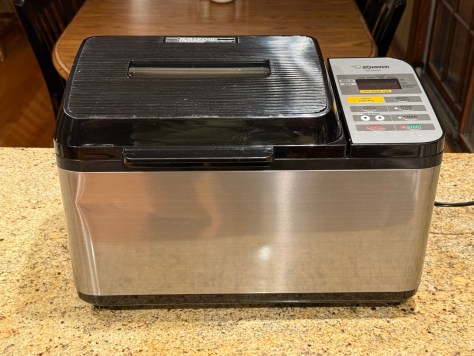
I have now written several post on making bread using a bread maker. I’m a gadget guy who has a couple of bread makers as I like to compare how different machines work. Along these lines my $14 thrifted bread maker works well as does my Zojirushi Virtuoso, which is considered a top of the line machine.
Today, I’ll make some bread in the Zojirushi machine and explore the differences between it and my $14 thrifted bargain.
Here is the recipe that I’m using today.
Remember to add the ingredients in the order listed. I’m using the whole wheat setting on the Zojirushi. The Zojirushi frequently wins top awards for the quality of the bread that it produces. It has a unique twin paddle system that makes a loaf shaped similar to the bread that you would buy at a bakery. It also has a second heating element in the lid to help with browning of the bread. You can create your own bread programs on the Zojirushi. Lastly, it has a pre-warm cycle that heats up all of the ingredients before it starts the kneading process. How important are these features? Let’s make some bread and find out.
I like to weigh my flour to get a more accurate measurement. You can weight all of your ingredients, but many of my recipes are in standard volume measurements and I’m usually too lazy to convert every single ingredient.
To 9 ounces of water I added 1.5 teaspoons of salt.
And 1.5 tablespoons of oil. I’m using olive oil here.
The recipe calls for 2 tablespoons of molasses, but I’m using honey. If you use the same measuring spoon that you used for the oil, the honey will easily slide out.
I thought I would try adding 1/8 teaspoon of ascorbic acid as this can help with rise and has some some mold fighting qualities. This step is completely optional.
Now its time to add the flour, which I did by weight. Half whole wheat and half bread flour, two cups each.
In went the two teaspoons of active dry yeast.
A bread maker is a set it and forget it gadget. However, since I’m using this recipe for the first time I wanted to make sure that the dough looks good. If there was a lot of flour remaining or if the dough ball looked “ratty” I would have added a tablespoon of water and repeat this step until I had a nice smooth ball like the one above. If the dough looked too wet and was not forming a clean ball I would add a tablespoon of flour and repeat after 30 seconds until it looked like the above.
Into the bread maker it went on the whole wheat setting.
The bread turned out well, it was soft with a good crumb.
Here are my conclusions on my $14 thrifted Regal machine versus my top of the line Zojirushi Virtuoso.
-Both can make a decent loaf of bread.
-The $14 thrifted machine has a vertical pan, so when you slice the bread you get a square slice that reminds me of square sandwich bread. The Zojirushi machine makes a long loaf that resembles bakery bread. Its somewhat unique double paddle pan creates a more traditional loaf than most other horizontal pan machines with a single paddle. Those slices can be quite tall. Note, if you cut those tall slices in half they fit just fine in a toaster.
-Both machines bake the bread well, but the Zojirushi has a finer and more even crumb.
-Some say that the double paddles on the Zojirushi kneads a better dough. However, I don’t see much of a difference.
-The top heating element on the Zojirushi does brown the top of the bread a bit better, but not enough to make it an important feature in my opinion. I have also used the Zojirushi Supreme which doesn’t have a top heater and it seems to brown the top of the bread well too.
-The Zojirushi allows you to program three additions “courses” (programs) where you can determine all aspects of the kneading, raising, and baking process. This is pretty cool if you are a baking nerd.
-The Zojirushi machines is much heavier and robust than my thrifted machine. It will likely last longer.
-Usually the paddles followed by the bread pan are the first things that need to be replaced on a bread maker. Zoljirushi will sell you these replacement parts, while most other companies won’t. However, they are quite expensive, close to the cost of a new off-brand bread maker.
-The Zojirushi sometimes makes a lopsided loaf. This doesn’t happen with the thrifted machine as the pan is vertical.
In conclusion: Yes, the Zojirushi Virtuosos makes the best loaf, but my $14 thrifted machine also does a fine job. If you are into making bread machine bread get the Zojirushi. However, it is quite expensive. I picked up mine used for much less than the retail price. If you want to save some money but still want a Zojirushi consider the Zojirushi Supreme which is basically the same machine as the Virtuoso, but without the top heater. Additionally, it has a few less “courses” (programs). However, the only additional program that is worth considering on the Virtuoso is the gluten free program. But you can program one of the memories in the Supreme to do the same thing.
With all of my praise for the Zojirushi I have to say that my thrifted machine makes fine bread and great dough. Unless you are a nerd like me it is hard to justify the additional expense of the Zojirushi machines. However, you do you.