If you asked my kids for a dad quote, I’m sure that “There are no emergencies for those who are prepared” would be in their top five. They have heard me say that hundreds of times over the years, and they have taken it to heart.
I’m not saying that all problems are solvable. Instead, that quote conforms to my belief that many emergencies are entirely avoidable with a little planning and thought. Case in point, this weekend.
Julie and I had planned a long weekend getaway for the last few months. Originally, we were going to go to Cuyahoga Valley National Park in Ohio. Still, those plans were dashed with the government shutdown and the knowledge that everything, including the bathrooms, would be closed.
Julie had just read the book James, which reimagined The Adventures of Huckleberry Finn, telling the story from the enslaved man James’s perspective. Hannibal, Missouri, is only about four and a half hours from our home, so going there to see the caves, the town, and the birthplace of Samuel Clemens, AKA Mark Twain, seemed like a good idea.
We would travel and camp in Violet, my adventure van, a vehicle designed to handle whatever obstacle that came her way.
I bought Violet in 2018 as an empty Promaster high-top van and initially camped in her using an air mattress on her bare steel floor. Later that first year, I drove out to Colorado Springs and had Wayfarer Vans install basic camper structures, including a laminate floor, ceiling, and bed platform. However, the real work on Violet has been ongoing, and a project shared with my friend, Tom, who is an expert builder.
Violet was an empty cargo van when I bought her in 2018.
The idea was to create something more functional than a typical RV. The plan was to design a vehicle that could be independent of society’s infrastructure. Violet is just that. Every year, she has been modified as I learn more about her strengths and weaknesses.
Here are some of the things that we have changed. In 2018, we installed 400 watts of solar panels on Violet’s roof. This year, I purchased and installed a much higher power alternator as a backup to charge Violet’s house batteries on cloudy days when the solar panels are insufficient. I installed a much more sophisticated navigation system and sound system. Tom and I installed cruise control, and I installed a center console for more storage and to create space for atlases and camping directories. We installed 12-volt lights in the ceiling. I installed an advanced 4KW battery system to power everything in the cabin, along with a 2KW DC-to-AC inverter as a backup. Tom and I installed a Wabasto heater that connects to Violet’s gas tank and can keep the cabin warm on wintery days. Tom and I built an elaborate storage system under the bed that holds a fridge, pantry, storage boxes, and even a secret compartment. We built a newly designed all-electric kitchen with a built-in induction cooktop and microwave oven. The kitchen also sports a three-quart Instant Pot, a small air fryer, and an electric coffee pot, all powered by Violet’s solar panels/battery bank. The kitchen countertop was made from wood we harvested from a fallen tree. We even installed a turntable so the front passenger seat can rotate to face the cabin, which adds extra seating. And, by the way, when I mention “we,” when talking about construction, I need to emphasize that I’m just the assistant, as my friend Tom is the man with the tools and knowledge.
We built an all-electric kitchen that is powered by solar energy.From the bed looking towards the front of the van.
Violet is designed to function off-grid. Cooking, refrigeration, heating/cooling, lighting, and entertainment systems are all powered by the roof’s solar panels combined with Violet’s 4KW house battery system. She carries water, but she can also purify stream water if needed. She carries tools and emergency supplies. She carries electronic test equipment and has advanced two-way radio gear, and she can even communicate via satellite in an emergency. She is built for adventure, and she has camped everywhere from a Walmart parking lot out east to a National Forest in Wyoming to the desert plains of Arizona. She has taken me to all parts of the eastern, southern, northern, and western states.
The “garage” side of the cabinet that we built under the bed.The front side shows the chest refrigerator and the basket pantry. The kitchen to the right was replaced by our new design with a built-in induction cooktop and microwave oven.
I have upgraded her mattress, and sleeping in her is almost as comfortable as my home bed. The bed is very comfy for one, and acceptable for two due to space constraints. Violet even has a toilet, although the preferred option is to use external facilities.
Despite all my preparation, things can still go wrong on any trip, and the journey to Hannibal was no exception.
I usually borrow a sturdy ladder from Tom to wash off Violet’s solar panels before a trip. I did this two days before the Hannibal trip, and my roof inspection looked fine. The day before the trip, I was loading up Violet’s refrigerator with supplies. The fridge is right below Violet’s vent fan. Then, too, everything looked fine.
We drove to the Mark Twain Cave campground, which was 2 miles outside Hannibal. By the time we got there, I was tired. I told Julie that I was going to lie down on the bed for a few minutes and did so. I looked up at Violet’s vent fan in the ceiling and saw that the Lexan plastic cover over the fan had been shattered. This had to have happened on the day of the trip —how? The broken cover was a disaster as the fan is directly over the bed, and any rain would destroy the mattress. I have a genuine fear of heights, and Violet is over 8 feet tall, but I needed to get up to the roof and fix the problem. What to do?
Violet’s roof fan cover was shattered!
In 2018, I bought a collapsible ladder that was buried in one of Violet’s side compartments. I can’t tell you how much junk I store in that spot, but it all had to come out so I could wiggle out the ladder. Without the ladder, there would be no way to patch the broken fan cover. Luckily, I had also stored some plastic sheeting and tape just in case of an unknown emergency. That would also come in handy. I placed one piece of plastic over the fan base and closed the cover. I then put another piece of plastic over the cover and tapped it liberally. I did this standing on a fairly rickety ladder. I was grateful to be prepared to handle the emergency, but getting up high on a ladder was frightening. However, I had no other options. Survival tops fear in my book, so I just did it. I told myself that I could be afraid after the job was done.
A few other disasters occurred over the weekend, but they were minor compared to the shattered fan dome. I’ll try to correct them today. Because we were prepared, we were able to complete our mini-trip and had a great time. My favorite event was touring Mark Twain’s cave, which is very different from the other caves I have been in.
I really enjoyed touring Mark Twain’s cave.
We decided to drive side roads along the Mississippi and started back on Sunday morning after we toured Mark Twain’s boyhood home. We planned to stop for breakfast, but we could not find a restaurant along the way. Planning once again came to the rescue. We got gas for the car and bought some coffee at the gas station. We still had plenty of food left in the fridge, so we had a little in-van picnic at the gas station. Our preparation paid off.
A gas station picnic.
The rest of the trip was uneventful, and we arrived home around 7:30 PM. I brought in the refrigerated foods and settled in. However, within 10 minutes of being home, the power went out and stayed out for hours.
It had been cold, and the weather was not suitable for going to the unheated bathhouse to take a shower, so a hot shower was a top priority on our return. No power equals no lights. What to do? I keep battery-operated lanterns on every floor of the house, and one came in handy to illuminate our bathroom. We got our showers! Then Julie told me her phone was almost dead, so I went back into the camper and bought her a large battery bank to charge it. Additionally, I have a battery-operated radio, which we used for information and entertainment, so the whole situation became an event rather than an emergency.
Showering by lantern light.
All of these things could have been “emergencies,” but they were not because of a little planning. There are so many simple steps anyone can take to plan for unforeseen events. Have some emergency food and supplies on hand to stay safe during a winter storm. Make sure you have a light source and a portable radio with batteries. Consider your individual needs. Do you have infants? Buy an emergency pack of diapers. On medication? A little extra supply wouldn’t hurt. Think about what problems you may face and have a plan of action. Do you know how to turn off the main power to your house? Do you know where your house water valve is?
Have basic tools in your car. Have an alternate way to charge your phone both at home and in your vehicle. Keep several simple first-aid kits: one for the house and one for the car. Wear appropriate clothing when driving so you are prepared if you get stuck. Keep a winter kit in your vehicle with some non-perishable food, a blanket, hat/gloves, jumper cables, and a flashlight. Make sure you take your cell phone with you when you are out and about..
Run scenarios through your mind and come up with solutions to the problems they raise. Your situation and place of residence will determine your needs. You may not need an emergency winter kit in Florida, but you might need some hurricane supplies.
Be prepared and turn emergencies into inconveniences. Remember, there are no emergencies for those who are prepared!
A few weeks back, I enjoyed camping at the Medicine Bow National Forest in Wyoming. It was a beautiful and peaceful spot. The campsite had a lot going for it, but it lacked modern conveniences, including a usable cell phone signal. I did have enough of a connection to send out slow text messages, but that was about it.
However, I needed to have information. I was traveling and hiking, and I needed local weather reports. I was camping during a national pandemic, and I had to know the news on that topic. I would be returning home via South Dakota just as the Sturgis Motorcycle Rally was commencing. I wanted up-to-date information on that event as it would directly impact what National Parks and Monuments I would visit.
Over the years, I have become dependent on the Internet. I stream music, videos, and radio stations. I read the news, and check the weather. The Internet has become a vital link that keeps me connected and safe. However, it is an extremely vulnerable utility. I have a cable Internet connection at home, which is then broadcast via a wireless router to my devices. On the road, I use cell towers to grab the Internet on my phone. These options are both complex and resource-heavy. If a cable is broken or a cell tower is down, I have no internet. If I can’t recharge my power-hungry devices, I’m also out of luck.
Climate change has escalated natural events in the world. While I was camping, forest fires were ravaging the Pacific Coast, and large parts of Louisiana were dealing with Hurricane Laura’s aftermath. Massive areas were without power, and no power means no internet. As climate change escalates, we can only expect more forest fires, hurricanes, floods, and tornadoes. With these natural disasters, we will have more utility outages. Beyond nature, hardwired systems are vulnerable to cyber attacks, as well as equipment failures. The Internet is a fantastic resource, but it is very fragile and vulnerable.
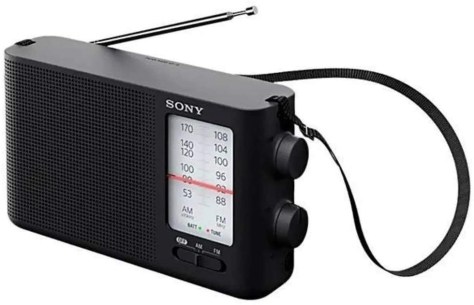
Back at my Wyoming campsite, I was without the Internet, but I did have an ace-in-the-hole. I had brought with me an old portable radio. It was a Sony device that I had had for many years. This straightforward gadget gave me all of the information I needed, as I could pick up multiple FM and AM radio stations. I checked the weather, kept abreast of local and national news, and listened to music and entertainment. Some of you may be asking, “Why not use your car radio?” That certainly could be an option, but I make an effort to not use car accessories when the vehicle isn’t running. I don’t want a dead battery miles away from civilization.
This old Sony radio was all that I needed to keep myself informed. You may see that the radio has TV audio. In the US analog TV was discontinued in 2009, so that feature no longer works on this device.
I have traveled the country, and I have never been to a place where I couldn’t receive radio. Typically, I can hear multiple stations at any given location, which is not surprising. In the US, there are more than 10,000 FM radio stations and almost 5,000 AM radio stations. Radio waves cover the US. Receiving radio signals only requires a simple, efficient, and inexpensive device. On average, a portable radio powered by AA batteries can run around 50 hours at moderate volume, and a radio that uses larger D batteries can run 150-200 hours. With careful use, a radio could provide the user with several months of vital information. Compare that to my iPhone, which barely makes it through a day without needing a recharge.
Twenty years ago, most households had at least one portable radio, but that is not the case today. I asked around my limited COVID circle, and most homes didn’t have a working battery-operated radio. People invest in all sorts of expensive things to protect themselves. A workable radio can be had for less than the cost of a pizza. Remember, disasters are on the rise, and radio is a much more reliable resource than home Internet, cable TV, over-the-air TV, smart speakers, and cell phone service.
Where is the hurricane going to make landfall? When is the emergency freshwater truck going to arrive? Where are the medical services being offered? Is the forest fire advancing? What roads are open, and what highways are closed? Will we have freezing temperatures tonight? These are just a small sampling of the type of questions you need answered in a dangerous situation. Radio has these answers.
If you have read this far, let me give you the bottom line. Go on Amazon or go to your local store and buy a portable FM/AM radio plus batteries. If you plan on using the radio for day-to-day entertainment, have a spare set of batteries available. If you will keep the radio for only emergencies, don’t leave the batteries in the radio, but keep a fresh set of batteries nearby. Good batteries can last for up to a decade when appropriately stored (a cool, dry place).
Let’s have some fun for those of you who are still on board and get into the nitty-gritty.
Portable radios come in several types. A typical pocket radio sells for $10-$20 and uses AA batteries. They do the job, but their small speakers and controls can make using them a chore. Larger portable radios typically sell in the $20-$100 range. They offer bigger controls and better-sounding speakers. Overall, I prefer a larger radio over a pocket radio. Also, it is best to have a radio that is simple to operate. In many instances, this means buying a radio that has a traditional layout, rather than a thousand buttons and switches. However, the end-user should determine what is best for their needs.
Portable radios come in several styles. Some are analog looking-they have an actual dial with a pointer. Some are digital looking and use buttons and digital displays. However, under the hood, most current portable radios are digital (DSP radios). They perform all of their functions on a single IC chip. These devices are actually dedicated computers designed to receive radio waves and to convert those waves into audio signals.
I am a radio lover and collector, but I haven’t bought a new radio for over a decade. To research this post, I watched hours of radio reviews on YouTube. In the end, I felt that I needed to buy some modern radios to gain a proper understanding of what worked and what didn’t work. Consumer-level radios are inexpensive, so I thought I would go this extra step for you, dear reader.
I found some interesting differences between these new radios versus those I had purchased in the past. New radios use “step tuning.” When you tune this radio type, it clicks in 10 kHz steps (on AM). On better radios, this feels like tuning an older analog device. It is easy to blow past stations on more inferior designed radios unless you move across the dial very slowly. Some of these newer radios seem to have a problem with their AGC (automatic gain control), which can cause weak AM stations to pulse in and out. Some radios crackled when receiving powerful stations, suggesting that their front ends were overloading. Despite these negatives, most radios had very good FM reception and good enough AM reception. Every radio that I tested would serve their owner in an emergency. However, some radios were easier to use and worked better than others.
I was surprised that most popular consumer electronic manufacturers no longer sell portable radios in the US market. This market is now saturated by brands that I had never heard of. Based on this, I thought I would list my ranking of available radio brands. The list is from best to worst.
CC Radio/C Crane Radio
C Crane has been making high-quality radios for decades. They design their radios to be excellent performers, and because of this, they charge a premium price. If you are a radio lover, buy one of their long-distance CCRadios radios (prices ranging from $90-$200). However, lesser radios will also serve you in an emergency. C Crain does make a pretty good emergency style radio, the “Solar Observer,” which sells for a more reasonable $59.99.
Sangean/Sony/Panasonic
Most common popular consumer brands no longer sell portable radios in the US market. However, Sangean, Sony, and Panasonic still do. You may not have heard of Sangean, but they have been selling high-quality radios in the US for decades-usually under different brands like Radio Shack, Proton, and C Crane. Sony sells a handful of radio models, and Panasonic sells two portable radio models in the US. Most of these brand name radios offer an excellent performance to cost ratio. They are well-built products that are refined. Tuning one of these radios feels more like turning a real analog radio (a good thing). They don’t overload or pulse on AM stations, and they have good selectivity and sensitivity on both FM and AM.
This Panasonic radio (RF 214D) can be had for about $30, and it is a good performer. Be careful if you buy it on Amazon as some sellers are charging as much as $55. Walmart has a good price.This Sangean PR D4W has excellent FM performance and the best (by far) AM performance. It also has NOAA weather alert. However, all of its buttons may be confusing to use for some. I watched a review of this Sangean SR 36 pocket radio, and I was surprised that it was a poor performer. This is the exception rather than the rule for this well-regarded company.
Kaito
Kaito is a Chinese radio company. Some of their radios are as good as those made by Sony, Sangean, or Panasonic. Some of their radios are not as good. The Kaito KA500 is a good emergency radio that sells for around $49.00.
This Kaito KA390 was inexpensive and had good FM performance and decent sound. Unfortunately, the AM performance was the worst of all of the radios that I tested.
Off Brands
Many radios sold in the US have brand names that suggest that their primary market is elsewhere. Prunus, PowerBear, Vondior, Running Snail, Dream Sky, and Retekess are just a few brand names. I have tested some of these radios, and my general impression is that they are of lower quality than those listed above. However, all of the radios that I tested were still acceptable; most had very good FM reception and adequate AM reception. Some of these radios had overloading problems, while others had issues with AGC pulsing of weak AM signals. Also, some had other issues that ranged from crappy volume controls to finicky tuning. With that said, all of the radios that I tested worked well enough. However, if you choose one of these radios, I would buy it from a place where you can return it…just in case.
This QFX radio is almost an exact clone the Panasonic RF240D, but the resemblance is only skin deep. The radio did have decent AM and FM reception, but tuning it was very fiddly, and the volume control started at loud and immediately went to louder. This Prunus J-05 radio also performed reasonably well. However, AM reception was mixed when receiving weak stations.This 1A2BVV brand (yes, that is the brand) JP-1 radio is well built and has above average sound. FM is good and AM is OK. Oddly, the volume on AM is about half of the volume on FM. However, it is still adequate.I picked up this Byron Statics radio for $17.99 and wasn’t expecting much. Construction was fairly cheap, but it sounded good and FM and AM performance were OK. It also came with an AC adapter for plug-in use.
What features are essential, and what features are fluff?
FM band
FM is a must feature. FM stations are everywhere. There are over twice as many FM stations in the US than there are AM stations. People love FM because it has good sound fidelity, and it is less likely to suffer from thunderstorm static crashes and the buzzes and clicks that electronics, like computers, generate. FM (frequency modulation) stands for how the signal is broadcast, but the actual band used is part of the VHF (very high frequency) spectrum. These waves travel in a line-of-sight fashion, and the most powerful stations have a range of around 40 miles. Naturally, smaller stations have a shorter range. It is possible that all services could be interrupted in a wide area, and this could remove local FM stations from the airwaves. This is why having a radio that has AM reception is important.
AM band
AM is another must feature. Just like FM, AM (amplitude modulation) refers to how the signal is broadcast, but the actual frequency spectrum in use is called the medium wave band. This band has a unique characteristic as radio waves at these frequencies can travel by ground and follow the curvature of the earth. The strongest AM stations can be heard for up to 100 miles during the daytime. At night these stations can bounce off of the ionosphere and travel even further. I can easily listen to AM stations from New York, New Orleans, Denver, and Atlanta (to name a few) from my Chicagoland home during the night.
Also, many communities have TIS (Travelers Information Service) stations. You may be familiar with these low powered AM stations as they often broadcast information at places like National Parks and airports. However, they also can be used for emergency information. Their low power and simple operation make it likely that they will remain on the air during power failures and internet outages. Many communities have TIS transmitters that can provide localized information if commercial stations fail. My town has one of these stations at 1610 kHz, and the city next to me has a station at 1620 kHz.
Weather Band
In the early 1960s, the federal government established weather radio. This service is now governed by NOAA (National Oceanic and Atmospheric Administration). NOAA weather radio occupies a band located in the VHF spectrum above commercial FM radio. There are over 1000 NOAA stations in the US, which cover 95% of the population. Listening to NOAA can be trying as the transmissions are broadcast using a monotone computer voice. Schools, commercial radio stations, cell phone carriers, factories, and many more use NOAA’s alert function for severe weather warnings. In addition to time and weather, NOAA radio is authorized to provide any critical information in an actual emergency. NOAA information is relayed to commercial stations, so it is likely that you won’t be missing much if you don’t have this band.
Shortwave Band
This band is located between the commercial AM and FM bands. Shortwaves have unique properties as they can travel for many thousands of miles. When I was a kid, I would regularly listen to English language broadcasts from all over the world. However, many of these international stations have abandoned shortwave and now stream on the Internet. Most inexpensive radios that have the shortwave band are not very sophisticated in their reception of these frequencies. With that said, I recently listened to one of these radios (the Kaito KA500) on shortwave and found a few English stations (religious programmers) and a bunch of Spanish speaking stations. Other parts of the world, such as South America, Africa, and parts of Asia, still rely on shortwave radio stations. It is not necessary to have the shortwave band on a basic emergency radio in the US. Sophisticated shortwave radios can receive other types of communications, like single-sideband (SSB). Some may find this kind of reception useful. However, simple shortwave radios can’t decode SSB.
The dedicated emergency radio
Many manufacturers have created dedicated emergency radios. These radios have FM and AM reception, and some will have a weather band and/or shortwave band. The mid-priced versions of these devices are reasonable radio performers. However, you are paying extra for features that you may not use or need.
Many of these radios have a flashlight/reading light, but they are often weak. They will also have a rechargeable battery that you can charge in a variety of ways. You can charge the battery just like you would charge your cell phone, which may be desirable for those who don’t like tossing out batteries. However, these radios emphasize that they have solar panels and a cranking dynamo to charge the battery. In my opinion, those features are mostly gimmicks as the solar cells are very tiny, and you would have to crank the dynamo for a very long time to play the radio for more than a few minutes. Also, prolonged cranking would eventually destroy the radio’s dynamo, as it is just a cheap component.
As an experiment, I used the dynamo on the Kaito KA500 to charge my cell phone. I cranked vigorously for 1 minute. The phone went from a 30% charge to a 31% charge in that time… and my hand hurt. There is nothing wrong with owning an emergency radio, but a simple (and less expensive) standard radio is all that is needed in many cases. If you decide on an emergency radio, get one that can use both its rechargeable batteries and regular disposable ones. That will give you the greatest flexibility in an emergency.
If you want a dedicated emergency radio, the C Crane Solar Observer ($60) and the Kaito KA500 ($50) are nice radios.
The CC Solar Observer is a solidly built radio with very good overall reception. The Kaito KA500 is a well-designed radio. It was one of the few radios in this review that could actually receive stations on its shortwave band. It also has a weather alert function. The overall performance was good.
My recommendations
Any battery-operated radio is better than no radio. However, I think a desktop-style radio is a better choice than a pocket radio. Unless you are a radio lover, pick one that is simple to operate. You don’t need to be figuring out keystrokes during an emergency.
I believe that the best value radios are those from Sony, Panasonic, and Sangean. They are reasonably priced, perform well, and their construction is good. I would not leave batteries in a radio unless you are regularly using a radio on battery power. Batteries leak and can render a radio useless. However, I would keep batteries close to the radio so you can load them at a moment’s notice. Remember that band name Alkaline batteries can remain viable for many years if kept in a cool and dry environment. Most radios that use AA batteries will play at moderate volume for about 50 hours, and those that use D batteries will play for about 150-200 hours. That is a lot of play time.
My number one recommendation is the Sony ICF-19. This radio performs well, sounds good, and costs less than $30. It runs on 3 D cell batteries and can play for 400 hours on FM and 450 hours on AM, an incredible energy-conserving feat. You can’t plug it into AC; it is battery only. I love its simple operation; anyone can figure out how to use it in seconds. It wasn’t the most feature-rich radio, or the cheapest, or the best performer. However, it does everything well, and its super-long battery life makes it my #1 choice.
The Sony ICF-19 is my top choice.
If you don’t have $30 to spare, buy a pocket radio for $10-20 or a no-brand tabletop battery radio for $15-$25. They will also do the job, just not as elegantly.
I continuously see prepper channels on YouTube, where people have several years’ worth of food and other supplies. However, the most essential thing that you can have in an emergency is information. The most bulletproof and reliable mass communication method is a simple FM/AM battery-operated radio. Please don’t delay; get one today. It could save your life tomorrow.
Bonus Tip One
If you want the most economical option, you need to go with a pocket-sized radio. I tested many of them, and they all worked well enough to get you vital information in an emergency. Unless listed below, they all have reasonable FM performance, and they can receive local AM stations. Some of these radios use real analog circuits, others use a DSP (digital) chip but have an analog dial. Their sound quality and volume are what you would expect from a tiny speaker and a small plastic cabinet. Their build quality reflects their low price. These radios typically run on 2 AA type batteries.
I’m listing the price that I paid for these radios, but it seems that the price varies from moment to moment on these items.
This Power Bear brand pocket radio is listed as an “Amazon Choice” product. Its construction seemed cheaper than other similarly priced pocket radios. Its speaker sounded tinnier than others in this category. Its FM reception was not as good as similar products. The radio was able to pick up more distant AM stations than some, but very poor AGC made those stations painful to listen to. Price $12.99This Benss pocket radio was only $8.99. The performance was reasonable at this price point and its speaker sounded richer than some others in this group.This Dream Sky radio was $11.99. The FM performance was better than others in this group, and the AM performance was fine for local stations. The sound was better than others in this group. The Retekess TR 605 was $16 (using a coupon). Sound quality was slightly better than others in this group. FM performance was good, and the AM performance was OK. This radio also has a built-in flashlight that was actually useable. This radio uses a rechargeable battery which may be desirable for someone who uses it on a regular basis. However, I prefer the option of using disposable batteries for an emergency radio as I think they are more flexible. This Kaito KA200 was $12.99. It is about half the size of the other pocket radios and has a useable, but tiny speaker. Radio performance was surprisingly good for such a small radio. This radio uses AAA batteries, which will not last as long as AA batteries. However, it is easy to have extra batteries on hand. I think this radio would be great for someone who wants a radio, but travels light. A backpacker comes to mind.
Bonus Tip Two
I believe that the solar panels and dynamos on emergency style radios are mostly gimmicks. If you want unlimited power, you can buy an inexpensive 10-40-watt solar panel with a USB outlet. Use the panel to charge a battery bank, and then use that bank to charge a rechargeable radio, cell phone, or other 5-volt gadgets.
This TP solar 30 watt panel sells for around $70 and has everything that you need to charge a small battery bank. You can also DIY a 10 or 20 watt panel for even less.
There are no emergencies for those who are prepared. A little planning may someday save your life and can reduce anxiety too!