Category Archives: Uncategorized

Traveling, Friendship, and Friction.

Some ask for permission, and some beg for forgiveness. I’m in the former category.

Some prefer the excitement of the unknown, and there are those who find comfort in planning.  I am in the latter category.

We don’t live in a perfect world, and there is no such thing as an ideal person.  With that said, most of us are happy in relationships driven by cooperation rather than conflict.

I have this “thing” when I travel, I like to have a reasonable amount of gas in my car.  This is especially true when I’m traveling out west, where gas stations are few and far between. My worry kicks in at a quarter of a tank of fuel and builds until I find a gas station.  At around an eighth of a tank, I can feel my heart race, and as the indicator needle drops further, I start to panic.  

In July, my friend Tom told me that he planned on traveling out west with his son for a vacation. Tom was working on several big projects, but the summer was drawing to a close, and he wanted to give his boy an adventure. “The hiking paths at Glacier are closed, and so I was thinking about camping in Wyoming and western Colorado.  Do you want to come along?” He asked. “Yes, absolutely,” I replied.  Violet, my campervan, had been sitting idle all summer due to the pandemic. I was more than happy to get back into her driver’s seat. 

I tried to pin Tom down for some details, but he shrugged me off.  Remember my “planner” comment from above?  Tom tends to be in the “more spontaneous” camp.  Eventually, he let me know that he was planning on going the first week of August.

As the departure date approached, I pressed for more information, but it seemed to aggravate him.  I knew that Tom was stressed, but I still needed the necessary data. “When are we leaving?” I asked. “I think around 4 AM. We can meet on the road.” He replied.

We live minutes from each other, so the “meet on the road” comment was confusing. I started to get Violet ready for the journey. I made a trip to Walmart to buy camp food.  I packed a duffle bag full of clothes. The day before we were scheduled to leave, I texted him and asked him where we were going to meet. “On the road,” he replied. “Are you serious?” I responded. “What’s the big deal?” was his comeback.

I was about to drive 1000 miles with no other information than a destination.  My mind started to move into high gear.  Had I somehow coerced Tom into inviting me to go on this trip?  No, I didn’t.  Was he upset with me for some reason?  I see Tom most days, and we get along well.  It was clear that he didn’t want to drive in tandem with me, but it was unclear why. 

My behavior in such a situation is very predictable and dates back to my childhood.  My reaction is a multi-step process, most of which happens very quickly.  First, I feel very hurt.  Then I wonder if I did something wrong.  If I did do something wrong, I try to correct it.  If I didn’t do anything wrong, I move on to the next stage, anger. I’m not a very angry person, so this stage rapidly transitions to the final stage… I call that stage, “Kuna pride.”

When I was a young child, I would try to engage my dad. For instance, when I was in fourth grade, I found an old radio in the alley.  I brought it to my dad and asked him if he would help me remove the radio’s speaker, so I could use it in another project. I recall him sitting in an upholstered rocker that we had in our living room. “Dad, could you help me get this speaker.  I want to use it for something else, but I don’t know how to remove it from the chassis.” He seemed to hover 10 feet above me.  He moved the edge of the “Sun-Times” that he was reading and looked down at me. “It’s impossible to remove those speakers,” he said and went back to reading the paper.  I knew that it was possible to remove the speaker because I had already figured out how to do it.  I was asking him for help because I wanted to spend time with him. I wanted him to value me, and I wanted him to be proud of me.

I felt hurt, then I blamed myself for not being a good enough son, then I got angry, and then I moved into Kuna pride. I took the old radio down into the basement and pulled the speaker.  I brought it back upstairs and showed him that I had solved the problem without his help.  I knew at that point that he would be more annoyed with me than proud.  I wanted him to see that I didn’t need him.  That I didn’t need anyone.  I wanted him to know that if he didn’t believe in me, then I would believe in myself.  I would not let him or anyone determine if I was good enough. I would figure out life on my own. I would find my own path. That, dear reader, is Kuna pride.

I know that it is considered wrong to be proud, but I felt that I had little choice.  If my own father didn’t want to spend 15 minutes with me, who would?  I could become the reject that I assumed that he thought I was, or I could adopt the idea that I wasn’t a reject, I was just different. Different is neither good nor bad. Being different would allow me to form my own thoughts. I didn’t need to sacrifice who I was on the fickle altar of popularity.

I could cite other examples of Kuna pride in my life, but you get the idea.  In some ways, Kuna pride has made me a stronger and more independent person.  I can think on my feet, and I don’t need a lot of external validation to do those things that I feel are correct.  Naturally, there is also a downside to such a trait; I’ll let you ponder that.

When it was clear that Tom didn’t want to travel with me, I moved through my “stages.”  “I don’t need anyone to travel.  I can do it on my own. I’m not going to let anyone determine who I am. If he doesn’t want to spend time with me, so be it. I will make this trip my own adventure” Kuna pride was now in command.

I turned on the Violet’s 12-volt Dometic fridge and stocked it with perishables.  I loaded her pantry with dry goods.  I filled a snack bag with some fruit and salty treats and placed it on the console next to the driver’s seat. I shoved my duffle bag in a storage compartment under the bed. I filled my thermos with coffee, my Hydro Flask with ice water, and placed both in the center console cupholders.  I punched in Curt Gowdy State Park, Wyoming on my iPhone’s GPS, started Violet’s engine, and backed out of the driveway.  

With Kuna pride, there is always some residual hurt and anger. Still, I quickly buried those feelings as I was not about to allow anyone to take anything more away from me.  I was going to make the most of the drive. 

I filled the driving hours thinking about random things, listening to podcasts and music, and making phone calls.  As I approached Omaha, I realized that my phone wasn’t charging.  I had just replaced the charging cord, and jiggling the connection confirmed the fear that my iPhones lightning port was defective.  I moved into problem-solving mode and started to search for a T-mobile or Best Buy store in Omaha.  Just then, I got a text message from Tom. “Where are you?” I replied that I was approaching Omaha, and I had to make a stop there. “We are about 25 minutes ahead of you and are stopping in Omaha, too,” came his text.  I replied, “OK.” I was not about to ask him if he wanted to meet up in Omaha.  One of the aspects of Kuna pride is that once I’m hurt, I establish a 20-foot high emotional barrier to prevent being hurt again.  I spied a Love’s Travel Stop and pulled in.  I filled up on gas and found an overpriced wireless charger for my phone and continued my journey.

More text messages from Tom started to come in, and he was acting normal.  I told you that I’m not a person who stays angry, and this is especially true when it comes to people that I care about.  My barrier wall was intact, but it was crumbling a bit.

I continued to drive with an eye on the fuel gauge and made sure that I found a gas station when the tank was at the quarter level.  On past trips with Tom, my need to fill up has been a stress point between us.  He likes to drive as far as possible on a single tank of gas; I have had to bring him a jerry can when he has run out of fuel in the past. Now I could stop for gas as frequently as needed.  There was a relief in this.  

The further west that I traveled, the worse my T-mobile signal fared. I dug around and found my prepaid Verizon hotspot. I had added a month of service to it just before my departure as a safety net.  As I said before, I am a planner.

With the hotspot connected to the Verizon network and my T-mobile iPhone connected to the hotspot, I was able to regain some connection. However, I was still getting a lot of dropouts.  The communications with Tom continued via Facetime and voice calls.  Tom asked me why I had ignored his calls before the text that I responded to near Omaha.  Apparently, my iPhone was malfunctioning on many levels. I made a note to myself to buy an iPhone 12 in the fall.   

As we got closer to the exit for Curt Gowdy, Tom told me not to follow the directions from my GPS. “There is a better exit, I don’t remember what number it is, but I’ll recognize it when I see it. I’ll let you know what it is once I find it.” I told him, “OK.” He eventually relayed the exit information to me, and I started to scan the Interstate for the sign.  To make the situation more confusing, I had to drive through what seemed like a million road construction cones.  Suddenly, my Verizon hotspot disconnected from my phone.  I reached down to power it up, and at that exact time, I drove past the exit.  A wave of panic rushed over me.  I was in the middle of nowhere, and I had no idea if the next exit was 1 mile or 100 miles away. I had been driving 14 hours, I was exhausted, and now I was sick to my stomach.  

Luckily, Laramie’s exit was only about 10 miles west, and I pulled off the Interstate.  By then, Tom informed me that all of the campsites at Curt Gowdy were filled, and he was leaving the park. “Stay at the visitor’s center,” I texted. “I’ll find you there.” I pulled into a small church parking lot and tried to figure out where I was. Tom called and told me to meet him at the intersection of Happy Jack road and the Interstate.  He might have told me to meet him on the second moon of Jupiter, as I would have had an equally good chance of figuring out how to get there. “Wait, wait, wait! Let’s meet at the visitor’s center. I can put that into the GPS,” I said.  Tom continued to push for the Happy Jack destination, and then it came out of my mouth.  You can imagine the types of words that emanated from my piehole; however, it would be impossible to convey the level of anger and rage that accompanied them. I had had it.

I was driving again and directly in front of me was the entrance to the Interstate.  How the heck did I find it?  I pulled onto the expressway and drove east.  Suddenly, the GPS announced, “Next exit Happy Jack road.” I didn’t remember programming the GPS, but that was the exit that Tom wanted me to meet him.  We connected and started looking for a place to camp.  We drove into the Medicine Bow National Forest and found a campground, but it was full.  We drove to another, and it was also full.  We found a forest service road and drove in.  We came upon a family and asked if they knew if camping was allowed along the service road.  The husband said that there was dispersed camping, but we would have to drive down a bit.  We pressed forward and found a clearing about a mile and a half up the dirt road.

I parked Violet and tried to settle down.  I was absolutely exhausted, stressed, and shaking.  At the same time, I was relieved that we had found a place to camp, and I was happy to see Tom and his son.  They came over, and we started to chat.  The first thing that Tom commented on was how surprised he was at my expletives. I acknowledge his statement noting that I was exhausted and frustrated.  At that point, Tom’s son asked me in earnest if I really did have all of my breakfast meals planned out in advance. It was clear that they had had a discussion in the car concerning my behaviors.  I don’t believe that the discussion was complementary in nature. I decided to take the high road. “People are different.  Some are planners, some are more spontaneous.  Neither position is right or wrong…” At that point, Tom butted in laughing, “It was such a relief not having you follow us.  What a pain in the ass.” My kindness button switched off.  I was furious again.  However, I knew that it would be foolish to respond to him in my depleted state. I was in no position to accurately judge anything.

The evening ended, and I went to bed, but I didn’t sleep despite my exhaustion.  Why was I here?  Why did I go on this vacation? The questions tumbled through my mind.  I decided that I would talk to Tom the next morning and tell him about my feelings. I would also say to him that I would be returning home the following day.  It made no sense to drive 1000 miles and then return home without doing anything, and I wanted to hike the park, but I couldn’t see spending the next week with Tom.

The next morning Tom had noticed that I was acting more sullen and tried to use humor to lighten me up.  I told him that I needed to talk to him without his son present.  Having a serious conversation with Tom is possible. Still, it is not conducted in a typical fashion, as he has a tendency to interrupt.  

I told him about my frustration and my plan to leave the following day.  It was clear that Tom didn’t want this, and that his comment from the night before was meant to be humorous.  However, there was a grain of truth in his barb. He told me that he was feeling a lot of stress and wanted to drive away his tension. He noted that it had been difficult for him to have me follow on past trips due to our different driving styles. He implied that he didn’t want that additional stress on this trip.  I admitted to him that it was also stressful for me to follow him.  Driving tandem was stressful for both of us, but for opposite reasons.  He noted that he was only 30-40 miles ahead of me during the entire trip and that he would have come back to get me if anything had gone wrong.  He said many other things, but the gist of the conversation was that no ill will was intended by him. He had asked me on the trip because he wanted me to come and not out of a sense of obligation. 

On my part, I was aware that I was reading his behavior through the veil of my past experiences. With the acknowledgment of our mutual stress, my anger faded, and we were just Mike and Tom on another one of our adventures.  I could feel the relief from both of us as we acknowledged how external stresses and differences in our personalities were the root causes of the friction between us.

That later fact deserves further comment.  I tend to be a planner who wants all of the boxes checked before I engage in something new.  Tom finds excitement in the unknown; he enjoys flying by the seat of his pants.  In ordinary life, we complement each other.  I have made Tom more organized, and he has made me more spontaneous.  However, driving 1000 miles in a single day is not part of normal life.  Tom said he was sorry if he upset me.  We were both happy to move forward. There is a reason that we are best friends. We are imperfect, but neither of us is cruel.  We not only like each other, but we also look out for each other.

The trip continued under the best of terms.  Will I travel again with Tom?  The answer is, yes.  How will we travel to our next destination?  Well, that is yet to be determined.

I wrote this post for several reasons, but mostly to stimulate you, dear readers, to think about points of conflict that you have had in your relational life.  Our past impacts our present. It is easy to misinterpret a person’s actions and motivations.  We are all different, and one person’s goal in a situation may differ from another person’s.  Textbook communication and conflict resolution protocols are great when you can do them. Still, when you can’t, it is OK to imperfectly resolve a problem.  The most important characteristics when moving forward are sincerity, empathy, and honesty. With these traits, a solution is possible.  If you are in a relationship that is phony instead of sincere, or one where the parties can only relate to their own needs,  or one that is dishonest instead of honest, then no actual resolution can ever be achieved. If these negative characteristics are present, then it may be best to move on or accept that you will be stressed continuously in a repeating pattern of disharmony.

There is more to this vacation story, but I’ll save that for another day.  

Peace

Mike

our campsite at Medicine Bow National Forest.
Getting ready to hike at Curt Gowdy State Park, Wyoming.
Touring the Wyoming State Capitol.
Sharing some hot morning tea.

Our Easter During A Shelter-In-Place COVID-19 Pandemic.

I have celebrated Easter Sunday in the same way for decades. The morning starts with a candy hunt by the kids, followed by a light brunch. We then attend a late morning church service. I rush home from church to make my “signature” cheesy chivy potatoes, which is my contribution to our family’s Easter party. We then pile into our car and drive off to my sister’s house in a nearby suburb. Along the way, I pick up flowers for my two godchildren.

For Easter, my sister and brother-in-law supply their house and a lot of the food. However, most of us are assigned a dish-to-pass. We typically are given the same dish to make year after year, which is how cheesy chivy potatoes became my signature dish. You may think that the recipe sounds disgusting, but many family members have told me that they look forward to it every Easter. Chessy Chivy Potatoes are not haute cuisine. 


Mike’s Recipe for Cheesy Chivy Potatoes

  1. Make a whole bunch of mashed potatoes.
  2. Stir in a lot of cheese. This can be any combination of meltable cheeses. Over the years, I have used sharp cheddar, American slices, and even Velveta. 
  3. Add chives to taste. I’ll sometimes saute fresh chives, but I have also used the dried bottled stuff. They both taste the same.

I bring a large pan of the potatoes, and I’ll often leave the party with an empty scrapped casserole dish. Our Easter meal is Midwestern… ham, potatoes, jello molds, rolls/butter, sweet potatoes, Easter lamb pound cake… you get the picture. We do have a few vegetarians in our group, so there are also some vegetarian-friendly foods added to the menu.

My sister’s Easter party is always a highlight for me. Everyone is eager to mingle and chat, the weather is typically beautiful enough for a walk, and the food is comforting. By 8 PM, I’m ready to head home. Easter Sunday concludes quietly, often by watching one of those classic Easter movies. However, all that changed with the COVID-19 pandemic, as many weeks ago, my sister canceled the event due to the virus.

As a family, we decided to do something for Easter, but we weren’t sure what that “something” would be. Our plans slowly formed as the day approached.

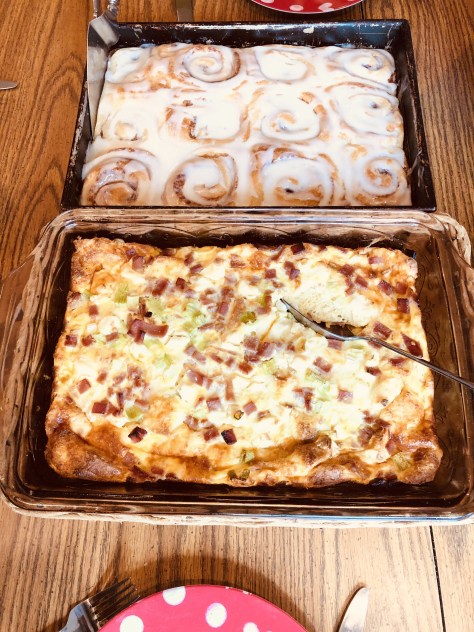
Julie made a brunch style egg dish, the kind where you mix bread, eggs, ham, and cheese and let the combination sit overnight in the fridge. It puffs up into a delicious souffle style casserole when you bake it the next day. Also, she proved some Rhodes cinnamon rolls. These start as frozen pucks that you place in a 9 x 13 pan overnight. By morning they are doubled in size and ready for the oven. There is nothing like the smell of baking cinnamony bread to wake you up in the morning. Add some strong hot coffee for a perfect start to the holiday.

Hot Cinnamon Rolls and Overnight Egg Dish

We didn’t buy any Easter candy; I didn’t think that this was a big deal as our kids are adults. I was wrong. This was rectified by Grace and Kathryn, who took a quick trip to Walgreen’s candy aisle the day before.  

Enough Easter candy to make anyone sick.

Later Sunday morning, we went to church…online. Our church had started a streaming ministry to lock-ins, and so they were ready to broadcast when Illinois’ shelter-in-place order came through. I cued up the stream on a Macbook and “Cast” it to our family room TV. The overall production quality was excellent, and they wove in video clips and remote music into the sermon. At communion time, we ate Ritz crackers and had a small sip of box wine. Watching church on a TV is not as engaging as participating in person, but the overall impact made it a worthwhile experience.

An online sermon cast to our family room TV.
Multiple musical collaborators turned our family room into a church concert.

Our early afternoon was carved out for connecting with others. At 2 PM, we all huddled around a computer and logged into a Zoom call to Julie’s family. The group represented members from 4 states and one foreign country. Her family follows rules well; everyone waited to talk, and the conversation rolled along smoothly.  

Huddling around a computer on a Zoom call to the Nelsons.

At 3 PM, I connected to my side’s Zoom call. Kunas are very exuberant, and most have little experience with conference calls. The resulting connection consisted of conversational chaos. It was fantastic to see everyone, but after about 10 minutes I decided that it was time to leave the meeting. Lastly, I was able to connect with my oldest daughter, Anne, via FaceTime. By 4 PM, I had touched base with more people then I would have if I had followed my usual Easter routine. This surprised me.

Reaching out with Zoom to the Kuna side of the family.
A good ol’ FaceTime call to daughter, Anne.

For dinner, Julie made some chicken legs that I bought during a pandemic grocery trip along with some stuffed shells and fresh asparagus. This was not our traditional Easter dinner, but delicious and celebratory none-the-less.

A non-traditional but delicious dinner.

After dinner, I discover new neighborhoods on a walk with my daughter Grace. Our evening ended with a family viewing of episode 8 of “The Tiger King.” We, too, have succumbed to this national phenomenon. I have to say that episode 8 seemed more like click-bait than a real episode, but it still managed to occupy 60 minutes of our evening.

I discovered this cool mid-century home when we decided to go in a different direction on a walk.

There you have it, our Easter during the pandemic. We didn’t go to church or have traditional Easter baskets. I didn’t make cheesy chivy potatoes or go to my sister’s house for a party. However, we managed to incorporate all of the essential elements of our typical Easter into last Sunday. We ate special food, and the kids had their fill of hollow chocolate bunnies and Cadbury eggs. We attentively attended an online church service. We caught up with loved ones, and we did family-centered activities. We didn’t give up Easter; we just modified it. It was a good day.

We may need to change other behaviors during (and after) this crisis time, but that doesn’t mean that we need to give up on life or traditions.  

I’m sure that there are activities or connections that you are missing since you have had to socially isolate. I would ask you to distill the essence of what you are losing into its characteristic elements. Be creative and see how you can reproduce those elements differently so you can transform your situation from one of loss to one of discovery.

Peace

Who Is Stopping Me?-Me!

What is stopping me?  Me!

Despite all of my efforts, I can still be a victim of my own imposed limitations. My personal flaws bother me.

I have been reasonably busy during my retirement year, and have grown in a variety of ways. I have been fortunate to use my photography skills to do work for others, and I wholly enjoy the challenges that those opportunities have presented.  Every time I create something for someone else, my photography grows a little more. However, I am bounded by the expectations of the client. The constraints of the job limit my creative vision. There is another area of photography that I am drawn to.  It is an area that has little commercial value. 

I walk early in the morning, and sometimes I’ll spy lights on in houses that I pass.  I always wonder, “Who is up in that house? What are they doing? What are they having for breakfast? Are they getting ready for work or school?  What kind of work do they do?” The questions continue in my mind. I ask myself similar questions when I drive through small towns and villages. In each, lives are moving forward, some successful, others less so. 

In the Midwest, many small and medium-sized communities are failing. Factories are abandoned; residents have moved to larger cities. Stores in the downtown areas are frequently closed or occupied by resale shops and bars. Houses are often in need of repair. These realities are especially evident in places ignored by interstate highways.  Once vibrant communities slowly die, a process fueled by decreased populations and reduced city revenues. Each house, storefront, and building tells a story, and every one of them is fascinating to me.

There are other discoveries to be made on rural roads.  Great barns, some shiny, others in ruin. Majestic parks, historical markers, and hidden vistas dot the landscape. All you need to do is to pause and look.  Sadly, few do.

There is a little boy inside of me who is full of wonderment. I have been fortunate to have a few people in my life who share similar excitement when discovering those things that most others would pass on.  These individuals have an inner child in them, and I am so very grateful that we have found each other.

However, I know of no one who has both the “wonderment quotient” as well as a love of photography. No one would find it interesting to go on a photo-taking adventure with me. Years ago, I joined a photography MeetUp group.  However, the group expanded so rapidly that it ignited my shyness, and I stopped going. I much prefer more intimate experiences. 

Who is stopping me?  Me!

I want to visit small towns.  I want to explore the countryside.  I want to photograph images as I see them.  Why have I been ignoring this need?

I am aware of how fear impacts my ability to do new things.  I tend to overthink, and this can lead to “what if” scenarios, which can be immobilizing. However, I refuse to let fear stand in my way of doing anything rational.  I will push past it. 

Guilt also plays a factor.  I have to admit that I feel guilty that I have so much free time.  I feel guilty that I can do an activity on days when my wife works. Going on a day trip requires a level of self-indulgence. 

Who is stopping me?  Me!

I scanned a road map and determined that there were several towns on Route 64 that looked interesting. I could drive to them and back in a single day.  I mentioned my plan to Julie, and she was OK with it.

I traveled last week, and I wholly enjoyed my explorations.  Here are some of the photos that I took:

A few of the many doorways that I photographed.  They all could tell a story.

A huge grain elevator in the middle of nowhere.

Old houses in need of some TLC.

An abandoned college campus.

A magnificent county courthouse.

Mississippi Palisades State Park.

I faced my fear and guilt and accomplished my goal. However, the experience wasn’t perfect.  I was once again aware of the loneliness that I felt. A feeling that I wanted to share my experience with someone.  “Look at that cool building!” “What do you think of that view?” “Would you shoot that barn from this angle or that angle?”  A travel companion would have been icing on my exploration cake.

I am planning more photo day trips, and I’m also considering pushing my comfort zone further.  I’m thinking about reaching out to strangers to see if there is someone who would like to go with me on a photoshoot day trip. I can’t be the only retired guy with both an interest and a camera. An additional bonus would be the sharing of travel expenses. However, the exact same barriers are preventing me from moving on to this new idea.

What if I’m not compatible with a new travel buddy?  What if they don’t like me? What if they are an ax murderer? -OK, that latter point may be a stretch. I understand that if I experience a terrible match, it is only one day of my life. Indeed, a reasonable risk. 

The second barrier is more significant for me.  I am an intense person who forms emotional relationships. If you can deal with me, you will be rewarded with a true friend who will stand by you no matter what. I value a few strong relationships over dozens of weaker ones. I like relationships where I can be myself and not fear that I’m “too intense” for the other person to handle. These kinds of connections require a lot of work, effort, and time from both sides.  If I developed a strong relationship with a new photo buddy, I would feel guilty that I was taking time away from my established connections. This may seem illogical to you, but it is an honest concern for me. Two good friends are not the equivalent of one best friend. 

It is interesting that common themes stand as barriers from me to being completely true to my needs.  Fear does play into my decisions, but I’m used to pushing past that feeling. However, guilt plays a more important function.  Guilt that I’m having fun when someone else is not. Guilt that I’m being disloyal to those who I care for. Guilt that I don’t deserve to have as much success as I’m having. I can surmise why I have these feelings, but that doesn’t eliminate them.  However, I believe that I can work through them on a case-by-case basis. It will be an interesting growth journey.

I can’t say if I’m going to try the photo buddy route, but I can say that I will absolutely go on another photoshoot day trip.  There is so much to see, and with each discovery, I feel that I grow. I have never wanted to be determined by someone other than me.  With that said, I don’t want to be determined by my self-imposed limitations. I want to base my life on what I can do, not what I can’t do.

How do you limit yourself? 

Peace

Mike

What The Apollo Missions Meant To Me

“Do you want to go to Houston in January?”  Julie said. “I guess, but why Houston?” I replied. Apparently,  Spirit Airlines had a cheap fare to Houston, and Julie felt that it would be warmer than Chicago.  

I had forgotten about the trip, and then it was suddenly upon me.  We needed to leave the house by 3:30 AM on a Thursday and at 9 PM the night before I was frantically packing. Over the years, I have learned to pack both lighter and more efficiently.  I keep a Dopp Kit ready to go, so all I had to do was to transfer the liquid items into a quart ziplock bag for TSA. Also, I packed a hoodie, some shirts, an extra pair of pants, my sleep ware, and of course, socks and underwear. 

I have a camera case in the style of a backpack, which is my under-the-seat carry-on. Since I use the bag when I’m not flying, I made sure to dump out all of the pouches and pockets.  Thankfully, there were no banned items. Into my backpack went a fully charged iPad, a minimal first-aid kit, sunglasses, lip balm, a battery bank with adapter cords, and a few packaged snacks for the flight. The front pouch of the backpack is padded for cameras.  In it, I placed my small Olympus OMD EM10 camera with its kit lens, an extra camera battery, a 20 mm F 1.8 lens, and a few other camera accessories. I’m an avid photographer, but I don’t want to haul a lot of extra camera gear.  

I usually wake up early, but that is not the case for Julie.  Yet, she was a good sport, and we were soon on our way to OHare International Airport.  Our gate seemed to be in a different state, but that is what you expect when you are flying on a budget airline. Soon we were boarded and waiting to take off.  Surprisingly, the budget carrier’s customer service was pretty good. However, my legroom was terrible, and within about 30 minutes, I started to have leg cramps. I  focused on the fact that the flight was only 2 hours; it was a long two hours.

One place that we wanted to visit was the Johnson Space Center/Space Center of Houston, and after a light brunch, we drove through the gates, paid our admission fees, and started our tour. We were approached by a tall black man wearing a polo shirt emblazoned with the center’s logo.  “Can I help you?” He asked. And with that, he gave us a detailed overview of what to see not only at the museum but also at the adjacent Johnson Space Center. He strongly suggested that we board the two shuttle tours as both of them would take us around the Johnson Space Center’s campus.  One of the tours would allow us entry into the actual command center where the Apollo space missions were directed.  

I was flooded with childhood memories.  I grew up during the 1960s, and the space race dominated my thoughts during those years. That decade was a time of great American pride.  There was a feeling that we could accomplish anything, figure out anything, do anything. I watched every single space launch and always held my breath when the giant rockets rose slowly and somewhat crookedly as they traveled up and beyond the earth’s atmosphere.

The 60s were a time when Americans feared that the USSR was going to invade our country and make us slaves to communism.  Russia not only had launched Sputnik, the first satellite, it had also placed the first person in space. There was an honest concern that the US would be left behind.

However, on May 5, 1961, Alan Sheppard was strapped into a tiny Mercury capsule atop a Redstone rocket. He was sent on a 15-minute sub-orbital flight.  The Russians had already placed Yuri Gagarin into a real earth orbit one month earlier, but there was a sense that we were still in the game. However, it wasn’t until February of 1962 that we successfully sent John Glenn into Earth orbit on top of an Atlas rocket.

As a kid, it seemed that each new flight offered a spectacular new accomplishment, and in 1965 NASA launched the first human-crewed Gemini capsule, which held two astronauts. Where the Mercury capsules were controlled on the ground, the Gemini capsules were piloted by the crew.  The Gemini flights captivated me, and during these missions, astronauts walked in space, docked with other spacecraft, and did many other firsts (for the US) in preparation for an eventual lunar landing. 

In 1967 tragedy struck the US when three astronauts were killed aboard Apollo 1. Its pure oxygen-containing cabin suffered a flash fire. Suddenly, my hubris shattered. 

In future missions, NASA changed the atmosphere from pure oxygen to a less combustible atmosphere mix, and the number of flammable materials in the cabin were reduced.  In October of 1968, Apollo 7 launched with a crew of three, and the country was once again moving towards its goal of landing a human on the moon. Which, of course, happened in July of 1969 with the flight of Apollo 11.

When the first crewed Mercury mission launched, I was eight, and when Neil Armstrong landed on the moon, I was 16. Only eight years and so much had happened.  In1969 I had a summer job that started early. However, I made sure that I stayed up to see the fuzzy black and white TV image of Mr. Armstrong as his foot touched the moon’s powdery surface. How fortunate I was to witness one of the most momentous events in history!

The impact of the space program went well beyond a lunar landing.  It was an inspirational program during an inspirational time. I had already been fascinated by the sci-fi B-movies. I had found a “mentor” in Don Herbert, the host of “Mr. Wizard,” which was a TV show that encouraged kids to do scientific experiments. However, the space program took me from fantasy and the ordinary to the extraordinary. Everything about it was real, yet it seemed unreal.  NASA had the coolest on-board computer, the most fantastic space food, and a mission control center that seemed right out of the future. It inspired me to think beyond myself and to believe that I, too, could do anything. I was an American, living during the most fantastic time in history. I thought that the only thing that could stop me was me.  

We boarded the shuttle and made the short trip from the Space Center of Houston to the adjacent Johnson Space Center.  The tour guide telegraphed some facts along the way. The land was used for grazing cattle before it became one of the most famous places on earth.  The buildings were designed to look like a college campus. The displayed Saturn rocket was the most massive rocket ever built, and so on. As we approached the Christopher C. Kraft Jr Mission Control Center, we were cautioned that the building was still in operation, and we were to remain absolutely silent during our time there.

We entered Mission Control and climbed over 80 stairs to the Apollo command center. NASA had spent millions renovating the room, which echoed a 60s vibe.  The space was filled with built-in CRT consoles and huge viewing screens. We stepped into the observation room and took our seats. This was the same room that dignitaries and the press used when the actual flights took place.  Even the burnt orange theater-style chairs were the original ones. Our guide started up a video that explained the significance of the room. Then it happened, the entire control room lit up. The computer monitors turned on and started to stream data.  The giant screens illuminated showing flight paths and the grainy image of Neil Armstrong as he took his first steps on another world. It felt like I had been transported in time. My heart started to race as I felt my excitement build. The same excitement that I felt on that July night in 1969 when I saw the first video transmission of a human being walking on another world.

As the space program continued, people lost interest.  They grumbled that the cost was too high for too little.  However, the price isn’t only measured in the gain of scientific knowledge, the discovery of new materials, or political bragging rights. An entire generation of children became interested in science because of these programs.  They became computer designers, engineers, medical doctors, researchers, and pilots. I think it is impossible to determine the overall gain that our country made because of NASA and the space program.

The Johnson Space Center continues as a facility that now manages satellites as well as missions to the International Space Station. A new initiative, the Orion program, will return humans to the moon and eventually to Mars over the next few decades. 

On the shuttle to the Johnson Space Center, I saw young children.  I wondered if one of these boys or girls lives will change due to their visit?  A future scientist, engineer, researcher, or astronaut? NASA isn’t a waste of taxpayer’s money, it is a substantial investment in our future. Just like President Kennedy, we need to summon our imaginations to comprehend this fact.

Mike

Here is the audio reading of this post: http://psychiatricsecrets.libsyn.com/what-the-apollo-missions-meant

The tiny Mercury space capsule.

The Apollo spacecraft housed three astronauts.
A real Saturn rocket, the largest rocket ever built.
Mock up of astronauts on the moon.
Mockup of astronauts on the moon.
Massive engines from on the stages of the Saturn rocket.
Rocks brought back from the moon.
The real Apollo mission control.
A more modern control center used for the International Space Station. Note the ashtray loaded with cigarettes!

Traditions

We arrived home with our arms full of packages and were met by a blinking light on the answering machine. I pressed the play button and heard Julie’s mother’s voice. “We won’t be able to drive to Chicago for Thanksgiving; your father is lost in Siberia.” The answering machine clicked off. That was the total message. We stared at each other in disbelief. What did we hear? 

We decided to host Julie’s entire Minnesota family for Thanksgiving, and they would be staying at my house for several days. Although I kept a neat house, it was still the home of a bachelor, and I didn’t have many of the amenities that a traditional house would have. In the weeks approaching Thanksgiving I had been on a buying spree. I purchased new bath and dish towels, juice glasses, pot holders, a creamer, other kitchenware, bottles of shower gel and shampoo, new rugs for the bathrooms, and even a new rug for the kitchen. 

I spent an absolute fortune on food and bought everything from fresh Ho-Ka turkeys to a giant shrimp platter. Since they would be staying for several days, I made sure that I had enough food for multiple breakfasts, lunches, and dinners. 

I polished my house from stem to stern. My linen closet was full, and my refrigerator was beyond its capacity. But it was the Wednesday night before Thanksgiving, and the entire get-together had just been canceled by a one-sentence phone call. I was flooded with feelings. There was a relief knowing that I wouldn’t have to entertain a  large group for three days. There was concern over what I would do with all of the food that I bought. And, there was significant worry about Julie’s father, who was lost somewhere in Russia. He said that he was going to Siberia to sell leather coats, or was it computer hard drives this time? Bob always seemed to be going to very exotic places to sell things. He had worked in Army intelligence and then the CIA in his younger years, and we used to joke that he still was a covert spy. 

I was not yet aware of the understated way that Swedes communicate, and so I was utterly bewildered by Julies’ mom’s phone call, which appeared as casual as someone calling to say that they would be 15 minutes late. 

How could we know if Bob was safe? Could we trace his credit card activity? Should we call the State Department?  It was a national holiday, and it seemed like everything had shut down. We did what we could and prayed. Late Friday night, I received a fax from Julie’s dad saying that he was fine and had Thanksgiving dinner with the head of the Russian Orthodox Church. I imagine that all of this sounds slightly fantastic. Still, it is entirely accurate, and it was the start of over 25 years of hosting Julie’s family for Thanksgiving.

Her family would arrive on Wednesday night and leave on Saturday morning. Julie and I would share the overall workload. Still, I was in charge of the Thanksgiving meal, including the preparation of the turkey. Thanksgiving has always been a lot of work, but with repetition, it has become routine. Our menus are always the same. 

Thanksgiving Day 

Breakfast: 

Freshly baked cinnamon rolls, various other sweets, coffee, mandarin oranges, OJ, cereal. 

Dinner (2 PM): 

Turkey, dressing, mashed potatoes, sweet potato casserole, freshly baked rolls, corn casserole, jello salad, green bean casserole, cranberries, gravy, various add-ons, and pie. Julie’s mom usually brings a pecan pie, which we supplement with pumpkin pies and at least one other dessert. (Yes, it is a gut buster meal).

Supper: 

Sandwiches, salads, sweets.

Friday

Breakfast

Ham and Egg Strata (sort of a bready souffle), OJ, coffee, hot rolls, sweetbreads/coffee cake, oranges.

Lunch

Homemade cream of turkey soup (one of my specialties)

Sandwich fixings and dessert 

Dinner

Stuffed pasta shells, tossed salad, garlic bread, dessert.

Saturday

French toast, OJ, coffee, various cereals, various sweetbreads/coffee cakes.

Julie’s sister Amy kindly brings some of the desserts and we make the remaining ones.

Our Thanksgiving weekend is filled with lively conversation, football games on TV, card and board games, long walks, and lots of eating. Every year I look forward to her family’s arrival, and I immediately take a nap as soon as they leave. Hosting Thanksgiving has become a family tradition, but this is changing.

This year my two nieces celebrated Thanksgiving with their spouse’s families. My nephew stayed in London, and his dad (my brother-in-law) traveled there to be with his son. My daughter celebrated with her Peace Corp peers in Africa, and Karl’s brother Kurt spent the day with other relatives. This reduction in force eliminated some of our activities, like the giant Bunko game, but many of our usual pastimes continued. 

Amy, my sister-in-law, told Julie that next year, she would have her own Thanksgiving in Minnesota as she wants to maximize the holiday time with her far-flung children. It is likely that Julie’s 90-year-old parents will celebrate with Amy, as will the rest of the family. However, we will stay in Illinois as it allows us to spend the most time with our kids who are in college and beyond. Next year our 25-year tradition will end.

I do have sadness over this, but I also wonder what our new smaller gathering will bring. I imagine that we will still have a giant, gut-busting dinner. My kids all look forward to their favorite dishes. However, we will undoubtedly pare back on the other meals. We may fill the weekend with new activities. Perhaps a family trip to the movies, or a ride to downtown Chicago. 

Few things in life remain constant. Some traditions last longer than others but most eventually evolve or end. It is essential to respect tradition, but it is unhealthy to be a slave to it. A change can offer new experiences and new growth. We will always have the memories from past events.

In life, it is important to be flexible. We will try to use some of our old Thanksgiving traditions as a foundation for our new holiday weekend. Next Thanksgiving will be a new adventure.

Addendum: Julie read this post and wanted me to correct it noting that the changes for next year’s Thanksgiving are not written in stone and that our tradition could be continuing. I add this addendum at her wish and for completeness.

Making sure that the turkey is 165 F.
One of two tables set for Thanksgiving.
Joining hands to give thanks.
I’m in charge of making the Thanksgiving dinner.
Food served buffet style.

Halloween, And First Snow

I heard the weather report on Tuesday. It would snow on Wednesday and Thursday. Not just a little dusting of snow, but 4-6 inches. I felt my heart sink. Thursday was Halloween, and it would be cold and snowing.

I always thought of Halloween as a fun holiday. A day to dress up, be creative, and a bit silly. 

My involvement with the day has changed over the years. When I was single, I often worked late, so I was one of those houses where a doorbell ring yielded little for an expectant trick-or-treater. When Julie entered my life, either one or both of us were at home to pass out candy. Early on, we established the tradition of eating Chinese carry-out on Halloween. A habit that started out of chance, but is now has become an expected event.

The introduction of children to our family brought new traditions. I would carve pumpkins to the specific instructions from my kids, and Julie and I would help them realize their costume visions. One year Julie blew up dozens of purple balloons to turn Grace into a bunch of grapes, and I remember spending many evenings perfecting a costume for William that transformed him into a living Lego block. 

Julie would pull a kitchen chair into the front hall so she could be close to the door to pass out candy. She especially liked seeing the little kids dressed up, so excited and fresh. I would walk with our kids, protecting them from imaginary danger. My reward was their company. 

Our Halloween decorating was simple, a few candlelit pumpkins on the front stoop, and a giant blow-up pumpkin on the front lawn that I had purchased from the Dollar Tree. That monstrosity graced our home for at least a decade, although its internal lights ceased operation after the first 5 years of service.

As my kids aged their trick-or-treating became more independent, then stopped altogether. However, I could vicariously remember those pleasant days by passing out candy to the next generation of young candy seekers.

However, this year, Halloween was predicted to be very snowy and very cold. Even if the kids did come out, they would be sealed in coats and hats hiding their costumes and blunting their wonderment. With all of our kids out of the house, this functional cancelation of Halloween felt especially harsh. It was another life-change to deal with.

I discovered that it snowed more Wednesday night when I got up for my morning walk at 4 AM on Thursday. I have a morning routine set on my Google Nest smart speaker, which includes the weather. Bitter cold and more snow were the agenda. I cleaned up, got dressed, drank coffee, and prepared myself to face the snow and cold. 

I stepped out of the front door, and I was met with a winter wonderland. The air was still and calm, and a thick carpet of snow lay on the ground. The trees had not yet shed their fall leaves, and these appendages served as landing pads for snowflakes that transformed them into glistening ornaments. 

The snow had served as sound insulation, adding to the stillness of the morning and making my walk even more meditative. I felt a sense of peace and a feeling of calm as I traversed the distance between my house and the Starbucks on Chicago Avenue.

Julie had decided to lighten her workday, so she would be home for the bulk of the trick-or-treaters. At 4 PM, I was ready for our transient guests with bucketfuls of candy that were placed in a massive orange bowl. Eventually, Julie came home, and we ordered Chinese food from Grub Hub; Pot Stickers, Brocolli Chicken, Spicy Tofu… enough food for the night and lunch the next day. 

We decided to start another tradition and streamed a horror movie. Our first watch was “Aliens,” a movie new to Julie, but one that terrified me so much the first time that I saw it in 1986 that I checked the back seat of my Nissan Sentra when I left the theater. This time around, it was less frightening; muted by time and the much smaller screen of our family room TV.

Halloween concluded with only three groups of trick-or-treaters (less than 20 kids) gracing our doors. Yet, the day was a success.

Dear readers, as you know by now, I look at every event and experience as a potential tool for learning. I had an expectation of what Halloween was supposed to be, but the weather dashed that dream. However, Mother Nature didn’t take away, it gave. My morning walk was quiet, beautiful, and serene. Yes, there was a lack of trick-or-treaters, but that allowed us to start the new tradition of watching a scary movie. The day was different but no less pleasant or special.

I wanted to pass out candy as a way to revisit the time when my children were young, naive, and full of expectation. That didn’t happen, but instead, I was given new experiences combined with some of our old traditions. My Halloween symbolized my current life, build on the foundation of the past, but changing in an unknown way. My current life direction is not that different from the expectations of my children in the past. I, too, await with excitement to see what tricks or treats will be placed in the bag that I call my life. 

Snow on the autumn leaves made them look like glistening ornaments.
The carpet of snow dampened the sound and made my walk quiet and meditative.
Downtown Naperville as I walk towards Starbucks.
Even my back yard looked like a winter wonderland.

A Frying Pan Teaches Dr. Mike A Lesson

I looked in the sink, and it caught my eye. I had observed it many times before, but I had ignored it. Now, I felt different. I wanted to do something.

There, among the suds and water, was our ten-inch frying pan. The pan that I bought over ten years ago when we switched to induction cooking. The pot that we purchased because our old cookware wouldn’t work on a stovetop that used an oscillating magnetic field instead of one that heated by a gas flame or an electric coil. 

The pan had been shiny stainless steel the first time that I used it. It performed its job flawlessly, and I gave it little thought. It is easy to take for granted something that does its job well and without complaint. I suppose that is what I did with this pan.

Its interior was spotless, almost new looking. However, the pan’s exterior was an unsightly mess. After thousands of uses, its outer surface was covered in little spatters of burnt oil that had built up on its shiny surface, causing it to gain a streaky bronze-like appearance. Beyond this bronzing, there were significant blackish marks on the base of the pan that appeared like someone had drawn them with a fat black permanent marker.  

The pan’s thousands of cooking cycles each took their toll. Each cycle adding another droplet or two of burnt oil to its surface. Each cycle further bonding the older stains into the metal. A soapy sponge or scrubby did not eradicate these blemishes. Our dishwasher’s efforts were folly. The pan was wholly functional beyond its ugly exterior. The only options were to live with its unsightliness or to replace it.  

I was moved to clean it. I adjusted the water to a scalding hot, and I squirted more dish soap into the sink. I pressed the scrubbing side of a sponge against the tarnished metal, and with all of my might, I moved the sponge in concentric circles over the base of the pan. Over and over, I continued my efforts pressing so hard that my biceps ached. I agitated the surface of the pan to the point that thick creamy soap suds obfuscated it. I felt that surely I had made an impact. I rinsed the pan, and to my astonishment, it looked exactly as it did when I started. I double my efforts, and then tripled them, but to no avail. It seemed like the stains were there to stay. 

I paused and thought. It appeared that I was approaching this problem like I had approached many issues in my life, with brute force. During my pre-retirement life, I had little time to ponder, and I had to solve problems in as an expedient way as possible. I aggressively gave 100% of my time to get a job done. I thought that I had to do things this way as there were always ten other tasks waiting. When you work like this, you can never celebrate what you have done; the work that you are doing on one task serves only as a delay from starting the next job.

Perhaps it was time to approach this problem differently. I reached under the kitchen counter and grabbed an old can of Bar Keepers Friend and a pillow of steel wool. I then sprinkled the Bar Keepers Friend on the stained surface and made a paste by adding a few drops of water. I walked away. After a bit, I returned with the steel wool and scrubbed the pan’s surface. When I found myself pressing with a painful force, I backed off with a deliberate effort and used a light circular motion instead. My arms didn’t hurt, and the movement felt meditative. I found myself humming in rhythm as I continued my slow and deliberate actions. A quick rinse showed some progress. I repeated my steps of letting the paste sit and then lightly scrubbing the surface, and with each repeating cycle, more of the decade-old grime disappeared. 

Instead of continuing a pattern of actions that gave me a negative outcome, I approached the problem with thought and consideration. A gentler approach achieved my goal and left me energized instead of tired and frustrated. Understanding trumped aggression. 

And with that, dear readers, I end this week’s post.

Ten years of grime gone.

Yet Another Family Weekend

If you have had children in college, you are aware of the phenomena known as Family Weekend. A time to face crowded restaurants, sold-out football games, and inflated hotel room prices. 

At this point in my post, I can hear some of you shouting back at your computer screens, saying, “Well, what about the children, Dr. Mike, you cynical SOB.” Dear reader, of course, we go for our children, but you have to admit that my opening sentences do have the ring of truth.

I have four children. Two have graduated from college, and two are presently attending college. I have gone to such weekends for three of my four children. My daughter, Kathryn, went to a college that was over 1,700 miles from our home, and it just wasn’t practical to go with my wife and two minor kids.

This year I attended two such celebrations. Earlier this month, I drove two hours to be with my son at his state university, and last weekend I drove five hours to go to my daughter’s school in another Midwestern state. 

Taking Grace out to lunch on her Family Weekend.
Taking Grace out to lunch.

There is a tremendous amount of hype over these days, and we are typically inundated with flyers, postcard reminders, and emails. Despite knowing that hotels fill very early, we have a tendency to book late, which has resulted in us having to stay in hotels in other towns or pay the outrageous prices that such procrastination brings.

Family weekends always includes a football game. We commit to going to the game, but by the time we go to buy the tickets, they are sold out. There are a variety of other activities, and there is typically some performance by a celebrity, no matter how minor. We have a 50% hit rate when it comes to getting tickets for those shows.

William showing us his campus.

My wife is our primary booking agent, and she was horrified to find that the only hotels available for my son’s weekend were $300 a night. Instead of paying that, she booked a campsite in a nearby county park for less than $30. I was delighted with her choice for several reasons. First, I love camping, which I especially enjoy in my homemade campervan, Violet. Second, this would be the first time that Julie and I would attempt sleeping in the van together. Thus far, I have only slept in Violet solo, and we weren’t sure if the two of us would fit on Violet’s non-standardized platform bed. We booked similar camping accommodations for my daughter’s Family Day weekend and the same reasons. The results of our sleeping experiments would determine the feasibility of the two of us going on longer adventures in Violet.

My friend Tom and I planned Violet’s buildout well, and traveling in her is a pleasure. She is self-contained, and solar panels on the roof power her house functions (roof fan, interior lights, fridge, etc.). The kitchen is permanently stocked with pots and pans and equipped with both a butane stove and a microwave oven. She carries her bedding, and her garage area holds outdoor necessities like a table and chairs. Going on a weekend trip is as simple as packing a change of clothing and raiding the house fridge for food to make a few simple meals. Since we would be taking our kids out for meals during their respective Family Weekends, the only foods that we needed to pack were some snacks as well as some freshly ground coffee for our wake-up cup.

Making pour over coffee in Violet the van.

I know that it would be more interesting to share dramatic stories of generational conflict or teenage angst, but the fact is that I have fantastic, wonderful offspring. They are smart, kind, considerate, and have great empathy. My pride in them overflows.

At both colleges, I witnessed kids walking with their parents with their heads down in utter contempt. I heard snarky comments from students and saw parents with exasperated looks on their faces.  

During both of this year’s Family Weekends, our kids were gracious hosts. They smiled when they looked at us, and when we professed our love for them, they sincerely told us that they loved us back. They not only allowed me to hug them in public, but they squeezed me just as tightly. They didn’t seem bothered that we wanted to do things with them, and we were the ones who ended the evening because we were just tuckered out. They even were willing to go to Sunday brunch with us, delaying any activities that they had planned for that day. They are just fun to be with.

The campus at dusk.
A little chapel on Grace’s campus.
The student center.

There is something that happens as your children age; they become adults. I know that this may sound obvious, but the actual experiencing of this phenomenon can seem oddly strange. I spent 36 years raising children (that is not a typo). In that role, I (along with my wife) was the caregiver, the decision-maker, the soother, the provider, the compromiser. These roles never end for a parent, but they do evolve. 

As a parent, you start to see this transition when you realize that your kids have their own opinions, interests, and desires and that those attributes may be different from yours. Suddenly, you are aware that you are talking to them with the honesty of an adult conversation rather than with the protected and padded conversations that you had with them only a few years earlier. You start to notice that they are taking your feelings into account when they interact with you. You observe them making plans and charting their course. You note that they are keeping their responsibilities and honoring their commitments without your reminders.

When I saw these changes in my children, I was immensely proud, but also quietly sad and even a little afraid. When they were younger, they looked up to me; now we look eye to eye. I had the answer to all of their questions; now they give me answers. I had a feeling of security knowing where they were and what they were doing; now, I can only assume that they are making good choices. Raising children is a tremendous responsibility, but that work returned something to me worth any costs, that return is called “family.”  

I am not saying that my children have become islands onto themselves. They still need my support, and they even ask for my advice. However, my contributions have become just one stream out of several that they use.

Julie and I put away money for our children’s education. However, there was no reasonable way that we could wholly pay for all of their college degrees. We are fortunate that our kids are smart and do well academically, which opened the door to merit scholarships. When it came down to college decisions, several factors were at play: the overall quality of education, the cost of education, and how the applicant (our kids) felt about the school. The financial goal was simple, scholarship funds + college savings = debt-free college degree. We would never expect our kids to go to a school that they hated. However, a school’s scenic location or a state-of-the-art fitness center were of minor importance. The kids made their own decisions, but they did have to deal with years of my ponderings on the positive impact of having zero college debt. This may seem too calculating to some who grade schools by climate, football teams, and ivy league pedigrees. Debt may be the inevitable price for many college degrees, but if it can be avoided, I think that it should be avoided. 

Our William was somewhat reticent about his college choice; however, it ticked off all of the boxes. It was gratifying to have him tell us that after five weeks away, he liked his new school. He was mature enough to move forward instead of continuing to stay in a sullen place. 

It was awesome to witness our kids acting rationally and maturely. Grace told us of her horrifyingly stressful midterm week with accuracy and also with some humor. When Julie said, “What can I do to help you,” Grace wisely replied, “Just listen to me and love me.” She let us know that it wasn’t our job to fix her problems; loving her would be enough.

I am a realistic man who knows that few things stay the same. I’m not expecting that everything will be rosy with my kids from now on. I know that we all have our ups and downs, but I feel that my children have the flexibility and resiliency to cope in today’s modern world.

For me going to Parent’s Weekend had little to do with football games or comedy acts. Parent’s Weekend was just another time to be with my children and to marvel at the miracle before me.

And if you are wondering about the camper sleeping thing, yes, we can both fit on the bed with a little artful spooning. 

I love to camp.
Julie reading on Violet’s platform bed.

When Things Fall Apart

October 1st, 2019 was a day that will go down in infamy. OK, that is a bit dramatic, but it was a challenging day.

I had to be at Tom’s house at 5 AM as I was going to a job site to do a photoshoot. I had prepared the night before by getting out gear, charging batteries, and resetting my camera to its standard settings. After some coffee and conversation, we headed to the job location in nearby Warrenville.

I was shooting outside in a shaded area, and I knew that additional light would make a difference. Before I got out of the car, I attached the flash to my Canon 5 D Mark IV. I headed to the customer’s backyard and took some test shots without the flash, confirming that a flash would enhance the pictures and so I powered on my old but very reliable Canon 430 EX speedlite. I took a picture and did a quick look at the back of the camera to chimp the results. The photo was hopelessly over-exposed. I checked the camera settings to discover that it was not communicating with the flash; my flash was fried. The day was not starting well.

I returned home, and decided to tackle the hedges in front of my house. I am not a yard work kind of guy, and so I try to simplify these tasks as much as I can. Along these lines, I have a battery-operated hedge trimmer. I have a bunch of other battery-operated lawn gadgets that use the same battery packs which I had charged a week earlier. I slid in a battery and started to clip a large, and out of control bush. After about 30 seconds, the clipper stopped cold. I put in the second battery, and the same thing happened. The final battery acted similarly, crap.

I still have my original corded electric hedge trimmer, which I then pulled out. My long extension cord was nowhere to be found. I had lent it out to a friend, and it had not come back to me. I pieced together three smaller extensions, plugged in the old trimmer and pressed its power button. The gadget sprung to life, but after about a minute it slowed and stopped. Checking everything from the AC outlet to the extension cords proved that the problem was in the clipper, it was busted. With a sigh of remorse, I dug out my manual clippers and went to work on the bush, creating a massive pile of branches and leaves. I then went back into the garage to get a rake, so I could gather the mess that I had created. Within seconds the head of the rake fell off. Back in the garage, I found its spring-loaded retaining clip, which was so stiff that I couldn’t reattach it. How in the world did it fall off? Into the garbage the rake went.

I grabbed another rake and built a huge pile of leaves and branches. I returned to the garage to retrieve a paper grass bag that already had a small amount of chopped grass. I double-checked to make sure that the bottom of the bag was intact before I started to shove my newly cut shoots into it. I then carefully lifted the bag and carried it back to the garage at which point the entire bottom ripped open dumping dirt, leaves, stems, and partially decomposed and fermented grass everywhere.

Naturally, my hedge trimming took longer than expected. Now in a rush, I grabbed my computer bag and drove to the Apple store. This was my second visit to Apple this week as I have two computers that have keyboard recalls. As usual, it was a “hurry up and wait,” experience. Eventually, a young man named Jordan appeared. I explained to him that the keyboard on my MacBook was malfunctioning and that I was aware that Apple had a recall on this particular model. Jordan scanned my serial number into his iPad and shook his head. My MacBook had been bought as an overstock item, and because of this, it was sold “as-is.” If I wanted to fix it it would cost over $350. Apple produced a defective product but wouldn’t fix my computer due to a loophole; typical Apple.

I got back into my car and decided to go to Menards to buy a replacement electric hedge trimmer, some contractor bags, and a long extension cord. I always wander through Menards as I can never find what I’m looking for in that store. I meander to their food section where I buy a can of Progresso Cream of Mushroom soup. I am not sure why I buy groceries at a hardware store, but I often do. Now in the checkout line, I hand my items one by one to the cashier. The store’s checkout counters are tiny. Finally, I hold up the large box for the trimmer which she scans. I then place the box back in the cart. The clerk looks at me with a raised eyebrow and in an exaggerated movement cranes her head towards my cart. She queries, “I suppose you also want that can of mushroom soup?” There it was stuck behind the hedge trimmer box. Yes, I say sheepishly as I imagine being hauled away for soup thievery. I simultaneously wonder how I missed the can and why I was buying it in the first place. I leave the store with my head hanging low.

On my way back home, I remember that we had some Lou Malnati’s deep dish pizza leftovers. A vestige from entertaining our friends John and Barb over the weekend. Easy to reheat and tasty; finally a little break in my day of fails! Unfortunately, under the foil, I find a piece of crust and a tiny trimming from a larger piece. I sigh and heat my subpar dinner in the microwave.

Over the last few months, I have episodically gone down to my basement with a black contractor bag; my goal being to remove at least one bag of junk for the garbage, or for a Goodwill donation. I feel that every bag removed is one bag closer to a clean space. On such an adventure earlier in the week, I had noticed that the dehumidifier wasn’t working. I cleaned the unit’s filter and readjusted its dials in a hopeful effort.

With a black contractor bag in hand, I went down to my basement; its mustiness confirmed that my dehumidifier repair efforts were in vain. It appears that I’ll be spending another $250 bucks at Menards this week. I make a mental note, “Avoid the soup aisle.”

I did a review of my day and decided it was time to call it quits. I took a long shower, put on my PJs, and went to bed. Time 8:30 PM.

Dear reader, I think we all have had days like this. Nothing truly terrible happened; no lives were lost. However, when I’m having such a day, it feels like I’m being attacked by a swarm of mosquitos —irritating, annoying, joy sapping.

I don’t believe that there is any particular significance to these days. I feel that they are just the product of random occurrences. However, they are still troubling and tiresome. In my mind, the best thing to do when faced with such a situation is to accept and surrender. That is exactly what I did.

I write this post on October 2, 2019 at 6 AM. A day for a new beginning. A day to buy a new dehumidifier

On Dyslexia And Backpacking

Freddie Nietzsche has referenced the impact of life’s difficulties in a much more eloquent way than I ever could, but with that said I do have the ability to turn something negative into something positive. 


I have mentioned my dyslexia in the past, but I think it deserves re-referencing here. As some of you know, I was unable to read in second grade. My teacher told my parents that she thought I was very bright and attributed this inability to poor vision. My parents took me to an optometrist who prescribed a very weak eyeglass prescription. I guess optometrists have to make a living.  


My 7-year-old expectations were dashed when I put on the specs only to discover that I was as illiterate as before. The fear that my parents would be angry at me pushed me towards a solution; I created my own method to make sense out of the jumble of random symbols that my mind was seeing. I feel that my alternative way of reading has given me an advantage. I may read slower than many, but I have superior comprehension. Beyond comprehension, I appear to have an excellent ability to understand the subtext and sub-connections in a written piece. My reading difficulty turned into a reading advantage for me.


I apply this concept to other aspects of my life; most recently to the subject of backpacking.In a past post, I wrote about my trip to Glacier National Park, and how it had a life-altering impact on me. A subplot in this post centered around backpacking. 


I enjoy day hiking, but I declined an offer from my friend, Tom to backpack with him. Tom is an inexperienced backpacker who challenged himself to hike in the backcountry armed only with knowledge from YouTube videos, and a healthy cash donation to REI.  


His 4 day/3 night trip turned into a 6 day/5 night experience due to dehydration, electrolyte imbalance, and physical exhaustion. Despite these barriers, Tom succeeded in his quest and enjoyed the experience. Further, he feels that he bonded even closer to his son, as they had to work together to accomplish their goal.


I am happy for Tom’s accomplishment, but I am also grateful that he brought me a wealth of information on this topic. I had thought a lot about backpacking and read extensively on it, but third-hand data can only yield so much real-world details. Through Tom’s narrative, I was able to get an up-close understanding of the experience. What were the primitive campsites like? How did he go to the bathroom? What would he change in future hikes? What were the positive things about the experience? What gear did he wish he brought? What equipment that he brought was unnecessary? It is one thing to watch a YouTube video from an athletic 25-year-old backpacker, it is another thing to listen to a 52-year-old guy’s first time out. Tom’s story gave real context that allowed me to visualize myself in his situations.  


My personality is such that I get enjoyment from learning information and skills. As a new area of interest, the topic backpacking offers both opportunities. Additionally, my solo day hiking trips revealed something about myself that surprised me. Despite being a loner, I very much wanted to share my experiences with someone else, and I wanted to do that sharing in the first person.


I already had a sleeping bag, and I decided to buy an inexpensive lighter weight tent. Other small purchases followed: a blowup pillow, Smartwool socks, a better headlamp. 


My next phase was to try out new behaviors in a controlled environment. I set up my little tent in the living room, unrolled my sleeping bag, and climbed in for a nap. Success!

Setting up my backpacking tent in my living room. Making sure my sleeping bag fits (and taking a little nap).

When Tom came off the trail he gifted me all of his Mountain House freeze-dried food with the statement, “I’ll never eat that stuff again!” I have eaten MH on occasion and found it reasonably palatable. However, Tom ate Mountain House for all of his meals, and quickly became sick of his soft and lukewarm diet. I would likely have a similar reaction, and so I have been exploring other simple backpacking meals. In fact, I have created a few homemade “freezer bag” meals that my official tester (my daughter, Gracie) said tastes better than the commercial stuff. 

Trying to rehydrate pasta and my own dehydrated veggies. Rehydrating commercial freeze dried veggies. Making my own freezer bag meals that will be compared with a MH meal.Thanksgiving dinner in a freezer bag. Just add hot water and wait 10 minutes! My meal rehydrated.


The next phase of my experiment will be to attempt a backyard sleepout. I’m curious if I’ll be able to stand up straight after sleeping on the hard ground all night. Pending the weather forecast, I will likely do this in the next few days.


So, will I backpack? Unfortunately, I have run into some pitfalls in advancing this process. My goal was to do a three-night hike with Tom next summer when he travels to Yellowstone National Park. When I mentioned this to him, he was receptive but informed me that he was thinking about a 5-6 night adventure rather than a 3-night trip. This long trip would not be wise for me based on several factors. Tom is younger than me but in similar physical shape. Despite drinking a lot of water, he became dehydrated, and due to the sequelae of electrolyte loss simple movement became difficult for him. It is also clear that he became physically depleted after day three of his hike; this was his energy limit based on his level of physical conditioning. Any additional days became ordeals for him to conquer rather than enjoy. I would likely have a similar experience. Lastly, the way that he coped with this exhaustion was to lengthen his trip, advancing his adventure from 4 days to 6 days. This expansion would be multiplied with a more extended trip. For instance, a 6-day trip could turn into 9 or 10 days. Based on all of this, it would be foolish for me to consider such a long hike. I did suggest to him that we go on a few short local overnighters, which would allow me to check out my ability in situ, but as of this moment, he isn’t too interested.


What about other options? It would be great to hike with my son, Will, but he has no interest. Julie has never expressed a desire to go backpacking. My other kids are busy with their lives, friends, and activities. 


I am starting to explore the option of an organized club or Meet Up group, but I wonder if the cohorts would be too advanced for me. I have even pondered finding someone on Craigslist, or some other public forum. What would I say in an ad? “Wanted a middle-aged or older guy who has never backpacked who would like to go backpacking with someone equally inept.” For some reason, I don’t think I would get a lot of takers.


At this point, I am enjoying learning about a new topic and testing out new skills. If this hobby advances further, all the better. With that said, I believe that learning new things is always useful, even when the knowledge doesn’t have an immediate practical purpose. Seemingly specific information can often be generalized. For instance, my ability to develop decent freezer bag meals is directly related to the many years of hotel room cooking that I did when I worked 2 days a week in Rockford.


My goal is to enjoy the journey and not negate the process by only focusing on the end game.


Today I told you about my backpacking transformation, but the same techniques can be used when dealing with much more difficult problems. In fact, these rules also apply to other issues, even trauma. There are several factors necessary to turn an unwanted experience (a negative) into one that is desired (a positive).


1. Understand the process. 

2. Explore the pitfalls. 

3. Practice the behaviors. 

4. Evaluate if the overall outlay of time and energy are justified.


This methodology works, and so I thought I would pass the tips on to you. 


Peace