In February 2024 this website crashed for no apparent reason. Despite using professionals at GoDaddy.com it was impossible to restore anything after October 2021 (over 100 posts). I do have many of those post in draft form (no final edit or photos) and I have decided to repost them in that manner. I apologize for typos and other errors. How do I feel about losing all of my original work? Life goes on.
A few years back, I was contacted by my best buddy from medical school, and over time, we have emailed each other. It has been great to hear from her and to learn more about her exciting professional life, where she worked internationally as a research physician. Additionally, she is more up-to-date about the happenings of my former classmates, many of whom did very well professionally. One became the US Surgeon General for some time.
In a recent email, she recalled her admission interviews at Northwestern. She had the standard three interviews. One was a senior medical student; the other two were the same physicians who interviewed me. However, her experience was quite different from mine. I’ll talk more about that later. In this post, I want to explore the concept of fate and how you sometimes have to put logic to the side when deciding. Please note that I’m not encouraging my readers to do foolish things. I’m saying that sometimes, “The best-laid plans of mice and men go awry.” But first, some background. You may already know some of this from my previous posts.
When I was in grade school, the nuns labeled me as gifted. In second grade, I couldn’t read because of dyslexia and other central processing problems. Due to the fear that I would be in trouble at home, I developed a method using the newspaper’s funny pages to translate words into symbols. By the 4th grade, I was a slow but very competent reader and scored higher in science than the rest of the students in my entire grade school (which consisted of 1st-8th grade) on a standardized test. I was scoring in the range of a junior in high school in the 4th grade.
I loved science, as it made sense out of the crazy world that I lived in. The nuns were so convinced I was different that they told my parents, “God has special plans for Michael.” Despite this, my dad made me go to a terrible public high school while my siblings had all been sent to private schools. He knew it wasn’t the best place, noting, “If you want to learn, you can learn anywhere.” I am not trying to badmouth my father. Perhaps he was just burnt out from years of paying tuition, or possibly he was reworking his feelings of having to drop out of school in 8th grade so his older brother could attend college. He always noted that he was “Glad to do it.” Was he? He spent the next ten years attending night school. Did I remind him of that situation or possibly his brother?I will never know.
I was a big kid but highly naive. I had truly terrible times at that high school. I did what I had to, but my goal was to get through the years. Despite my traumas, good things also happened. I was quietly angry and sullen, but teachers took note of me. Three in particular went way out of their way to befriend me. Trust me, I did not seek them out. Honestly, I think that someone (something) greater than myself was watching over me. That someone wanted me to learn more than my ABCs.
The blue-collar neighborhood that I was raised in was undergoing an exodus of whites who were leaving due to real estate agents practicing “blockbusting.” There was a very negative feeling about blacks, and I heard terrible things about them regularly. Before high school, everyone that I knew was white, and 99% of them were Catholic. However, the teachers who befriended me were not. Two were black, and one was a Jew. Thank God for them in so many ways. They went above and beyond to engage with me. They shared parts of their lives with me. They treated me like a person, not a burden. They told me that I was gifted and implied that I could do anything I wanted. Each connected with me for different reasons and did so during a different school year. One told me that I was a gifted listener, another said I was a gifted writer, and the third told me I was a gifted teacher. All three things that I did later in life. They helped me heal from my anger, and their actions gave me the confidence to take control of my life when I entered college. However, their greatest gift was introducing me to people different from me, by showing me that they were not different. I’m not saying that “We are all the same.” I am saying, “We are not that different.” This process eventually made me understand that I had no right to judge another person based on any superficial reason. As bad as my high school experience was, the overall impact of these and other teachers positively changed me. So, was I supposed to attend that terrible school?
These teachers gave me the confidence to do my best when I started college. Here, too, I was given limited options as I was only allowed to attend our community college. However, this also turned out well as I gained many friends and attended school with my lifelong friend, John. By finally taking control of my life, I could focus on myself rather than the expectations and criticism of others. I love learning, and I have a knack for test-taking. My community college was housed in temporary metal barracks-like buildings. It was nothing to look at, but the teaching was good. Here again, I had some very positive interactions with teachers. That may be a story for another day.
After community college, it was time to go to university. My memories are different from reality. I only applied to one school, and I always wondered why I didn’t apply to the U of I, our flagship state college. In my recollection, my friend John had convinced me. However, he has since corrected this misperception. John’s parents died at an early age, and he was going to stop his education after community college as he didn’t have the means to continue further. John reminded me that I convinced him to continue in school, something I do not recall doing. So I picked the school? I am still trying to understand why. However, I enjoyed going to that university. By the way, my friend John graduated college, then went on to graduate school and became a successful school psychologist. It was meant to be.
We all have strengths and weaknesses. In some ways, strengths are our superpower if we utilize them. My mantra has always been to make the most of my strengths and turn my weaknesses into strengths. I only have one strength going for me. I have an insatiable desire to learn, allowing me to do well on exams. That’s it.
I’m clumsy, and because I’m blind in one eye, I have no depth perception–no sports career for me. I’m quiet and introspective, and I have difficulty faking it if I don’t like someone–business careers are not in my future. I love learning about obtuse things that only some would find interesting. If I’m into something, I typically know more about it than most (I’m obsessive), so I can only discuss a few topics at a level I would like. Lastly, I process information in ways that are very different from many, so it is not uncommon for others to not “get” what I’m talking about. I’m telling you that I’m a one-trick pony. If you only have one trick, try using it to your best.
How could I negotiate my only trick into a career? To me, the answer was obvious. I would become a university professor. I had the grades and test scores to get into graduate school and even had an area that fascinated me: microbial biochemistry (I told you I was odd). I not only got into grad school, but the school paid my tuition and even gave me a monthly stipend to attend. My plan was moving ahead nicely. I finished my master’s and was about to transition into my PhD work. Everything was going as planned, or was it?
Getting a PhD wasn’t the right thing for me. I fought that feeling with everything in me because it would be the road to my success. This was my one trick; how could I throw it away?
To make matters worse, I started to get an overwhelming urge to leave graduate school after my master’s and apply to medical school. I absolutely could not shake that feeling, which was beyond absurd. No medical school should want me. I was an older student, but like most applicants, I was a white male, so there was nothing to set me apart except my age which was a negative. Most people who apply to medical school start that process in high school. They attend a great high school and then transition to a prestigious college. They work in clinical experiences, as they often come from professional families who have connections. One of my med school classmates told me that he had a subscription to the NEJM when he was a freshman in high school. I only knew what the NEJM was when I was in graduate school. I learned that some used professional writers to help them with their personal statements. One international student was the son of the president of his country; another was an Olympic medal winner. There were unconfirmed rumors that some parents had donated large sums of money.
What did I have? I went to a terrible high school, a community college, and a typical college. Nothing was stopping me from getting a PhD. I already had the basic research and techniques down. I had most of the coursework done. My master’s thesis was very comprehensive (it probably could have been a PhD dissertation with some additions). It would take me two, possibly three more years to complete a PhD.
What in the world was wrong with me? How could I throw that away? Where were these intrusive thoughts about applying to medical school coming from? How could I get rid of them? I was messing up my life. My decision to go to grad school was so logical, and once again, I was about to abandon logic because of a feeling! I was about to give up a sure thing for something with a 1% chance of success.
So what did I do? I left grad school after my master’s, took the MCAT, and applied to the seven medical schools in Illinois. I was married to my first wife then, and she was even against me applying to medical school. I got a research job at the University of Chicago to fill the gap year and waited. I felt that I had just thrown my life away. However, the external force was too powerful for me to resist. I honestly had no choice.
OK, I’m just going to say it now. That eternal force was something beyond me or the world. I call it God. You may call it your guardian angel or whatever you like. I was being pushed to do something ridiculous, yet it felt correct. It was crazy.
Let’s get to even crazier stuff. Remember my med school friend, Harriette? She had the same two doctors that I had for interviewers at Northwestern. She also had a senior medical student interviewer (standard practice). The docs grilled her. Her interviews were very stressful, which is the norm.
This is what happened to me. I was anxious (naturally) and had to go to the bathroom (sorry to be graphic). As I was standing there, I noticed that someone had scribbled on the wall, “How to get into medical school.” One of the bullet points said, “Ask insightful questions.” I considered about a dozen somewhat unusual questions and committed them to memory. I guess It takes me longer to void than most.
My first interview with Dr. Berry. He had a stack of my documents in front of him, and in a monotone voice, he would take a single sheet and ask a question like, “Is this your MCAT score?” I would say “Yes,” and he would say “Hmm” and then take the next sheet out. “Is this your personal statement?” I would say “Yes,” and he would say “Hmm,” and so forth. He never asked me a question, which was completely different from other med school interviews I had already had at other schools. This was also opposite from the grilling that he gave Harriette. At the end, he asked me if I had any questions. I asked him some of my “insightful questions.” For every one of them, he said, “That is an excellent question; I don’t have an answer for that.” At one point, he gave me a little sly smile like he was playing with me. The interview, which should have lasted at least 30 minutes, was over in less than 15, probably more like 10 minutes. Things were not going well.
Next, I had Dr. Green, a big-shot nephrologist. He had an enormous office consistent with his status. He had also grilled Harriette. I entered his office, and he invited me to sit down. I felt tiny in that gigantic office. He did not ask me a single question. He asked me if I had any questions, and I started with my “insightful” ones. For EVERY question, he said, “No one has ever asked me that question. I’ll have to think about it,” and didn’t give me an answer. We sat silently for a few minutes, and on my own, I stood up, shook his hand, and said, “Well, I guess the interview is over then.” I left. There was NO THIRD INTERVIEW ON MY SCHEDULE. I usually interview well. These were the worst interviews of my life.
I had to go somewhere to process my feelings and drove out to Palos to be comforted by my sister, Nancy. I was physically shaking by the time I reached her house. She could see that I was agitated and asked me what was wrong. I told her about my experience, which made no sense. Why were they interviewing me if they knew they would never accept me? Couldn’t they give me a chance? I was an excellent student who scored high on the MCAT. I was willing to dedicate myself to being the best doctor I could be. It wasn’t my fault that I did not know how the system worked. I had no choice but to go to a community college. I didn’t even think about medical school until I had just about finished my master’s degree. I didn’t know that I was supposed to have clinical experience before applying. There was no way that I could do that anyway. I didn’t have any connections. My parents weren’t physicians. Why was I so compelled to apply to medical school? Was this a cruel joke from above?
A week later, I received an acceptance letter from Northwestern. It was my first acceptance.
I applied to seven medical schools, and six of them interviewed me. All the schools that interviewed me either accepted or put me on a waitlist. What? How is that possible?
We don’t have control over many things in our lives. I have had many experiences where I have carefully planned out a situation, only to abandon those plans and go with a feeling. Strangely, it was the right thing to do.
In the case of medical school, I felt that applying was a foolish waste of time and money. However, I now believe that someone or something felt differently, so I was compelled to do it. Why did 6 out of 7 schools have an interest in me? It makes no sense.
Northwestern was the last school to interview me and the first to accept me. Their interviews were odd and utterly different from the more expected experience that my friend, Harriette, had with the same doctors. In retrospect, it felt like I was accepted before entering the building. How is that possible?
I still don’t get it. Was my higher power telling me to trust in Him? Perhaps He gave me those last impossible interviews to show me that even the impossible can be possible. I don’t know. However, going to med school was clearly what I was supposed to do. It was one of the best decisions of my life. I didn’t know it, but I was meant to be a physician. I can’t even say that it was my best decision because I didn’t make it. Life is full of mysteries.
Oh, you want to know why I became a psychiatrist despite never taking a psychology class in college? That is another story.
Roughly a month ago this website went down for no apparently reason. I contacted Go Daddy (my web host) and paid for additional services in the hope of repairing the site. They were able to restore my site up to October 2021, but everything newer than that seems to be lost. I do have drafts of those more recent posts (around 100 of them), and will start to re-post them soon. Sadly, the posts will be copied from drafts, so please excuse any typos and other problems with them. I can’t see editing 800-1000 pages of text. Additionally, all images from those post posts are also lost. My apologies. Mike
Have you noticed a trend where you feel that you are no longer a valued customer? I have, as have many of my friends and family. But, before I get into some negative examples, I thought I would mention some positive experiences.
-In 1973, I was a sophomore in college taking high-level math and science classes. My classes required the use of complicated equations, but they also needed many basic math calculations. For example, I would have to interpolate a logarithm using regular multiplication and division. This basic math could double my homework time and could be prone to errors. That is the bad news. The good news is that handheld calculators were just being introduced in the 1970s, and they were capable of doing all of that basic math.
Texas Instruments had just launched the SR-10 “scientific calculator.” In functionality, this calculator was similar to those that you can now buy at a dollar store, but it was revolutionary in 1973. I needed one; however, there was one big drawback…the price. The calculator retailed for $150.00, and there were no discounts. That is about $900.00 in 2021 prices. I was a blue-collar kid with very few resources. However, I knew that using that calculator would make the difference between a two-hour homework night vs. a 4 hour one. So I combined my savings from my summer janitorial job with other monies and went down to Marshall Fields (a high-end department store) and bought one. The SR-10 was absolutely worth its astronomical price.
Eleven months after I bought the calculator, it started to malfunction. I was horrified. I needed the calculator, and I certainly couldn’t afford to buy another one. I was sure that my warranty was up, but I took it back to Marshall Fields in a desperate move. The clerk examined it for any blatant abuse (there was none) and reached under the counter and gave me a brand new SR-10. I was floored. At that moment, I became a life-long and very loyal Marshall Field customer.
-My daughter was starting college at the University of Arizona in 2015, and I had the task of driving both her and her belongings to Tucson. Since this was a 3400-mile round trip, I had my Honda Fit serviced beforehand at Valley Honda in Aurora. They did the usual things, including changing the oil. During that trip, in the middle of Iowa, I saw smoke and realized that my Fit was on fire! Thankfully, I was able to pull off the expressway. It turned out that the technician at Honda hadn’t properly seated the oil plug, which eventually dislodged spraying oil on a red-hot engine. This could have been an absolute disaster, but instead, it was only a significant inconvenience.
We had to stay in an Iowa hotel for several days while the Fit was repaired locally. I was pretty upset and wrote a letter expressing my concerns to the GM of Valley Honda. What did he do? He wrote me a letter of apology, paid for my Iowa repairs, guaranteed to repair the Fit’s engine for free if any problems developed, and sent the oil changing mechanic to my house to apologize to my family and me.
I was again floored. I would recommend Valley Honda to anyone. They are the model of what a car dealership should be. Yes, they made a mistake, but they were willing to own it, correct it, and say that they were sorry.
I don’t mean to upset your warm and fuzzy feelings, but here are some recent examples of negative interactions.
-I recently took my Promaster van to Naperville CJDR for an oil change. I warned the service writer that an aftermarket radio was connected to the van’s OBD, but he disconnected it with the engine running anyway. This resulted in the radio malfunctioning due to a voltage surge. He said it wasn’t his problem because the radio was “aftermarket” even though he broke it. I asked to see the service director, who was so condescending that I had to tell him to look at me when I was talking to him (like what you would do with a 12-year old bratty kid). This was only the beginning of my interaction with the SD, as he tried to blame me for his service writer’s mistake.
Naperville CJDR has an automated texting system that asked me to write a review on Google. I did, and it was a negative review. Later that day, another automated text was sent from CJDR saying they wanted to ensure that I had an “Oustanding Experience.” I texted them back to say that I did not have a good experience, which was the last I heard from them. This was peeving. I then sent a copy of my Google review to the dealership president, and… no response as of this writing. I would never recommend this dealership and will drive the extra 15 minutes to a different Chrysler dealership for future service appointments. They have lost a customer for life.
-My sister, Nancy, sent several hundred dollars to one of her grandkids via PayPal. Her grandson had an account, but it was no longer active. This meant that the money was not accessible and was in “limbo.” Nancy wanted to cancel the transaction, but there was no way to do this via the PayPal website. She finally found a support number to call and spent many hours and several days trying to get her money returned. Unfortunately, what should be a straightforward process turned into an impossible one, and as of my writing, the money is lost in cyberspace.
-My friend Tom had an office in a building that was eventually bought by the city of Naperville, who then evicted all of the tenants. Tom had a business internet account via Comcast, and this business account came with a contract for two years. He had the service for well over two years, but every time he altered the account (for instance, when he increased his internet speed), it automatically reset for two more years.
Tom tried to cancel the account as Naperville had taken possession of the building. He called Comcast customer service and explained this to a rep who refused to do anything and said that Tom would still be responsible for monthly payments for the remainder of the contract, even though Comcast would not be providing any services. I was with Tom at the time of this call, and it was clear that the rep was rude and unyielding. I was so upset that I wrote the CEO of Comcast with a detailed complaint with Tom’s permission. Unfortunately, I never received any reply, and Tom had to pay Comcast until his contract was over for a service that they were no longer providing.
-My sister, Carol, is an avid reader. She was glad that she had a Kindle during the pandemic as she could download books. She decided to upgrade her Kindle to a newer and more expensive model, but she had a simple question about choosing the correct one. She wanted to buy from Best Buy. She tried calling Best Buy several times, but she found herself in IVR hell, where their automated system couldn’t understand her requests and then would hang up on her. Eventually, she just gave up.
-Amazon
There are too many stories here, so my comments will be more generic. There was a time when you would go to Amazon and assume that you would have the best selection, best customer service, and the best price. Those days are gone.
Bulk items can be more expensive per unit than single items; item descriptions can be misleading, prices can be significantly more than at your local store, counterfeit items are sold as the real thing, and reviews can be fake. However, it is when you have to deal with customer service that things become distressing. It is almost impossible to talk to a real person. You have to search for Amazon’s 800 customer service number using Google, as you can’t find it on their website.
Amazon will reject a return request without giving you a reason. My friend Tom tried to return some epoxy resin because its supplied pump was defective. He filled out the return request and was told that it was “Not eligible for return.” He had just received the resin two days before, so this made little sense. I got on his computer, and we eventually found a text-bot to interact with. It turns out that the item couldn’t be returned as it was a hazardous compound, but Amazon would be willing to offer a refund. Great! However, Tom would never have gotten the refund if we didn’t go the extra step of connecting with the text-bot. People give up after they are told that the item isn’t eligible for a return.
-There are many other examples of the decline of customer service ranging from terrible computer support to constantly getting the wrong order at McDonald’s.
I have always believed that good customer relationships were the key to a successful business. When I was a practicing physician, over 90% of my referrals came from existing patients or a core group of referring health care providers. What was my secret? I not only offered my patients quality care, but I also treated them with respect. When they would call me with a concern, I would call them back. I ran my appointments on time, so no one was stuck waiting for hours to see me, and I took time to answer their questions. As far as my referring health care providers, I responded to their phone calls and always sent them a detailed report of my diagnostic impression. All of these actions would seem commonplace, but they were not. Treating people like… well people kept me busy for the 30 years that I was in practice.
Studies have shown that a 5% customer retention rate can yield a 25% increase in profits. Nothing is a more powerful sales tool than a trusted friend telling you about an excellent experience with a particular business or service. Customers are often willing to spend more if they think that the service received is better.
Earlier this year I upgraded the stock radio in my van. I went to a local company (F&G Car Audio-Naperville) for the installation because I had such a good experience with them when they installed an autostart on a car years earlier. Like before, they did a great job, but more importantly, they always returned my calls when I had a question or concern even AFTER the purchase had been completed. So the next time I need this kind of work done, I will surely return to them. Doesn’t that make sense?
I’m not reporting anything you haven’t heard before, so why is customer service so bad? Simply because it can be.
When companies become virtual monopolies, they know that they can remain profitable despite their terrible customer service. Comcast is an example of this. They don’t care if you hate them because you will still use them.
Other companies follow a cost reduction trend. For example, computer companies used to have superior customer support, but it cost them money. Their solution was to use off-shore technical support, even though it was universally hated. As soon as one company successfully made the transition, another followed. Once the playing field was equally terrible, it made no economic sense for a company to change things for the better.
The Harvard Business Review explored the case of United Airlines, which is reported to have terrible customer service. You may recall the story where a physician was physically dragged off an airplane because it was overbooked. As horrible as this was, it did not impact the airline’s overall profitability. That fact sends an unmistakable message to executives.
HBR also stated that making things difficult for a customer can increase a company’s profits. Every additional hoop that has to be jumped through will cause many customers to give up. Endless hold times, obnoxious overmodulated music, transferring a call only have it disconnect, etc. We have all been there. Once you hang up, you are no longer the company’s problem.
Businesses know that customers do care about good customer reviews, and they sometimes do whatever they can to “rig the system.” For example, some companies that sell on Amazon have employed paid reviewers to write a good review of their products. Remember, if you have enough good reviews, you can become an “Amazon Choice” product, which means even more sales.
Local businesses also rig the system. Have you ever had a salesperson ask you to give them a 5-star review? I have.
So what can you do?
-The most important thing that you can do is to be vocal. For example, if you are unhappy with a product or service, let the merchant know this, but do so logically.
-Expect a reasonable resolution. Can the product be fixed? Can you return it and then upgrade to a better product without a restocking fee? Can you get a refund if warranted? Know what you want beforehand, but be open to a reasonable compromise.
-Treat the merchant with respect. In most instances, this is possible. However, sometimes it is impossible when dealing with a condescending, entitled, or dishonest seller.
-Move up the chain of command. Often, low-level employees have limited recourse. If you are unhappy with an outcome, ask to take your concerns to the person’s supervisor. Note: I know of some companies who will now refuse such requests!
-Write a review. Go on sites like Yelp and Google and take the time to write an accurate review. Businesses look at those reviews, and you may not only help fellow customers, but you may also alert a business owner to a potential problem. This is especially the case for smaller companies where the owner may not have a monitoring system in place.
-Consider spreading the word via social media. The idea is not to slander the company but to honestly tell others of your experience.
-Move even higher up. In the incident I had with Naperville CJDR, I looked on their website for the GM’s (titled, “President” at that company) email address to send him a copy of my Google review. Guess what? His email is not listed (Other dealerships have a complete list of email addresses). This, unfortunately, was a bit of a red flag for me. However, I did send him my views via their regular email portal with a note to forward to him. As of this writing, I have not received any reply suggesting a potential global issue with customer care.
On the rare occasion, I have gone so far as to directly voice my concerns to a corporation’s CEO. This process has yielded mixed results, but it always tells me a lot about the company’s culture.
I have had excellent resolutions when writing the CEOs of State Farm Insurance and Sony. When I contacted McDonald’s CEO, I got back a computer-generated and very generic form letter that said nothing. I wasn’t “Loving It.” When I contacted Comcast (for my friend), I didn’t even get that. With that said, it may be worth your while to write the big cheese when normal channels fail.
-When available, you can also reach out to consumer advocacy groups or other agencies that help consumers resolve problems.
-Sometimes, the best action that you can take is with your feet. Do this depending on the level of need you have for that product or service.
As far as CJDR is concerned, I’m done with them. They will no longer have my business. But what about giants like Amazon? I had a Prime Business membership with Amazon until this year. Now Amazon wants me to pay for that membership, plus a regular Amazon Prime membership to gain (basically) the same level of service that I had previously. This, plus Amazon’s continued focus on profits, made me think twice about renewing Prime, and as of yet, I have not done so.
What is the outcome of this action? First, I’m doing a lot less impulse buying. Second, I’m shopping locally for items that I previously bought on Amazon. Third, I’m generally buying less overall (yay!). Earlier, I was a significant Amazon purchaser; now, I’m a minor Amazon buyer. An additional benefit is less stress. For example, it is stressful to decide on what egg timer you want when you have over seven pages to sort through. However, if I go to my local hardware store, there are only two, much easier!
Since corporations need to serve their shareholders, they are interested in showing a quarterly profit. However, this is a poor long-term strategy. The only way to change this devolution is to let your feelings be known by your words, reviews, and feet. Sometimes you can’t change a company’s culture, but by the above actions, you are more likely to find an organization that believes that you and your business are essential.
Retirement brings both familiarity and surprises. Routines and novel experiences. It is no more static than working life, it is just different. And so I decided to go to a van dweller meet up, and here I sit outside of Bozeman, Montana in a barn, typing this post.
I decided to come here because I wanted to have the experience of meeting other van dwellers. I wanted to talk to them, and I wanted to see their van creations. I also wanted to challenge myself.
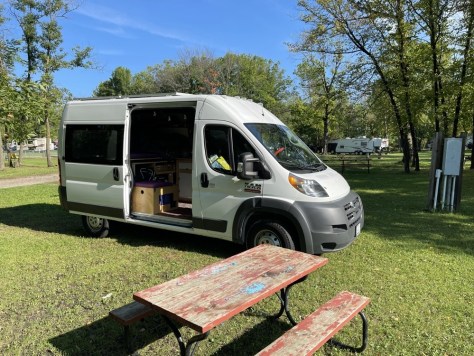
All of us at the meet-up had a basic buildout from Wayfarer Vans in Colorado Springs. My Violet was born there in 2018, while most of the other vans at the get-together had a newer lineage and thereby fancier additions. However, Violet was more than PVC walls and hand sewed colored cushions. Every year my friend Tom and I would tweak her, add to her abilities, and increase her functionality. Violet may not be the newest Wayfarer van, but I absolutely believe that she was the most beautiful of them all.
Today’s post goes beyond paint colors and cushion choices. Going to the meetup at the Star M ranch in Bozeman, Montana presented to me new challenges and surprising introspections that started well before I packed my travel snacks and filled my gas tank.
Despite my strong desire to attend I also had a sense of dread. I had asked Julie to accompany me but, understandably, she wasn’t interested in a 1400 mile trip to a dusty field. To go alone would mean that I would have to face any and all challenges of the journey by myself. To go alone would mean that I would have to put on my functional extrovert face, a performance that I am skilled in donning, but still an energy-draining experience.
As a professional interviewer, I have no problem engaging others when I am invited to do so. However, I have never quite gotten over my childhood expectation of being seen and not heard. It is immensely difficult for me to walk up to a stranger and start a conversation. My upbringing taught me that my thoughts and opinions were of interest to no one.
Intellectually, I have long known that this is not the case. Most people are happy, even eager to engage in casual conversation. However, old tapes run deep. Many years ago I decided to challenge those beliefs, and I did so in my usual manner of study, brute force, and repetition. My teacher was my friend, Tom.
Tom and I are very similar in our interests and temperament. However, we come to the table with different skill sets, and so we tend to utilize each other to compensate for those areas where we need shoring up. Our friendship has a practical side in that we constantly help each other to be “better.”
Tom has superior social skills and has an effortless ability to engage with strangers. I have witnessed him on dozens of occasions extracting personal information from a person that he has just met. “So how much money does a cement truck driver make?” Would be typical of a question that he would have no difficulty asking, and one apparently that most people have no problem answering.
I have the knowledge of how to engage with people, but watching Tom taught me that it was OK to engage with them. This may sound like a trivial distinction, but it is not. I have successfully adopted his techniques many times over the years, but I have never done so in an environment where I would be interacting with dozens of strangers, alone and without the benefit of an event that I was in charge of. The thought of doing so added to my anxiety, but it was insufficient to stop me. I have not gotten as far as I have in life by yielding to my anxieties. Fear is a barrier that I will climb over or burst through if necessary. I lived an early life being told that I was worthless. I was not about to live an adult life when I subconsciously told myself the same thing. I have value. I can contribute. I will only be limited by my true limitations and not by remnant ghosts from the distant past.
I usually deal with my anxiety by planning and problem solving, which is what I did for this trip. I wrote out a grocery list and made sure that my 12 volt Dometic fridge was sanitized and clean. I charged my USB flashlight and Bluetooth speaker. I checked the local weather and explored several plotted courses on Google Maps. I still had some residual anxiety, but that was to be expected.
What I didn’t expect was what happened to me several days before I started my trip. On Saturday I cleaned out and washed Violet, and I reorganized her storage. I also gathered nonperishables from our pantry. On Sunday I was supposed to go to a cousin reunion, but I had tickets for a Paramount production of “Kinky Boots.” I had purchased the tickets before the pandemic, but the play was on hold once shelter-in-place was instituted. This would be the first time that I would attend a public performance in almost 18 months. Sadly, this would mean that I would miss the reunion.
The play was a bit of fluff with a dash of “message.” The premise was ridiculous, a business is saved from bankruptcy by a drag queen who helps a straight-laced shoe factory owner make kinky boots designed to support drag queen feet. However, another message was folded into the fluff. Two men, very different, each dealing with the demons from their past help each other. I left the play feeling that my time was well spent, but I also acknowledged that the overall experience would be quickly forgotten.
On Monday I was to help my friend Tom. He was remodeling a bathroom for a Naperville client. He wanted me to take some before photos of the space as it would soon be demolished. These photos would serve as a counterpoint to photos that I would take of the finished job. The latter laboriously photographed and carefully edited to make the bathroom appear beautiful enough for a spread in “House Beautiful.”
I take these jobs very seriously and I approach them as such. On Sunday night I pulled out my professional gear, a Canon 5D Mark IV, and charged its battery. I selected and mounted a wide-angle lens on the camera body, and I made sure that my flash was in working order. As I said above, Tom helps me, and I help Tom.
On Monday I felt off. I drove to Tom’s place and got into his Flex. We arrived at the remodel site and were greeted by the client. Tom looked over his shoulder at me and told her, “This is Mike he is an amateur photographer and he will be taking some photos for me of the bathroom. That simple statement caused me to snap out loud, “I’m a professional photographer.” It also caused something to snap inside of me. It is clear that the client and her husband picked up on my comment as they continued the line of conversation in a joking way, but with a slight air of classism. With a chuckle, the husband asked me where my gallery was, and if I was planning on submitting my photos to “Home and Garden.” It was not the right thing to say to me at that moment. I bit my lip, weakly smiled, and offered a comment designed to end his line of questioning. He quieted and left the room. There was no way that I was going to jeopardize my friend Tom’s job. However, I was now boiling inside.
Dear readers, I am almost always a very calm and deliberate person. It is extremely unusual for me to raise my voice, and even more unusual for me to do so without a thoughtful and logical delivery. However, as soon as his clients were out of earshot I let loose on poor Tom. My rage was palpable as I told him in no uncertain terms that telling a client that I was an amateur inhibited me from doing my job to the best of my ability. I reminded him that I was doing professional work for him, despite the fact that I was doing it for free. I highlighted to him the time spent before and after a shoot, and the effort involved during those periods. Tom’s tendency is to interrupt and explain, but I was having none of this. With my finger pointed at him, I told him in no uncertain terms that I didn’t give a shit about his excuses. It was as if I was possessed by an outside entity. My rage dumped on him, but there was no sense of relief, rather I was consumed by a sense of confusion. What just happened, and why did it happen? I had no answer.
I helped Tom with a few menial tasks, but I did so quietly. I made small conversation, but it was stilted and awkward. Finally, he drove me back home, but he didn’t take me there, and instead he took me to his Devonshire property. “Aren’t you going to take me home,” I asked? “Mike, you drove your car here,” he replied. I was so upset that I completely had forgotten that I had done so. I got into Violet and drove the 5 minutes back to my house and promptly went upstairs and laid down on my bed as I tried to process what had just happened. One of the reasons was apparent. Like many men, I value respect above other values. In my mind, Tom was disrespectful of me by calling me an amateur when I have done many professional-level jobs for him. His actions were further amplified by the clients’ comments that seemed to imply that my attestation that I was a professional photographer was subject to ridicule. Still, my out-of-control retort to Tom seemed well beyond a simple case of a bruised ego.
After a bit, I forced myself out of my bed and went downstairs. I was still feeling surly and felt obligated to warn both Julie and Kathryn that I was very crabby, but not angry at them. However, I emphasized that my anger was generalized and that they should stay clear of me. As the day progressed I continued to feel a general dissatisfaction towards everyone, especially myself. I was completely baffled why I was being so reactive. Yes, I had some anxiety about driving to Bozeman, but that hardly could be the nidus for my volcanic rage. I just don’t feel that level of anger.
As the day went on I started to feel progressively more guilty about the morning’s events. I shot Tom a few friendly text messages. In turn, he did the same and mentioned that he wanted to formally secure Violet’s Wabasto heater. Tom had helped me install the heater a few months earlier and mentioned doing this final step at that time. However, this was not necessary for the trip. My sour mood continued.
I’m usually good at identifying behavioral triggers, but I was coming up dry. As the evening progressed I called my sister, Nancy, and voiced my concerns. Nancy is a professional therapist and offered me both support and insight. Unfortunately, I had already examined and discounted the behavioral causes and effects that she suggested. Yet, I was ever grateful for her support and kind ear.
Julie was in the room folding laundry as I pondered my anger with Nancy. Julie asked, “Would you like to hear my thoughts?” “Of course,” I replied. Her first thought was that she had recently gained some accolades and she wondered if I was feeling upstaged by her. I replied, “No, I’m happy when you succeed. I like basking in the glow of your successes.” She paused for a moment, almost to second guess what she was about to say. “Maybe it was the play?” I responded, “The play, why would that silly play have such an impact on me?” “Well, it involved men who were a disappointment to their fathers who didn’t believe in them. Fathers who wanted their sons to conform to their wishes while ignoring their dreams and aspirations. Sort of like your childhood.” Click…
Who would have thought that a simple play would have such a profound impact on me.
I instantly felt a release as the anger that I was feeling washed away from me. I hadn’t been able to figure out my reaction because it was too primitive, too dangerous, too risky to bring into my conscious self. Julie could see my internal conflict and her Ph.D. training gave her the ability to articulate it in a clear and therapeutic way for me. I was very grateful. Later that day I talked to my sister, Carol. Just like my sister Nancy, she was completely supportive of me and completely accepting. Like Nancy, she had no reservation to tell me that I was special, good, and loved.
I now realized that on the morning of the incident Tom represented my father and thereby served as a lightning rod for the anger that I was feeling on a subconscious level. In my primitive mind, he was rejecting me and my talents. I felt like he was saying that I was not good enough. This feeling was exacerbated by Tom’s client’s comments that humorously mocked the idea that I could consider myself a professional.
When I turned 18 I decided to take control of my life and I used the rage that I felt as a tool to propel me forward. I was going to allow myself to be who I was, do what I thought was in my best interest, and not allow anyone to be disrespectful of me or my abilities. No one had to agree with me, but no one was allowed to make fun of me. Doing so would result in the full force of my abilities to put them back in their place. Thankfully, I almost never had to do the above as most people were both respectful and considerate towards me, and this only increased as I amassed ever more degrees and titles. However, the play opened up a wound that I thought was long healed, and anger that I felt I had conquered decades earlier.
The next day I met with Tom, who was quiet and a bit standoffish. He had driven to a different suburb to buy a specialty tool to affix the Wabasto heater for me and refused when I offered to pay for the part. After he secured the unit I asked him if he had a minute because I needed to talk to him. To the best of my ability, I made sincere amends to him for my actions from the previous morning. My tough-guy sailor mouth friend was genuinely hurt by my prior eruption, and he let me know that. I felt relieved to say that I was sorry but genuinely upset that I hurt his feelings. I hoped that my bad actions had not irreparably damaged our friendship. However, that was all that I could do.
Despite the relief of understanding my outburst, I still had the stress of the upcoming trip. Tom signaled that we were good by offering to meet up for coffee on the morning of my departure. Julie did an extra load of laundry for me so I would have enough shorts and shirts for my adventure. Kathryn checked in with me several times to ask if I was feeling better, and both of my sisters continued to offer their unending support and love.
There is something powerful about real love, and each of these individuals showed me this before my journey. I am ever grateful. They were there for me despite my crankiness. I knew that I could get people to connect with me if I was brilliant, funny, interesting, or thoughtful. Here were 5 people who loved me at a time when I was none of the above. I was good enough just being me. How many people don’t have a single person who truly loves them? Here, I had five. I felt blessed beyond belief.
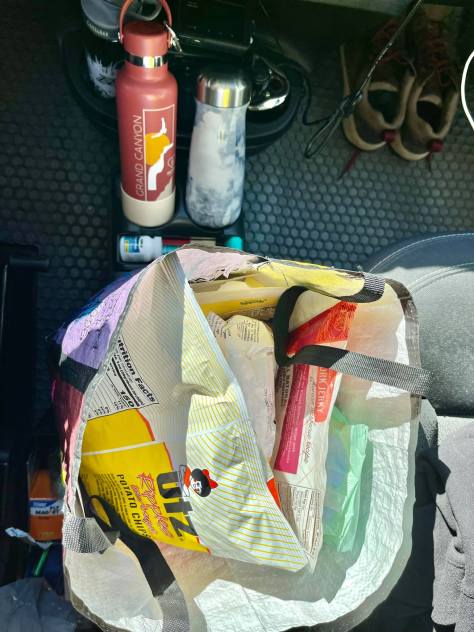
I still had to deal with my internal anxiety, but at least I was in a position to do so without the burden of past demons. At 9:30 AM I boarded Violet to start my journey. She was packed with clothes and groceries. Next to me was my snack bag, hydro flask, coffee thermos, and Motrin. I was as ready as I could be and feeling significantly calmer about the task ahead.
I had a fridge full of perishables and a “pantry” full of can goods. My sister suggested that I try packing my clothes in a laundry basket, which turned out to be a great idea.Next to me was a bag of snacks, a hydro flask with ice water, a thermos full of coffee, and a bottle of Motrin.
I pulled out of my driveway while listening to mechanical directions from Google Maps. Off I went.
The initial part of my journey was familiar and comforting as I drove past Rockford and into Wisconsin. I had taken that path many times driving to Julie’s Minnesota family. Beyond Minneapolis I would be heading to Fargo, North Dakota, then Bozeman, Montana.
Despite road construction driving conditions were good. I entertained myself by scanning local radio stations, listening to Sirius radio feeds, and talking on the phone. The trip was long, but I was feeling calm. I decided to drive until I felt tired as opposed to driving a certain distance. That feeling happened in Northern Minnesota. I found myself forcing my eyes open and I knew that it was time to call it a day. I searched for a campground but found none. I found respite in a Minnesota rest area. I pulled into a far corner of the parking lot, covered my windows with my homemade Reflectix shades, and crawled into bed.
My first overnight was at a rest stop in northern Minnesota.
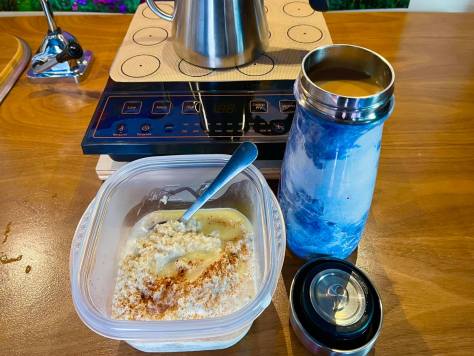
The next morning I made a quick breakfast using my induction cooktop. Pour-over coffee with cream, and oatmeal with dried cranberries. After a quick cleanup, I was once again on the road. This time I wanted to drive until I was about 3 hours away from my destination, the Star M Ranch which was outside of Bozeman. I drove west and watched the foliage change from a lush green, to a duller green, then to a scrubby brown-green. I scanned a couple of apps to find a campground but could locate none. It appeared that I was traveling in a vast zone of nothingness. Each exit proclaiming “No Services,” every one punctuated by expanses of rocks, dirt, scrub, and nothing more. Finally, I saw, “Rest Area Next Exit.” I had found my next sleeping spot.
A simple breakfast of pour-over coffee (made directly into my thermos) and oatmeal with dried cranberries.
The site was empty and isolated. Housing only a small brown building with facilities and a parking lot. It was perched over a valley with the meandering Yellowstone River cursing below. Like the night before I quietly moved in and selected a distant, but not a too distant parking spot. That night I ate a roast beef sandwich that I dunked into some microwaved Progresso Tomato Basil soup. I worried if the spot was safe, and I further pondered if parking overnight was legal. However, I took my chances, changed into my bedclothes, climbed into bed, and fell asleep.
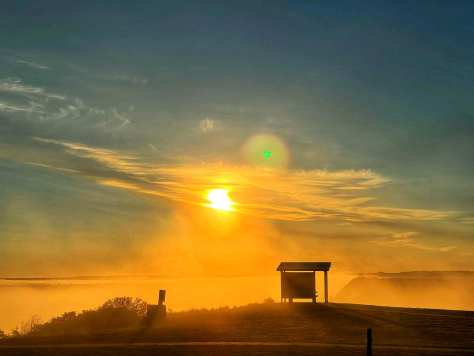
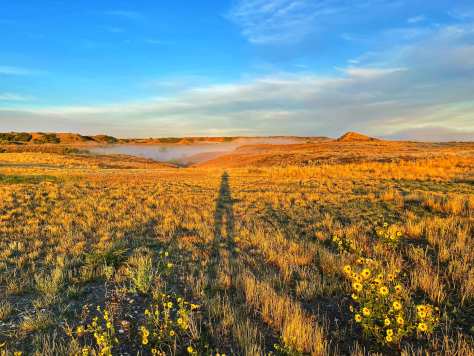
On my way I took a little side trip to the Theodore Roosevelt National Park. The rest stop that I stayed in Montanna overlooked the Yellowstone river.The next morning I looked at the window and saw what appeared to be a pair of men’s underpants outside my window. I don’t think it was there the night before.When I woke up the entire valley below was enveloped in a thick fog.The sign says it all.This was right next to the Montanna rest stop. Beautiful!
I slept soundly, in fact too soundly. I woke blurry, dull, and two hours later than my usual wake time. I made some coffee, but I didn’t feel hungry. I decided to wait until I could find a drive-through where I could grab a quick breakfast sandwich. After washing my face and brushing my teeth I pulled myself into Violet’s driver seat and headed west down I-90 towards Bozeman. My GPS signaled that I was three and a half hours away.
This was the only time that I ate in an actual restaurant on my trip.
Meetup-Day One
I drove down Stimson Lane and caught sight of a row of Ram Promasters in a field on my left. A colorful “W” followed by the words, “Wayfarer Vans” highlighted the entrance to the venue. I pulled in and was greeted by a cheerful staff member who handed me an envelope full of stickers and an itinerary. Another staff person acted like an airport marshaller and slotted Violet between two other vans. Once given the signal I placed her in park, turned off the key, and exited her confines.
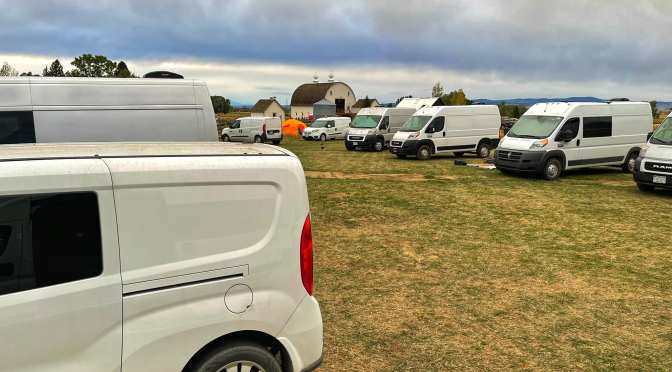
Ten of the forty or so vans had already arrived. Most people were sporting large 136 or 159 wheelbase Promasters, but some were driving the much smaller Promaster City. Wayfarer Vans had custom packages to convert all flavors of Promaster. There was a size for every taste.
Some of the Promasters. Violet is the one with the red umbrella. Another Promaster view. In all, there were three rows, and some random vans here and there.
To the left of me was a Promaster 159. It was occupied by two ladies from Nevada, Joyce and Ellen. They were both long-divorced who raised their respective children as single parents. They were also long-time friends who eventually decided to live together. One of them was in her 80s and they gained my respect with the knowledge that they had mutually bought the Promaster just last year so they could continue to explore the country. They were instantly warm and welcoming.
On the other side of me was a man in a Promaster City. Alan had a slight but wiry build that announced that he was a life-long athlete. He was gregarious in an effortless way, and he instantly engaged me in conversation. After some time he moved to another group and acted similarly. I could hear him laugh and joke with total strangers as if he had known them for years. I was envious of his ability and felt a bit ashamed that I was lacking in that area.
Across me was a man who identified himself as a confirmed bachelor. Doug had moved from big LA to small St. George, Utah. He said moved because he didn’t like what was happening in California. I felt that it was best to not press for more information, but I made a mental note to keep my liberal leanings to myself. Doug was a professional voice-over actor who could ply his trade anywhere that he had an internet connection. He was a friendly guy who was enjoyable to talk with.
Down the lane was another single man who had two immaculately groomed Schnauzers, a male, and a female wearing respective blue and pink harnesses. Vern was a retired IT professional who lived in LA and had a love of gadgets and a problem-solving mind that reminded me of myself. We got to talking and he revealed that he grew up in Chicago in the same neighborhood as I did. However, he lived on the east side of Western Avenue, while I lived on the west side. Another man entered our conversation and when he found out that we grew up in the same neighborhood he commented that we were probably playmates “in the day.” Vern and I shot each other a glance as we both chucked and said, “probably not.” Vern was black and I was white. Chicago was a racist town in the 1970s. How grateful I was that this was 2021 and not 1971. I think Vern and I could have been good friends in the day if not hampered by the limitation of our upbringing.
I was making a strong and good effort to socialize, but I was doing so by putting on my functional extrovert persona. It was fun, but also exhausting. I retreated to Violet for a supper of another roast beef sandwich, made expressly to use up my open package of cold cuts. The remaining event for the day was a bonfire, and despite my exhaustion, I was committed to going. The bonfire was actually a lava rock filled circle outfitted with a number of Bunsen burner like jets. It was an odd device likely designed to safely burn in arid and fire-prone Montana. I spotted a familiar face next to an open seat and approached the person asking if the adjacent spot was taken. “I think so,” was the reply. I quickly moved to another spot and sat quietly as my level of awkwardness built. I fumbled with my phone and tried to look occupied, but within short order, I knew that I wanted to leave. I had pushed my envelope about as far as I could and there was nothing left in me that would allow me to once again start a conversation with a new stranger. I was spent. I planed an exit strategy that I thought would be subtle. I would go to the Port-a-Potty and then sneak off to Violet. This was exactly what I did. Once inside I pushed in my Relfectix shade, popped in my Apple AirPods, and clicked on the audiobook that I was listening to, Becoming by Michelle Obama. I sat in the quiet with Violet’s cabin illuminated by 4 battery-operated faux candles that changed colors in a rhythmic and calming pattern. The instant relief that I felt verified that I had made the right choice. I’m an introvert and I can only do so much socializing. Yet, despite all of my good efforts, I feared that I had failed. I was judging myself based on a passing grade of being 100% perfect.
I wondered if I had made the right choice by coming to the meet-up. I was playing my comparison game. Everyone seemed to have an easier time socially connecting. I had done well enough, but I was play-acting. I felt inadequate and slightly ashamed. Yet, Violet’s safe and secure surroundings gave me the courage to go for day two.
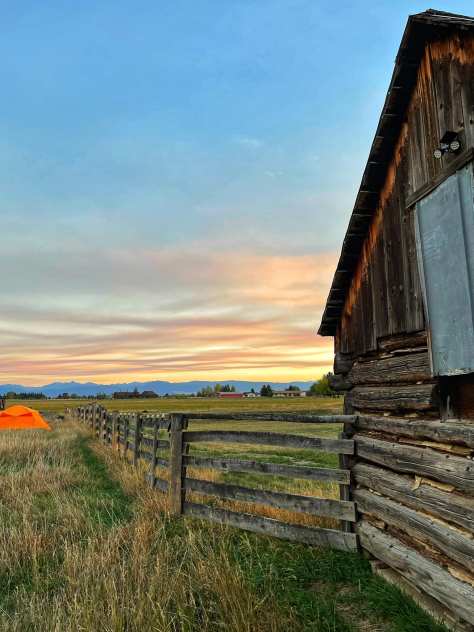
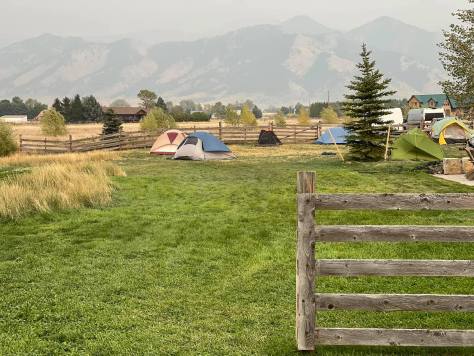
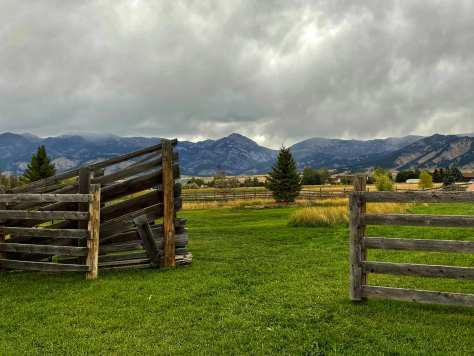
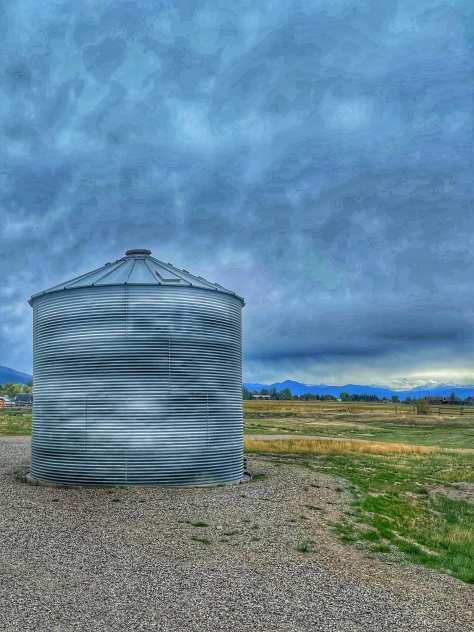
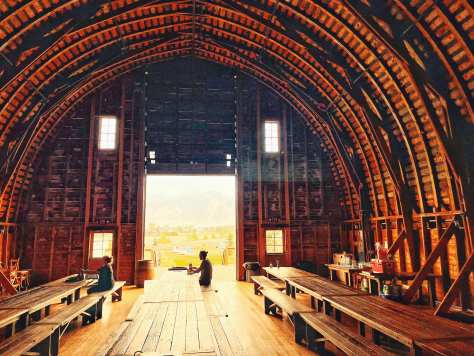
1919 Barn turned into a party barn. This is where all of our meals were served.Another photo that I took of the Star-M property.Some of the Wayfarer employees camped out in tents.Another property landscape. The clouds are rolling in, but so was the smoke from a forest fire.This grain silo is now a water tank for the barn’s modern fire sprinkler system.
Meetup-Day Two
I woke up and ripped open a pudgy package of Epic XL shower wipes. These one-by-two foot wipes have a slight eucalyptus fragrance and can serve as an emergency shower. Since showers were not available at the ranch the Epic wipe would have to be an acceptable substitute. As a dry camper, I am experienced using the wipes knowing that you start by cleaning your cleanest parts as you progressively scrub ever more needed regions. Once hygienic I brushed my teeth, sprayed on a little cologne, and dressed.
I exited Violet and immediately went over to the two ladies’ van as they were holding court with several other van dwellers. They welcomed me and I felt at ease entering their circle. The members of the group were no longer strangers, they were now, at least, acquaintances. We all meandered to the barn for breakfast but we were greeted by a sign saying that it was delayed due to a catering mess up. Our conversation continued in the barn and I revealed to them for the first time that I was a physician. Perhaps oddly, I don’t like to tell people that I’m a doctor as it can sometimes set up an artificial barrier.
Eventually, food arrived, an enormous selection that was quickly gathered from local stores by the Wayfarer staff. We listened to a few talks after breakfast, and then the group broke up to go to various scheduled activities-mountain biking, a short hike, or free time. I thought about going on the scheduled hike, around two miles, and regarded as moderate. I knew that this level of exercise was within my capabilities, but I held back. I didn’t want to slow up more athletic hikers. This was another old tape from the past. I never played team sports because I didn’t want to pull others down with my insufficiencies. Always being told how uncoordinated I was I believed that I would be a harm rather than a help to any team that I would join. I didn’t feel that I needed to challenge myself with this. I elected to take my iPad back into the barn, now empty and quiet, and to start this post. It was the right decision to make.
Something happened to the caterer, so the Wayfarer staff went out and bought an enormous amount of breakfast treats. The smokey sky from forest fires led to some spectacular sunsets.There were a number of talks. This one was on the history of the Star-M Barn and how it went from hay barn to party barn.
Eventually, I tired of writing and wandered back towards the campers and engaged in a number of conversations. The staff videographer asked me if I wanted to do a video tour of Violet. I agreed and the interview began. After the interview, we talked about cameras, editing software, and wireless microphone choices. Other van dwellers then came up to me with questions about Violet’s solar panels, microwave oven, organizational boxes, and Wabasto heater.
I found that the empty barn was the perfect place to write this blog.
Jinny was a newbie who had questions about my induction cooktop. She was a bit unusual as she was an older Asian woman traveling solo. I made an honest effort to encapsulate useful information about induction cooking and how I monitored my electrical system to make sure that had enough power for my other devices, such as my Dometic fridge.
Later Jinny showed me her van, a completely tricked-out Promaster 159. I got to know her a little better and it was clear that she had given a lot of thought to adopting this new lifestyle. She had the book knowledge and it seemed like she was now hoping to gain the practical knowledge to successfully travel in a van.
Many van dwellers had cool toys, like this folding e-bike.
As in my conversations with other van dwellers, I didn’t want to assault her with my professional interviewing style. The style where I can learn everything from a person’s favorite color to details about their sex lives in 45 minutes or less. What I would learn about Jinny would be what she would choose to tell me.
She told me that she had a huge house in Seattle that she recently sold. She purchased several acres of land outside of Seattle that already contained a 3 car garage and an RV garage. She bought the land because of the RV garage and bought an RV without ever driving one. This was a mistake as the lumbering behemoth was stressful to drive. She sold the RV and was much happier with her Wayfarer van.
She had a shed built on the land and had it converted into a tiny house. The residence didn’t have a kitchen but was reasonably close to the company that she owned. When her employees went home in the evening she use her workplace kitchen to make Hello Fresh types meals, a portion which she brought back to her tiny house. This seemed to work for her. Jinny was in the process of building a fourplex on the property, which she would rent out. Once completed she would retire and use the rentals for her income.
Jinny showed me a photo of her beautiful daughter and her adorable grandchild. They were living in Minnesota and I believe she was establishing her nomad lifestyle so she could spend more time with them. I thought to myself, “What a fascinating person.”
Then it was time for another catered dinner. This one consisted of a make-your-own taco bar but added the twist of pull pork and chicken mole fillings. Here I found Bill. I had talked to Bill a few times before. He was sitting alone and I asked him if I could join him. Bill was a tallish man with a wild horseshoe style mustache. Bill retired from the airlines after working for them for over 40 years. He then converted his passion for woodcarving into a successful mail-order business but shuttered its doors when the company became so successful that it sucked the joy out of his hobby. Bill said that he was always fascinated with trucks, so he then got his commercial license and became an 18 wheel truck driver for 10 years before he finally retired.
Bill lost his wife 3 years prior to our meeting and it was clear that he still missed her terribly. A former Chicagoan, he had moved to Mesa, Arizona decades earlier where he raised his two sons. Bill was immensely proud of his two boys, one who lived in Colorado and the other in Arizona. They came up in every conversation that I had with Bill. I liked this about him. Bill became my dining partner for the rest of the event. I could imagine him as a next-door neighbor and friend who would stop by for coffee and chat. That would be fun.
There were so many others that I talked to. The couple originally from Glen Ellen, Illinois now living in Steamboat, Colorado after raising their kids. They seemed the executive type, pleasant with ease with strangers that comes from years of neighborhood gatherings and business meetings. They commented on how neat and organized Violet was. I had to chuckle because they were right. Three years of my obsessiveness combined with friend Tom’s carpentry skills had turned Violet into a well-oiled machine where there was a place for everything and everything had its place.
There was Dana, a single woman in a 159 Promaster who was also fairly new to van travel. She had purchased some folding solar panels, but she was afraid to use them. I helped her set them up as I tried to emphasize how easy the process was. Dana was very social on day one but then seemed to disappear. She left early noting that she wanted to beat the bad weather on her journey back to Colorado. I felt that she had had enough of this adventure and wanted to return to the security of her basecamp.
There was a couple from Indianapolis. I met the first one during breakfast on day two and then her wife on day three. They owned a coffee shop in Indie but were hoping to sell it so they could explore America in their camper van.
There was the couple where the woman slept in her tiny converted Promaster City and the man slept in an adjoining orange tent. I’m not sure what their status was. Couple? Friends? Whatever their status it was clear that they genuinely liked each other.
There was the guy with the giant German Shepard and the lady with the Golden Doodle and so many more. When I saw someone I didn’t know I went up to them, introduced myself, and started a conversation.
The day ended back in Violet’s welcoming chamber, AirPods in, audiobook on.
Meetup-Day Three
I woke up to frigid temperatures and instantly turned on the Wabasto. Like the day before I procedurally went through my hygiene and dressing ritual and then went outside to socialize. Soon it was time for breakfast, sort of a Continental affair. I grabbed a fruit cup, muffin, and a small parfait and balanced a cup of coffee on top of my plate as I made my way from the food line up the stairs to the dining tables. I sat with a group of familiar faces as I sipped my coffee and nibbled on my muffin. I smiled and occasionally offered comments as they talked about everything from the cold weather to Elon Musk.
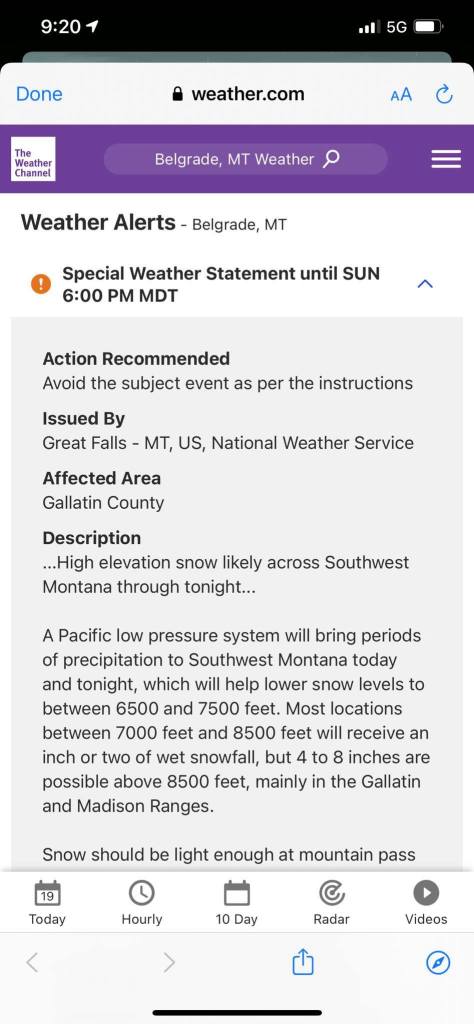
The frigid weather forced a number of van dwellers to pack up and leave as another number of them went off on various explorations. I hunkered down in Violet, as the only jacket that I packed was a light hoody. On occasion, I would wander out to re-engage with other dwellers to have pleasant conversations as I continued to reinforce my socialization skills. However, after doing this for the two previous days I was also happy to have my alone time. I wrote, read, and talked on the phone. Prior to my journey, I had planned on taking a side trip back to Yellowstone, as it was only 90 minutes away from Bozeman. However, my weather app said that the high in Yellowstone was going to be 42F on Monday, with a low of only 16F. Some snow was also predicted. I mentioned my change of plans while on the phone to my friend Tom, who was insistent that I should go anyway. That was Tom, who was always interested in exploring and learning something new. However, my short pants and thin hoodie suggested otherwise. I told Tom, “We’ll see,” code to let him know that I wasn’t going to do it and that I didn’t want to debate my decision. He understood, and we changed the subject.
The weather report told me that a side-trip to Yellowstone was a no-go as all I had was a light hoodie to keep me warm.
I had now found my pace at the meetup. Mixing socialization times with alone times gave me the balance that my introverted self required. More conversations followed with Vern, Jinny, the camera guy, and others mixed with writing, reading, and thinking. I was no longer exhausted, no longer mad at myself for not being the best “socializer” in the group. I no longer criticize myself for not challenging myself further. I was content.
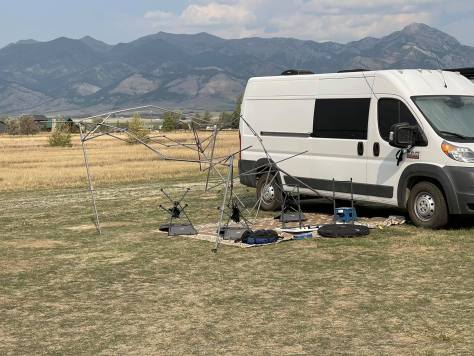
One day it was so windy that this poor van dweller’s awning was torn to shreds.
Meetup-Last morning and the road.
Half of the 40 vans had already left the event. I heard some people outside chatting, but many chose to avoid the bitter cold by staying inside their vehicles. Eventually, it was time for breakfast. This last meal was dubbed a “Grab and Go” meal. However, most of us grabbed and sat down. I found Bill and we both went down to the buffet line. Balancing a biodegradable style plate I examined and placed items into it. Some sort of egg dish, a small muffin, a little fruit. At the end of the line was the coffee. The cups were small, and so I filled two of them. Now I had to figure out how to balance two cups and a floppy plate up the stairs to the dining hall. I didn’t do this gracefully, but I manage to get to the table without dropping everything.
We sat and chatted and Bill invited me back to his van as I had expressed interest in how he liked a partition that he had purchased that isolated his van’s cabin from the front cab. At the end of the demonstration, he offered me a few pre-soaped sheets that he said were great at removing van bug reside. In my mind it was a gesture gift, suggesting a new friendship.
I said a few more goodbyes, to Doug, the coffee ladies, even some random folks who I had never talked to. I went back to Violet and made sure that her cabin was secure, lest everything wouldn’t go flying when I hit the road.
I wasn’t going to go to Yellowstone, but I wasn’t finished with exploring. I set my GPS for downtown Bozeman and drove out of the ranch. Bozeman is a town of around forty thousand and its downtown looks very similar to my hometown of Naperville. Two and three-story buildings, many appeared that they were constructed during the first half of the last century. They were well maintained and the shops that they contained suggested that the town was doing well. Sporting goods, coffee, bikes, spices and teas, the list went on. I took a few photos, but I was chilled and didn’t linger.
Downtown Bozeman is filled with cute shops and wide sidewalks.A lot of the architecture had a 1900-1920s look.I thought that this bike shop had an interesting sign.
I like visiting colleges and so my next stop was Montana State University, which was about six minutes away from downtown. Here too, I got out and wandered. The campus was spotless and pretty. However, it was sized more like the small North Central College in my hometown rather than the behemoth state universities that I’m accustomed to in Illinois. Yet, it is the largest university in the state of Montana, with an enrollment of around fourteen thousand students. I milled around with the students as they marched to their next classes and I was struck by how similar they looked to students that I had witnessed at other colleges that I had visited. Some were wearing heavy down vests, others in t-shirts and shorts. Some with expensive clothes, others wearing Goodwill bargains. Each bright face a potential future Elon Musk or Warren Buffett. I looked at the grey hairs on my arms and then back to their eager faces and I became acutely aware of the different phases of our lives. They were speeding towards expectation, I was lumbering towards acceptance. We were both still moving, still growing. However, I no longer felt the anxiety of urgency. Rather, I was taking what I had and tweaking it to better fit who I wanted to be.
Like many colleges, Montanna State had a beautiful “Old Main” building.However, there were also quite a few modern buildings.
I returned to the comfort of Violet and searched for a gas station, which I found on the edge of Bozeman’s downtown. A tiny station with a small convenience type store. I put the pump on automatic and went inside to grab a cup of coffee. After filling a 16 oz styrofoam cup I wandered the store looking for a perfect snack. There were rows of candy bars and protein bars. Aisles of popcorn and beef jerky, end caps of snack cakes. I took it all in, but nothing really appealed to me. I approached the front counter and was greeted by a woman in her 40s. She said, “Is that all?” I could tell that she was sizing me up, and I must have looked a sight. In front of her was an old man, somewhat disheveled, and with a full week’s growth of beard. I saw her glance at me and then at Violet. I could only assume that she thought I was homeless and I was concerned that she was passing judgment on me. She repeated, “Is that it?” “Yep,” I said and reached for my wallet. She said, “It’s only 99 cents and guess what?” I replied, “What?” She looked at me and gave me a big smile, “It’s on me.” My eyes misted up and I returned the smile, “Really? Thank you!” This lady was likely making minimum wage yet she was reaching out with kindness to a stranger who she had never met and who she assumed needed a little TLC. I felt lifted up by her random act of kindness.
The next days would be grueling as I wanted to return back home in two days, rather than the three that I allotted. Once again, I entertained myself with old radio shows, NPR, audiobooks, phone calls, local radio stations, and thinking. As I drove the miles I would cycle through these options. As soon as one would become tiresome I would move to another.
I came across a National Monument, Pompey’s Pillar, a rock formation in central Montana. The site is famous for many petroglyphs as well as the carved signature of William Clark of Lewis and Clark fame. Apparently, his signature is the only remaining physical evidence of his journey with Meriwether Lewis. It felt good to gain free entry using my lifelong National Parks Senior Pass. The ranger at the gate gave me a full history of the site and urged me to watch the park’s movie and to talk to the other rangers who were stationed on the rock itself. Another nice person!
Pompey’s Piller National Monument is basically one big giant rock.Climbing to the top of the rock provided some very pretty views.
There is only so much time that you can spend climbing a 200-foot rock, and it wasn’t long before I was once again sitting in Violet’s driver’s seat, heading east. Driving in the western states of Montana and North Dakota is a lesson in isolation. A thin ribbon of asphalt propels you forward, but much of the landscape remains the same. Brownish green brush, endless rocks, the occasional buff or range of mountains. It is all extremely beautiful, but disconcerting for an urban lad, such as myself. I’m used to a certain degree of noise and congestion and I gain a level of comfort knowing that there are 5 gas stations, 3 grocery stores, and two hardware stores writhing a 5-minute drive from my house. On I-90 I could drive 50 or even 100 miles without seeing a human-made structure. I passed countless exits with signs that stated “No Services.” With no connected town, these exits seemed to drop off the end of the earth into a zone of nothingness.
The landscape was barren but breathtaking.
As I drove I sipped coffee, then Diet Pepsi, then water. I rutted through my snack bag and munched on various trashy treats-Chex Mix, pretzels, Belvita bars. The amount of non-nutritious foods that I was eating made me feel sick, and I longed for a salad. However, that longing didn’t stop me from once again reaching into the bag to grab another crumb.
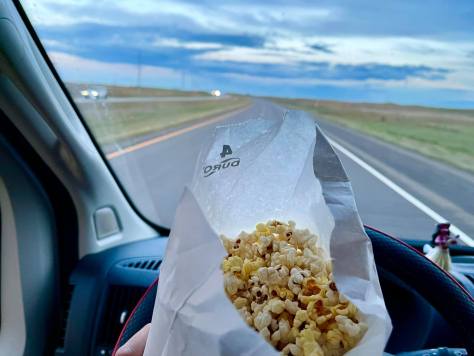
It was now around 6 PM and both Violet and I needed to fill up. Google told me that there was a gas station 26 miles ahead, the only one-and so that would be my stop. At the station, there was a man with snow-white hair and a bushy mustache who was fueling his Tahoe. He was pulling a fishing boat and heading west to Washington state. He too was a solo traveler and clearly feeling lonely. In short order, he started to tell me his story, but I had to cut him short as I wanted to grab dinner from the Cenex store. I entered the establishment and was greeted by the intoxicating aroma of gas station pizza. However, when I wandered back to the food zone I was disappointed to only find three items on the warming shelf. Two boxes of chicken strips and a breakfast burrito. It appeared that they had been heated hours before and I couldn’t bear the thought of eating them. I grabbed a bag of popcorn and a bottle of diet Mountain Dew-that would be my dinner for the evening.
Popcorn and diet Mountain Dew for dinner.
Yes, dear reader, I had a fridge and pantry full of things that I could have made. Eggs, canned soup, lunch meat, and even some vegetables. However, I just wanted to keep going. I was missing my loved ones and wanted to get home.
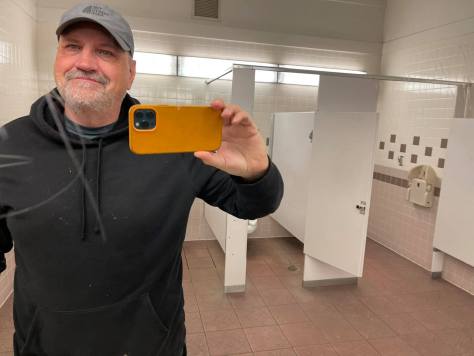
I drove on until I could drive no further. However, there was nowhere to stop. No town, no hotel, no truck stop, nothing. Now deep into North Dakota, I spied the blue and white sign of a rest stop. At last! My plan was to camp out there until the morning, but my heart sank when I drove in and saw a large black and white sign that said, “No Overnight Camping.” I knew that it was best practice to move on, but I had nowhere to go. I pulled into a slot and search for information on North Dakota’s DMV site. They stated that it was illegal to park longer than three hours at their rest stops and that they considered that sleeping in a van was camping. It couldn’t be any clearer. Despite being exhausted I assessed my situation and came up with a plan. Sleeping 3 hours would allow me to drive further to some other place, perhaps another rest stop or a truck stop. There I could repeat the practice. I set an alarm for three hours and crawled into Violet’s bunk. This time I didn’t change into my sleeping shorts. I wanted to be ready to move if an officer banged on my door and forced me to drive on. Apparently, I turned off the alarm during the night because I woke at 6 AM-rested. No one bothered me. I meandered to the bathroom, which was completely empty. I took a photo in there-a perfectly OK thing to do considering that I was alone, but somehow it felt a bit wrong. Then I was on the road again.
Taking a forbidden photo inside of an empty men’s room.I was going to treat myself to a real breakfast on my last travel day, but the closest restaurant was almost 100 miles away!I started my last drive with the sun directly in my eyes.
My last travel day was similar to the one before it. However, as I went further east both the landscape and the population changed. I drove on listening, thinking, snacking. Julie was texting me and pressing me about my location and when I planned on returning to Naperville. I was being deliberately vague as I wanted to surprise her by showing up a day early. Dear reader, I’m not very good at deception, but I did my best. She called me when I was driving through Aurora, about 15 minutes from home. I tried to divert her direct questions and I could clearly hear the frustration in her voice. When I arrived she was happy to see me but also peeved at me. Later, Kathryn told me that Julie was worried about me because I was acting uncharacteristically confused. She thought I could get lost or fall asleep on the road and she was concerned. Apparently, her being miffed with me was based on this unnecessary worry. I apologized.
I finish this post from the comfort of my little study with its mullioned windows and overstuffed leather easy chair. Despite its small size, it is larger than Violet’s living space by a magnitude. My environment is now a controlled 72F and I have a bathroom only a few paces away. Last night I took an endless shower, rubbing a thick bar of creamy soap over my body. I shaved away a week’s worth of beard and felt the spacious wonderment of a king-size bed, silky sheets, and puffy pillows.
I’m glad to be home, but I never felt deprived living out of Violet. I planned her environment well and that planning has served me.
My out-or-proportion anger towards Tom surprised and shocked me. The stress of the trip combined with the play and a few poorly chosen comments took calm and collected me and transformed me into a person that I felt that I had long left behind. Yet, it was still there. Issues from the past still haunted me 50 years later. It was a humbling experience.
I have taken long trips solo in the past, but that doesn’t mean that they are not stressful. I can fill hours of time alone, but it is more enjoyable to ride with a co-pilot. Whether that is Julie or William sitting next to me, or Tom driving his own car.
My biggest challenge was interacting with 75 strangers in a confined setting. Lessons from the past taught me that I should be seen but not heard and it has always been enormously difficult for me to initiate a conversation with a stranger. Over the years I have observed how my friend Tom easily connects with others and I have modeled those observations to successfully break my inhibitions. However, this would only involve a single person and for a short period of time. I have never challenged myself to do so with 75 strangers in a venue that ran for days.
I was down on myself on day one. Yes, I had started up multiple conversations with numerous people. However, I was judging myself against another and clearly coming up short. His incredible ease of socializing made my efforts look paltry. By the time that I was rejected at the bonfire, I was already exhausted and spent. This amplified my feelings of inadequacy and I wondered why in the world did introverted me subject myself to this extroverted challenge. I return back to Violet feeling defeated and exposed. Inside I felt a rush of relief and comfort. During that moment I gained a better understanding of myself. I am an introvert, I could expand my abilities and develop my social skills, but I would always be an introvert. Extroverts, like Alan, are different creatures who gain energy from their interactions. I enjoy people, but I need to recharge away from them which is why isolating in Violet felt so good.
Indeed, I had made great progress. Years ago I would have never approached a stranger to start a conversation. Lately, I have had no problem doing this. Now, I was on a trip that would force me to drive 3000 miles alone for the purpose of interacting with 75 strangers over an extended weekend. I wasn’t Alan, but I was still doing pretty well.
As soon as I recognized what was going on I altered my approach. I would still socialize. I would still initiate. However, I would give myself times to recharge in between. Sometimes I would quietly think, or read, or write. Any of these behaviors were enough to top off my battery and allow me to move forward and experience more.
The people that I met were all different, but they had a common thread-they were all incredibly nice and very interesting. How fortunate I was to interact with them. The hosting crew was also beyond pleasant. I got to chat with Ian, the owner of Wayfarer Vans for a bit. I asked, “Why didn’t you bring accessories to sell?” He replied, “I wanted this to be a family event, not a commercial one,” He succeeded.
I learned a little more about van life and a lot more about many interesting people. Beyond the weekend warriors, there was the lady who bought me a 99 cent cup of coffee, the ranger who wanted to share the excitement of Pompeys Piller, and the man with the bushy mustache who just wanted to talk to someone. Each was kind, accepting, and generous in their own ways.
At 68 I still have much to learn. Without realizing it I still am battling with demons from my past. However, I continue to grow and advance. I am who I am and some things will always be out of my reach. With that said, I’m not a static creature locked into a persona created decades earlier. I’m evolving in all ways. My goal is to continue to grow but to also accept myself. As an adult, I feel that I had pretty good ego strength. However, it only took a few events to make me return to a past time. I wasn’t able to shake off a minor blow to my self-respect. I turned a molehill into a mountain. Thankfully, with the help of others I was able to understand that process and (hopefully) use it to be a better person in the future.
I am so grateful to be me. Living in my little town, touring in my little camper. I will never be the most popular kid on the block, or the most famous, or the richest, or the most accomplished. However, I feel that I am loved and I love others. What more could I ask for?
Julie: How would you feel about taking Violet to Minnesota to see my parents and then go to the Minnesota State Fair?
Me: Sure
Any journey is filled with ups and downs, and so it has been with the journey of Violet the campervan. I bought her as an empty cargo van in 2018 after several years of deliberation. Initially, my camper decisions were based on camping with a family of 5, then 4, and finally two. I had come to understand that my family had aged out of family camping trips, a hard realization for me.
My friend Tom had told me that he would help me convert a vehicle into a camper, and we had actually looked at an old shorty bus for that purpose. I am not a construction expert, but I do have a good sense of the complexity of many projects. So I knew that building out a vehicle sounds easy. Still, in reality, it would be a time-consuming and challenging project.
I serendipitously came upon an ad for Wayfarer Vans, a company in Colorado that could install a basic camper “insert” in a single day. This prefab setup would give me a floor, walls, ceiling, bed, and kitchen box. Even in this basic form, I would have a useable camper.
I purchased a new Ram Promaster cargo van at a reasonable price and set about doing some preliminary work, installing a hitch and some passenger windows. I then drove to Colorado Springs to have the van transformed. The following morning I went to Wayfarer Vans, and Wayfarer kindly lent me a car that allowed me to hike at the Garden of the Gods State Park. By 1 PM I got a phone call that Violet was ready to be picked up.
Over the last three years, my friend Tom and I have slowly modified Violet. We have added everything from a solar-powered electrical system to a Wabasto heater to cruise control. Violet has become her unique creation, built on the bones of a commercial product. She is not only roadworthy but also a very liveable and practical space.
Due to her cargo van lineage, Violet only has two seats, and due to her camper setup, she only has one large bed. I envisioned that this setup would be suitable for solo trips, trips with Julie, and trips with my son, William. Unfortunately, her bed configuration couldn’t accommodate a “sleep-over” with my daughters. However, Violet could still be used with them on day trips. With every camper, there are always compromises, and this was the compromise with Violet.
My initial years of owning Violet have been filled with many exciting adventures. Still, few of them included Julie or William. They were not interested, but that changed this year. I have gone on many camping/hiking trips with William and Julie in 2021, which has been a wonderful and unexpected change.
And so, I direct you back to the first few lines of this post and the significance of their content. Julie was not only willing, but she was requesting a camping adventure in Violet… is it of any surprise that I agreed?
When I’m going on a camping trip with someone, I try to make their experience as good as I possibly can. So I cleaned Violet inside and out and made a trip to the grocery store to purchase all of Julie’s favorite foods. I also committed to doing all of the driving and all of the cooking so Julie could read and relax. The best way to get a repeat customer is to offer good customer service!
We camped outside of St. Paul, mid-way between Julie’s parents and the state fairgrounds. On Sunday, we visited her parents, and on Monday, we went to the Minnesota State Fair.
Prior, I had only gone to a state fair once in my life. My Uncle Nick took me and a few of my cousins to the Illinois State Fair when I was in grade school. I have a pleasant general feeling about that adventure, but I only have two discrete memories. The first memory centers around the general excitement I had going on a trip to Springfield, Illinois (I didn’t go on a lot of trips as a kid). The second memory was that my uncle bought me a foot-long corn dog on a stick. I think that this was the first corn dog that I ever had, and in my mind, it was a gourmet triumph.
Julie had gone to the Minnesota State Fair several times growing up. Unsurprisingly, many of her memories also centered on fair food, in her case, cheese curds and Tiny Tim donuts. She had talked about returning to the fair for decades, and I was glad to finally make that happen.
On the day of the fair we got up early, and I made two cups of pour-over coffee. However, we skipped breakfast as we knew that we would be spending the day eating a lot of trash carnival-type food. We tidied up the camper, a necessary step to avoid everything crashing to the floor when driving. I typed the fair’s address into Google Maps and started a zig-zag expressway trip to the venue. Google gave me slightly incorrect directions, and we missed the parking lot. Fortunately, we stumbled on a private lot that was both closer and cheaper. Score!
We entered a gate near the livestock pavilions and were instantly greeted by moos, nays, and bleats. Surprisingly, the animal smells were low. Perhaps this was due to excellent animal husbandry, or maybe it was due to the cooler morning temperatures. Either way, I was grateful. At this point, I will tell you the rest of the story in photos as they say that a picture is worth a thousand words.
We camped halfway between Julie’s parents’ home and the fairgrounds. About a 30-minute trip either way.One of the many things Tom and I did when we built out Violet was to add swivels so the front seats could turn, which made the cabin more user-friendly for two. I made some pour-over coffee for Julie and me, but we skipped breakfast so we would have room to sample all of the fair foods that we wanted to try.Our first stop was the cattle building. State fairs often have permanent buildings that are used for decades.Cows are surprisingly intelligent animals. Like many teens, this calf had a mind of its own. These sheep were unbelievably cute I think this device was for shearing. The sheep would stand completely still as if they knew what was about to happen. We saw a lot of officers on horseback. It was a pretty impressive sight. Teams of horses pranced around the fairgrounds. Fair cheese curds are really delicious-in my opinion they are significantly better than ones from places like Culvers.This, dear reader, is a deep-fried Snickers bar on a stick. It is a standing joke at the fair that you can get anything “on a stick.” In fact, I even saw one stand that was selling a spaghetti and meatball dinner on a stick. As far as the Snickers bar is concerned I found it way too sweet and way too greasy. We each took a bite and then binned it. This was a “boozy” pie from another stand. No booze could be detected, but it tasted pretty good!I know what you are thinking….…but this SPAM burger was delicious! The dairy building is the place……for all things dairy.Julie has talked about the butterheads ever since I have known her. They are the carved likenesses of Princess Kay from the Milky Way and her court (you can see her on the far left). The heads are carved out of butter one at a time.A close-up of a completed butterhead.There was also some international entertainment. Here are Indonesian dancers. Julie recognized the balding guy playing in the background. It turns out that they grew up in the same small town in Minnesota. He is now a professor of music at a local university. At last! I found my corn dog!With great anticipation, I took my first bite… I was underwhelmed. My childhood memory was apparently somewhat inaccurate. Julie found the Tiny Tim Donut Stand… Magnificent mini-donuts!So many hand-made crafts. I know that these items are supposed to be cute, but they creeped me out a bit.Julie’s first-ever job was working at a Bridgeman’s ice cream parlor. We had to take this photo. Home-made cakes. Yum! …but they were for viewing only.Home-made cookies… also yum. The contest items were behind glass, but they looked delicious.One of Julie’s fair memories was riding down this slide. Naturally, we had to repeat the adventure.Another memory of hers was the “Old Mill” ride, which is basically a tunnel of love. The ride is 100 years old and it shows. She was afraid that the ride was going to stall as it was so jerky, and my shoulder kept on banging on the walls of the ride. I guess it would be more exciting if you were a young teenager riding with that special someone and managed to snag your first kiss. I love demonstrations as they take common objects and make you feel like you just have to have them. This one was sort of an egg beater thing. However, they made it sound like it was the most amazing invention of the century. No, we didn’t buy one.One of the many contests… this one judging apples.Another craft project. Pretty amazing when you realize that this was made by hand. There was also a lot of free music. Here is the Minnesota National Guard band. Crowd sizes were pretty manageable and lines for food and activities were relatively short. We left the Minnesota State Fair and drove back home through Wisconsin. We found a delightful county campground and we were able to camp directly on a lake. This is what I saw from Violet’s front window at 6 AM after camping the night.
There was a certain naivety about the state fair and a feeling of a past gone era. An innocence not elsewhere found. I felt safe and happy. I had a sense of pride and patriotism. Someday, I will go back. It was worth it.
What I am about to post may seem contrary to our contemporary narrative. However, it is not. What I am going to write about today is the trait of selfishness.
The term selfishness evokes negative emotions and can be easily weaponized. “You are so selfish!” That phrase is almost guaranteed to cause the recipient a defensive retort or a sense of shame. In many cases, selfishness refers to a behavior where the selfish person’s actions are deliberate in intent. This is not what I will be writing about today. Instead, I will be exploring the personality trait of selfishness, and how like many rigid traits, it has direct and indirect harmful effects on both the selfish person and those around them. In addition, many individuals who express this trait would be shocked if it was identified in them, as they may think of themselves as not being selfish at all due to lack of awareness.
It is easiest to understand selfishness by first understanding its counter characteristic. One may think that this is selflessness, but that is not the case. The counter characteristic of selfishness is codependency. The term codependency has been the darling of popular psychology gurus for decades. It is bantered around as a psychiatric diagnosis, but it is not one. Because of this, there are many definitions of this term. For today’s post, I’ll define codependency as the characteristic of often putting the needs of others before yours in a maladaptive way. The long-term effect of this is to lose your own identity. In addition, the codependent’s sense of wellbeing is determined by the mood and wellbeing of those they are dependent on. If they are happy, the codependent is happy. If they are stressed, the codependent is stressed. These connections go well beyond normal empathy and are destructive for the codependent, the individual who they are dependent on, and the relationship that they share with that individual.
Very similar dynamics happen with selfishness, even though this trait is the opposite of codependency. Why is that the case? One reason may be due to the destruction of a healthy connection with others. Studies have shown that a healthy relationship with others leads to good mental health and better physical health. Therefore, anything that denies an individual the ability to form healthy connections with others can be potentially detrimental to them.
The trait of selfishness dictates that the person places their needs above others in a consistent way that (in the long run) negatively impacts the individual, those around them, and the connection that they share. I am not referring to known significant pathological disorders such as Narcissistic Personality Disorder or Antisocial Personality Disorder. In the former, others are viewed as objects whose sole purpose is to meet the needs of the Narcissist. In the latter, there is a lack of empathy, resulting in the absence of a moral center. In contrast, the selfish person can relate to others and possess empathy, but they can modify or switch off these characteristics when it serves their needs.
A selfish person often looks good on paper. However, their acts benefit them as much or often more than the recipient. There is a reason why they are doing what they do.
Selfish people come in a variety of “flavors” or categories. Many selfish individuals can exhibit characteristics from multiple categories, so these types are listed chiefly for convenience.
Types of selfish people.
The Stingy type
There are many ways that stinginess can be expressed. It is a consistent pattern of withholding when giving would have little negative impact on the stingy individual. Yes, being excessively cheap would qualify, but so would being emotionally stingy or stingy with one’s time or effort. For instance, a person has an emotional crisis and seeks comfort from a stingy friend. The stingy person listens impatiently and offers a suggestion or two to the sufferer with the hopes of moving on. Their efforts are superficial; designed to shut up the sufferer and they don’t involve a genuine willingness to be comforting or helpful.
The Look At Me type
These individuals can always redirect others to topics that focus on them. They need to be the center of attention. You tell them about something in your life, and they immediately one-up you. Their experiences are grander, their kids are better, and their traumas are more terrible. The other individual feels shortchanged, unimportant, exhausted, or inadequate.
The Woe Is Me type
These folks are chronically dissatisfied with their lives, no matter what they are doing. They feel that the grass is greener elsewhere, and somehow they have been shortchanged. This allows them to shortchange others, or to justify bad behaviors. This can especially be a problem for their parents, partner, or children, as these individuals are frequently indirectly or directly blamed for the selfish person’s unhappiness.
A stay-at-home parent may complain that they sacrificed their career to care for their children, but when they return to work they now complain that they don’t have time for themself. No matter what that they are doing, they are not happy. Their unhappiness is incorrectly blamed on external things instead of looking inward for a solution. This erroneous blame can result in maladaptive behaviors such as reckless spending, addictions, and extramarital affairs.
A selfish friend may believe that they are constantly doing all of the work in a relationship when this is clearly not the case. Resentments build and the friendship deteriorates. Since the problem is internal to the selfish person the cycle repeats. These folks are constantly finding new “best friends” only to have the connections quickly and destructively fall apart.
A child (or adult child) may complain that their siblings are always getting more (money, time, etc.) from their parents by cherry-picking examples when there are no larger indications of this. Their interactions with others center on mental checklists of the “What have you done for me lately?” variety. Their personal connections with others become transactional rather than intimate-and therefore wholly unsatisfying.
The woe is me type constantly complains that they are working harder, suffering more, and being cheated out of more. They elevate and amplify what they are doing while forgetting, negating, and minimizing what the other person is doing. They will often project their own selfish thinking on others. “Yes, you did this but you only did it to…” They use these misinterpretations to justify withholding, being angry, and acting out.
The Karen type
First, let me say that I have some difficulty using this term as I have an absolutely lovely niece whose given name is Karen. However, the term is now instantly recognizable, and hence my use. These individuals are usually identified as being white, female, and privileged. Is there a male equivalent to a “Karen?” Of course (a Chad). Are there Asian, Black, or Hispanic variants? Naturally. These individuals have a false sense of importance which they bestow on people who they consider weaker or more inferior to themselves. We have all seen videos of “Karens” in action, and the target of their rage is often a service employee, such as a waitress or a customer service clerk. Their intentions seem more about demonstrating dominance and expressing rage as opposed to getting their problem solved. Some of their familiar catchphrases are, “I want to talk to your manager right now!” and “I’m going to have you fired!” They may act very differently towards those that they consider their peers, but their overall lack of humanity has a negative effect on all of their relationships.
The Club Member type
This is a disturbing and growing category of selfishness that elevates the selfish person and their ideas while at the same time demonizing the individual or group that they consider in opposition. The club member adopts a “What team are you on?” mentality. Black lives or blue lives? Democrat or Republican? Etc. The other group is dehumanized, and this justifies selfish or even criminal behavior.
Some examples of this type can be found in recent Black Lives Matter protests. On one side, protestors justified looting stores using rationales that held little true merit. On the other side, police officers justified using unnecessary physical force (beatings, tear gas, etc.) to control groups of peaceful protestors. In both examples, the targets of the groups were dehumanized enough to justify criminal behavior (looting and destroying stores, and physically hurting peaceful protestors). With minimal examination, both actions were not only unlawful, but their justifications were ridiculous.
Club members can be incredibly destructive. A group can use its status to persecute another group. There are (unfortunately) too many examples of this that range from the Holocaust, to the persecution of the Uyghurs, to the enslavement of blacks as happened in the United States.
The Caste Member type
There are societies in the world that follow a strict caste system. Those on the bottom are treated very differently from those on the top. The United States appeared to be on target to have an equal society post World War II. Efforts such as the GI bill allowed individuals to transcend their born life station. For instance, working-class GIs had the opportunity to attend university and go from being preordained workers to influential leaders. After WWII, a large middle class was established, which served both as a unifier between classes and a path between social strata.
However, over the last few decades, the middle class has been declining with a resulting chasm between the haves and have nots. This is illustrated by the CEO gap. The average CEO makes over 970% of what they made in 1978, while the typical worker’s compensation has only risen 12%. As a result, we are becoming a country of rich and poor with two different sets of rules. An example is the US legal system. “Equal justice for all” is a great catchphrase, but a person who can afford a high-priced legal dream team will usually obtain a better outcome than a person who is reliant on an overworked public defender.
I remember reading an autobiographical book of a woman who was hired as a nanny for a powerful and very rich family in the movie industry. On the surface, it looked like a dream job, but it actually amounted to a twenty-four-hour-a-day, seven-days-a-week low-paying position that bordered on slavery. When the poor nanny decided to extricate herself from said position her boss (the husband) threatened to destroy her reputation to make sure that she would never be hired for another nanny job. Yes, probably a blessing in disguise, but that is not my point. I’m assuming that he would have never acted in such a selfish way if she was of equal or greater status to his.
The Justifier type
This indeed is a tricky category. It is the category that justifies selfish behavior based on a higher reason or cause. “I had to work to get health insurance; why should XXX get it for free!” “If we raise the minimum wage restaurant prices will go up, and some restaurants will close, causing people to lose their jobs!”
Depersonalizing entire groups or (worse) rebranding an oppressive action as a benevolent act allows individuals to feel justified in their selfish actions. Should someone really be grateful for the opportunity to work 40 hours a week without health insurance benefits, while making so little that they have to live in a tent? -Yes, that is really happening in 2021.
Causes of the selfish trait
The following is based on my thoughts and has not been established by rigorous scientific methods. Use these ideas as a springboard for your own theories.
Genetics
There are no papers that I am aware of that explore the genetic contribution to the trait of selfishness. However, it would not be unreasonable to assume that genes play some part in the evolution of this trait. Selfishness would offer some survival advantages to early humans. In addition, it is clearly understood that contrasting personality characteristics like empathy do have a genetic component. Is there a gene for selfishness or is it determined by a modification of opposing traits such as empathy? That is to be determined.
Environment Models
Most personality traits have environmental elements that promote the trait, so it is likely the same with the attribute of selfishness. But, what are some factors that could contribute to this trait?
Deprivation model
You can be deprived of many things that range from money, food, emotional support, physical security, and love. People raised in such systems can react to their trauma in a variety of ways. One way would be to adopt similar behaviors while feeling a need to ensure their own security. As a result, it becomes the norm to withhold and not give.
Individuals in this category may not even realize that they are being selfish as they have never learned how to act in a different manner.
Excess (Prince/Princess) model
This is the opposite of the deprivation model. A person is given so much that they never experience want, and thereby they don’t develop a true sense of connection with others. All of their needs are anticipated and attended to, which unrealistically elevates their ego.
When I was working in an affluent suburb of Chicago, I would see parents who would try to give their children a perfect life. If the kid got a bad grade, they didn’t tell them to work harder; they complained to the teacher and wanted them to change the grade. If the kid got into trouble, they would get them the best legal counsel so that they would have the least possible consequence.
I recall a couple who were shocked when their son was arrested for driving over 100 MPH down a quiet residential street (where loads of kids played). This child had a long list of irresponsible behaviors, so why did the father buy him an expensive high-speed sports car for his 16th birthday? Shortly after the gift, he was arrested for this incident, and his parents hired the best legal team because they didn’t want the young man to have that blemish on his record. By the way, he was well on his way to screwing up his life due to the lack of consequences.
Adults who were raised in a deprivation model can sometimes parent their own children using an excess model.
Societal model
A society can promote selfish behaviors. Terms such as systemic racism identify societal reasons for the selfish behaviors of one racial group (whites) against another (blacks). Volumes have been written on these topics with ramifications that range from the underfunding of HBCUs (historically black colleges and universities) to fewer job offers in resume reviews of qualified individuals with names that sounded more African Americans.
In many societies, minority groups are treated as inferior to the majority group, and those in power generally establish rules and customs that justify this mistreatment.
Isolation model
We live in a time that emphasizes the individual above the group and this allows isolation from ideas contrary to the individuals. You can exclusively watch news channels that mirror your beliefs without regard to balance. You can physically and virtually limit your association to people who are unlike you (religion, race, economically, politically, etc.). As a result, ideas stagnate, prejudices amplify, and a general sense of entitlement can occur.
I treated a very religious man who felt that it was perfectly acceptable to cheat some of his business clients because he felt that they were non-believers.
The Celebrity Model
Many idolize celebrities and excuse their destructive behaviors while desiring to be like them. A star cheats on their spouse because they find someone who seems more exciting, and there seems to be little consequence for their actions…Why not me? A politician amasses money and power by destroying the lives of others…That is how successful people do it, right? A sports icon gets away with murder…What’s the big deal? We honor and emulate people in power and idealize their actions. What appears to be business as usual for those individuals can be normalized to the greater society.
Expressing personality traits
It may seem counterintuitive, but an individual can express opposing traits separately or at times simultaneously. In this case, I am specifically talking about the traits of selfishness and codependency. I understand that that may sound confusing, so here is an example. A person has an established selfish trait, demonstrated by a long history of selfish actions. Then, they marry an alcoholic, and they try to control the alcoholic’s drinking and then their overall behavior. Soon, this becomes the focus of their life, and they are in full codependency mode, still expressing selfish behaviors to that person and those around them.
Finding balance.
It would be easy to read this post, take the ideas presented here to an extreme, and think it is always wrong to be selfish. However, there are absolutely times when an individual needs to think about their needs, and during those times, others may deem that behavior as selfish. Conversely, there are absolutely times when a person must put their demands aside and make someone else’s needs their priority.
Living a full and good life involves give and take and flexibility. If an individual is always only thinking about their needs, or if they are always subjugating their needs for the needs of others, they will have an unfulfilled and empty life. However, there is a big difference between always and sometimes. A successful life centers on balance, and that requires thoughtfulness and self-awareness.
It is easy to identify a selfish person by the way you feel after you interact with them. Some common feelings include feeling exhausted, used, guilty, shamed, empty, inadequate, or angry. However, it is much more challenging to determine if you yourself have a pattern of selfish behavior. A straightforward method to resolve this is to self-test your actions by daily focused journaling for a few weeks. The intention of your journaling is to explore one interpersonal interaction that occurred that day. That interaction could be with a spouse, relative, friend, or a third party (like a store clerk or someone driving on the same road). Write out the interaction, and then answer the following questions:
Why did you act the way you did?
If you would have acted differently, would that have had a different outcome?
Did you behave in an entitled way?
Did you think about the other person’s feelings or why they acted the way that they did?
Did your actions have a negative impact on someone else?
Did you feel that your behavior was justified because the other individual was different than you in some way? Inferior to you?
Would you have acted in the same way if the person was more similar to you? For instance, a member of your club, church, or social status?
Did you feel morally justified by your actions?
If you were having a conversation, how much time did you spend asking about the other individual?
How interested were you in their answers?
Additional questions:
Did you do a kind or thoughtful act anonymously for someone today?
What have you done in the last 24 hours that made someone else’s life better, even if that was in a small way?
If you see a pattern of personal selfishness, it is possible to change it with deliberate effort and by using the same journaling process to monitor your progress. The goal isn’t to turn you into a selfless Mother Teresa. Instead, it is to change your behavior so that there is more balance, as I described above.
I have worked with thousands of patients in the over 30 years that I have practiced psychiatry. Selfish people and their counterparts (codependent people) are not happy people. Finding the middle ground results in improved self-esteem, better relationships, and overall greater happiness.
Peace
Mike
Just a pretty picture to calm you after a challenging post.
Pre-dawn, and I am in my bathroom. I “clean up,” and I quietly get dressed. I don’t want to wake Julie, so I am in complete stealth mode. I pull up my socks and my iPhone pings, “Are you still sleeping?” Tom was 5 minutes early, and his white Ford Flex is idling outside the front of the house. I type, “I have to put my shoes on. I’ll be out in a minute.” I creep downstairs, put on my Danby’s, grab my bag, and sneak out the door. The house is still sleeping, mission accomplished.
——
Tom was cheerful, but I was still half-asleep. He hands me a large Dunkin Donuts coffee, and I take a sip. “It is going to be a beautiful day,” he says, looking at me. I nod, thankful that the caffeine is starting to work its magic. Without willing it, my brain starts to imagine the caffeine blocking my adenosine receptors and the resultant cascading impact on various neurotransmitters. “Damn,” I think, “Why does my mind always have to be cluttered with a thousand useless thoughts? Why can’t I just enjoy a tiny bit of quiet time?” I push the biochemical pathway out of my mind, but other ideas start to run in the background. Finally, I give up and focus on the quiet of the early morning and the soft music from the car stereo. Tom is playing a Spotify mix of straight-ahead jazz, Little Richard, and 90’s classics. We drive on.
Soon we are on I-88, then the Eisenhower as we speed towards the city. The traffic is light, which surprises me as Chicago expressways always seem congested. I look up and am transfixed by the pre-dawn view before me. The soft silhouette of downtown Chicago. Its massive skyscrapers remind me of a distant mountain range enveloped in fog.
I have to admit that I have a poor sense of space and direction. Despite having lived in Chicago for many years, I still become confused with Chicago’s streets. Finally, however, I start to recognize some familiar landmarks. The old Cook County hospital, the Billy Goat Tavern, and my favorite omelet joint-The Palace. We are driving through Chicago’s Near West Side and heading to River West. These were blighted areas when I was a graduate student at UIC in the 1970s. Now, they are hosts of million-dollar condos housed in red brick low-rise flats and shiny glass mid-rise skyscrapers. I am excited to see this rejuvenation but equally sad for all those displaced by the “wheels of progress.”
We finally arrive at Tom’s job site, a red brick four-flat designed in a mishmash Federal/Georgian/Minimal Traditional style. I’m not sophisticated enough to appreciate such designs as they always look a bit mongrel to me. I grab my camera bag but leave my hoodie behind in the Flex as soon the chill of the night will be replaced by a typical muggy Chicago summer morning. The sun is just starting to light the eastern sky as we trudged the 4 flights to the top unit, which is completely empty and ready for labor.
I wander into the unit’s empty master bedroom and look towards the alleyscape outside its side window. The sun is just cresting over the backs of buildings and distant skyscrapers; I am instantly flooded with memories and longing.
——–
The 1970s was a time of transition for me. I had just successfully defended my Master’s thesis in Microbial Biochemistry. Still, I had decided to abandon pursuing a Ph.D. in favor of the ludicrous idea of applying to medical school, a thought that came out of nowhere and completely consumed me. I started a research job at the University of Chicago during the med school application process. I didn’t want to stay at UIC as my fallback plan. The crazy “voice” in my head told me that I had to close the Ph.D. door. It was not for me; it could not be my “plan B.” I was throwing away something that I wanted only a few years earlier. Why was I so illogical? It was so unlike me.
I had planned my future so carefully. I would earn a Ph.D. and then become a university professor. Everything had fallen into place as UIC not only paid for my tuition but also gave me a small stipend. I was on track to achieve my goal, no small feat for a blue-collar kid from Chicago’s Southwest side who once attended one of the most dangerous high schools in the city.
The urge to give all of this up for potentially nothing built during the final year of my Master’s program. An idea that was both grandiose and insane. Getting into med school was an impossible dream on all levels. Most applicants come from top universities and have designed their lives to look perfect on paper. I had attended a Chicago Junior College and finished my undergraduate degree at a state “normal” university. I did exceedingly well at those institutions, but let’s face it, I didn’t go to science camp as a kid, I didn’t have a professional write my application’s personal statements, and I didn’t attend an ivy league undergraduate school.
I was shocked when seven out of the eight schools that I applied to interviewed me, and all of them either accepted me or put me on a waiting list. I decided to go to Northwestern, but this would mean giving up my suburban condo and moving to Chicago’s Near North Side. I found an apartment building that was recently converted to condos. It was one building off of Lake Shore Drive, and it was surprisingly reasonably priced. I moved in.
————
It is fascinating how an image can transport you back in time. There was something incredibly familiar with the sight of the sun reflecting on the green glass of a distant skyscraper as it also warmed the adobe-colored backside of a much closer apartment building. A rush of memories cascaded upon me. My first day of medical school where Dean Eckenhoff gave us the best and brightest speech. Buying Napoleons at the French pastry shop in the Belmont Hotel, sipping coffee at the Coffee and Tea Exchange on Broadway, eating lunch with a handful of other older students in the Medical Student Lounge, and walking home from Northwestern’s Chicago campus through Lincoln Park on a spectacularly beautiful spring day. The envy of my youth hit me like a punch to the stomach, and I longed to be back in that moment.
I bathed myself in warm memories before a more rational mind replaced them with a historically accurate recollection. Yes, Dr. Eckenhoff’s speech was inspiring, but most of my time at Northwestern involved study and hard work. Indeed, I loved those Napoleons and the bitter flavor of freshly roasted coffee. Still, I was so poor that I could only afford these delights rarely. I looked forward to spending time with my fellow lunch buddies. However, I ate the same frugal bag lunch every day: a generic bologna sandwich, cookies or a snack cake, and a pouch of insipid Capri Sun. Yes, I have memories of walking home through Lincoln Park, but I mainly arrived at my condo on Aldine via the #151 bus–time was always in short supply. I only saw sunrises because I had to leave for school at dawn. My personal life consisted of a failed relationship. My life was good, but it was not the rose-colored memory that that sunrise evoked.
I would never want to erase that time in my life, but it can never be repeated. I am a different person, changed not only by age but by a wealth of life experiences. Some of those experiences were beautiful, some terrible, some memorable, and others forgotten. All of them worked in concert to make me who I am today.
But, who am I? I’m a 68-year-old man who enjoys his life. I live neither in the past nor the future, but on occasion, I reflect on both. I am a person who does plan for the future, but I’m willing to bend in the breezes of the present. My age is relevant, but it does not define me.
To be in my 20s again would mean that I would have to give up my current relationships and negate my 4 children. To be 20 again would mean that I would lose the knowledge that money and possessions are just frosting on the cake and not the main course in the meal of life. I would still think that my identity was based on my title and accomplishments rather than realizing that my significance is more determined by those who love me. To be 20 again would mean that I would feel guilty when I wasted my time with creative pursuits instead of memorizing facts or learning techniques. Walking in the woods and pausing to smell the wildflowers would be forbidden. Making an elaborate dinner with my children as I sip on a glass of cheap red wine would be something that I would want to do in the future but couldn’t find the time in the present.
Last Friday, I enjoyed sharing an evening with two very dear friends, Ralph and Ann. Both professionals, both very busy, both younger than me. Ann asked me how I fill my days now that I’m retired. I paused for a minute, and I was about to give her a bullet texted answer full of activities and accomplishments. Such a list would be easy for me to compile and signify that I was not wasting my retirement time. However, such a compilation would not truly represent my present life. So, instead of trying to impress her with my productive activities, I told her the following:
Today, I woke up early and shuffled the cars in the driveway to make it easier for Kathryn to pull out. Then, I ground some coffee beans and made a pot for Kathryn, Julie, and me. I took a walk to my friend Tom’s house and chatted with him for a while. On my return, I talked with Grace and told her that I was so proud that she was now a Senior, but I also let her know how much I would miss her when she returned to school. Tom called me again and wondered if I wanted to go out to lunch with him. Of course, I said, “Yes.” On the way home, I stopped at the Jewel and bought snacks, as well as a pie for the evening’s activities. I returned home and tidied the house for company. Julie came home from work, but we quickly had to leave for Uncle Julio’s where we were having dinner with you (Ralph and Ann). I had a delightful time catching up with the latest happenings of my former clinic. I was especially touched when Ralph told me that several staff members asked him to say hello and that they missed me. Now, we were all at our house lounging in the sunroom, drinking decaf coffee and eating French Silk Pie. The windows are open, and a warm, gentle breeze is blowing past us. We talk of life, travels, and children. The kind of talk that only friends with a long history can appreciate. Ralph asks for a shot of CC, and I have to give it to him in a juice glass because I don’t have any shot glasses. Unlike 20 something me, there is no shame or embarrassment- I chuckle, “Take it or leave it.”
I tell Ann that it has been a perfect day, a lovely day. It has been an important day because it will never be repeated, as unique as a snowflake and just as precious.
Dear reader, so many of us live in the past or long for the future, and we destroy our present. We expect life to consist of a series of punctuated events, trips, accomplishments, and purchases. But that is not what life is about. With the greatest sincerity, I tell you it is about a walk, lunch with a friend, a conversation with a couple, the honest labor of cleaning a toilet, a heartfelt emotion, a summer breeze. So often, we throw away these gifts of our life’s season as we fixate on past successes and failures or place our lives on hold for some carrot in our future. Yet, we are all exactly where we are supposed to be at this very moment. All things have both a positive and negative side. How we view our lives is up to us. How we appreciate our moments is solely our responsibility.
Peace
Mike
I looked out the side window and I was flooded with past memories.
Kindness is not weakness. It is the opposite of weakness. However, this characteristic is more complicated than what can be defined in a simple statement. When I was a young child, adults often described me as being kind. Then, I felt that such an identification suggested that I was weak. I wanted to be regarded as intelligent, as that quality was valued in my family. In addition, I thought men were supposed to be harsh, insensitive, and aggressive to the point of being self-serving. Being kind suggested to my child’s mind that I was somehow less of a man.
Then, my kindness didn’t come from some active process; it was who I was. Why would I want to hurt another person? Why would I intentionally take advantage of someone instead of working to get what I wanted? Why would making someone feel weaker make me feel stronger? None of this made sense to me.
Kindness strongly correlates with another personality trait, empathy. Empathy is the ability to put yourself into someone else’s shoes. This is different from a characteristic called identification, where you feel the other person’s pain. Empathy lets you understand what someone else is going through. Identification is similar to codependency, which is not desirable.
My kindness was partially inborn and partially developed due to my feelings of being different. I knew how it felt to be mistreated because I was different and how it felt to be accepted despite that difference. Acceptance is a form of kindness.
The above suggests that the characteristic of kindness is both inborn and passive. However, there is also an active component to being kind. Therefore, at times it is necessary to work on this behavior.
In many ways, I have lived a charmed life. Naturally, I worked hard to achieve my goals, but many do the same with poorer outcomes. I have always been an observer of others, and there have been those who seemed to gain both power and pleasure by being mean or even cruel. Therefore, it could be assumed that “destroying the competition” is the royal road to success. However, I have made an effort to do just the opposite, and I have been successful. Some wealthy people are mean, that is true. Is there a difference between wealth and a successful life?
How does one define success? For me, it means having people in my life who I love and who love me. Second, it is the ability to achieve goals, including career goals. Third, it is the reality of having enough financial security to do most of the things I want. Finally, it is the ability to have a meaningful life that includes improving the lives of others.
I worked in a field where I helped others… that was a success. I was able to explore hobbies and interests outside of my work… that was a success. I raised four wonderful kids… that was a success. Of course, none of these things got me on the cover of a magazine, but for me, they indicate that I have been successful.
In my heart, I believe that I have remained a kind person throughout my life, but do I have any objective evidence that supports that assertion? On milestone days, our family’s practice is to go around the table and comment on the celebrant. So it was last Father’s Day. When it was my wife’s turn, she looked at me and commented that she appreciated how kind I am. I know that such a comment may be arbitrary, but it supports that my observation is not wholly delusional.
However, there may be some who may think that I have not been kind to them. Like everyone, I have moments of misjudgment, most of which are unintentional. There may be others who view my ability to set limits as being mean instead of simply establishing a boundary. Being kind doesn’t mean that you are perfect or that everyone will love you.
I ponder why kindness has gotten such a bad rap. The Bible touts the Golden Rule, “In everything, do to others what you would have them do to you. . . .” Matthew (7:12). More contemporary studies prove that treating people with respect and kindness yields better societal outcomes than treating them punitively. Several that come to mind include the industrial psychology experiments of the 50s and 60s. When factory workers were treated with kindness and given more control over their jobs they were happier and their productivity increased. More recently, when comparing Norwegian prisons (where inmates are treated kindly) with US prisons (noted for their cruel and punitive treatment), the rate of recidivism was shown to be three times higher in the US system.
Yes, some have become fabulously wealthy by inflicting pain on others, but massive wealth does not equate to happiness. We all need money and possessions, but after a certain point stuff becomes a burden. Multiple studies have indicated that happiness comes from our positive connections with others, not how wealthy you are or how cruel you are. Yet, we are fascinated by “Reality” TV shows where contestants are humiliated or “fired” by sadistic hosts.
What does it mean to be kind? For me, it means that I try to understand how my actions will impact others. Will my efforts benefit someone else? Will my actions have little to no effect on someone else? Will my actions harm or hurt someone else? When it comes to the latter point, I also consider the context of that hurt. For instance, if my beliefs bother someone because they conflict with their beliefs, it is on them and not me. If you hate me because I belong to a different political party… Well, that is your problem.
There are times that I have to set limits on others, and they may not like my boundaries. When my children were young, I had to define their roles. As a doctor, I would sometimes need to deny certain addicting medications to patients despite their demands. As a friend, I sometimes have to say no to a request. Being true to your beliefs is a necessary part of being a competent adult. It does not suggest a lack of kindness.
I suggested above that there have been times when I have unintentionally been unkind. When faced with such situations, I acknowledge my error, ask for forgiveness, and correct the issue. In addition, I try to observe the pattern of behavior that caused the problem, and I make an effort to modify that behavior. Naturally, this last action can be a moving target that requires constant realignment. Such is life.
What do I do when I have to deal with unkind individuals? Of course, that depends on the situation.
When dealing with a random situation (for instance, a road rage incident), I try to let go of my reciprocated anger and forgive the offending individual. This may be facilitated by saying a quick prayer for them.
In work situations, I have employed a variety of techniques. For example, if someone’s anger or meanness towards me is unwarranted, I will sometimes deescalate it. A non-response or a simple “OK” can be enough to cool down a situation and return the connection to a more respectful one.
There are other times when a correction is necessary. When I am in such a situation, I will tell the person how their actions made me feel instead of what a terrible person they are. For example, “When you ridiculed my comments, I felt angry and sad. Was that your intention?” Their response to such an inquiry will either rectify the issue or give me valuable information about their character.
There have been a few times in my professional life where neither option was appropriate. Usually, this involved someone whose explicit goal was to shame or hurt me. In those situations, I have found that the best course of action was to move on. Of course, bullies in a position of authority don’t like to give up their power, but that doesn’t mean that I have to put up with their bullshit.
Contrary to common belief, there is always another option out there. I treated a nice lady for many years. She had worked for the same organization for most of her life. She was regarded as a competent and dedicated employee. Unfortunately, her workplace underwent a reorganization and her life became a living hell. More and more work was piled on her, and she was severely criticized for the slightest error. Although miserable, she felt powerless as she believed that she was stuck at her workplace due to her age (early 60s) and the lack of other suitable opportunities. In addition, she was her sole support and she did not have a retirement nest egg. She felt that she couldn’t retire early and survive. These factors led her to suffer from depression and severe anxiety. Eventually, her workplace fired her for a trivial reason, and she was forced to retire early. She discovered that many of her fears were unfounded. Yes, her monthly income was less, but so were her expenses. She didn’t require work clothes, and she drove her car less. She had the time to cook her meals and had less of a need to “reward” herself with things. She was able to socialize more with friends and could spend more time with her grandkids. A year after she was fired, she told me that she was happier now than she had been in many years. Her worst fear became her greatest blessing.
My approach to dealing with mean people in my personal life is similar to dealing with mean people in my professional life—the main difference being the more significant ties that such connections bring. Many months ago, I was having a problem with a very close friend. For whatever reason, he started to treat me with disrespect on an ever-increasing level. The situation reached a point where I was ready to let go of the friendship. Instead of reacting, I reached out to another friend for their advice. He sagely told me, “Everyone has the right to be an asshole on occasion.” On reflection, my offending friend had been a loyal and faithful friend for the vast majority of our relationship. I approached him with my concerns, and he apologized for his actions. The overall impact of our conversation drew us closer rather than further apart.
In situations where the cost of leaving a relationship is very high, such as a spouse, the effort to correct the problem needs to be commensurate with that level of connection. It is unacceptable to be treated meanly by anyone consistently. Still, the status of the relationship makes it reasonable to put forth extraordinary effort to improve the situation, including seeking outside help. However, even in these instances, there are times when the best option is to move on. The only way you can truly respect and be kind to others is to be respectful and kind to yourself.
If you want to be treated kindly, you must be kind. Yet, we live in a world that legitimizes bully bosses, egotistical superstars, and antagonistic “Karens.” It is easy to falsely identify these individuals with success, power, and happiness. However, both common sense and empirical studies have shown that the Golden Rule benefits all. Cruel and mean individuals may use those behaviors for their gain. Still, such actions often don’t lead to happy or fulfilled lives. Instead, they can create empty souls who require the constant input of “more” to feel alive. When you require “more” there is never enough.
Assess yourself daily. Were you kind to another person that day? Were you unkind to someone? Was someone kind or unkind to you? What can you or should you do with the above situations?
Life is a journey… You may be wondering why I’m starting this post with a cliche. Still, phrases become cliches because they accurately and succinctly represent a common truth. So, life is a journey.
When I look back at my life, I find areas where my attitude has change 180 degrees over time and other areas where my opinions are the same now as they were 50 years ago. One place where I have made an about-face has been around my feelings towards having a family.
Early in my life, I never wanted to be a parent. I am sure that this was because I was constantly told what a burden children were. Statements like, “Your mother and I never fought until we had children” were commonplace in my home. It was a given that children were expensive creatures that only caused trouble and made one’s life difficult. In my childhood home, kids were placed a rung below the bad dog who peed on the carpet. So why would I ever want one of those?
My feelings did a 180-degree about-face with the birth of my daughter Anne 38 years ago; it was love at first sight. Having my own child made me realize what a blessing children are. I’m not saying that raising a child isn’t complicated or expensive; both are true. However, that is just part of the child-rearing equation. In fact, I now understand that my most significant life role has been that of a father. It was what I was meant to do.
William is our only boy. I had already raised three girls, and I was reasonably comfortable in that role. However, raising a boy was another issue; I felt wholly ill-prepared. I’m a very flawed person, and because of my flaws, I believed that I would be an inadequate dad for my son.
I didn’t have a role model to emulate or even a template to follow. My dad never taught me how to throw a ball or turn a wrench; I either taught myself manly things or pursued other interests. What if the way that I taught myself these skills wasn’t the “right” way? How could I possibly teach my son those things that I was never correctly taught?
I consider myself atypical and a bit odd. I’m obsessive and laser-focused, and I tend to overthink. However, despite my flaws, I keep friends for decades. I am fortunate to have male friends who genuinely care about me. I try to be a good friend to them in return. Did my male friend’s acceptance of me somehow suggest that I could also be a good father for a son? I didn’t know.
Physically I’m imperfect. My coordination is sub-par. I’m blind in one eye, and because of this, I have poor depth perception. Despite looking like a football player, it is difficult for me to do simple things like catch a ball as I cannot accurately judge distances. These attributes caused me to avoid team sports as I felt that I would be a detriment to any team that I belonged to. I worried about my inability to properly indoctrinate William in such areas.
As a child, I found happiness in solitary activities where the only judge of my performance was me. Electronics, science, computers, photography, cooking, meditation, camping, hiking, and other solo activities filled and enriched my life. These interests were easy to pass on to my girls, but would a boy be interested? My father thought my activities were weird and useless; would my son feel the same?
Early on, I had to face my fatherhood fears with William. As a young child, he was playing with a neighbor and the boy’s dad. When Will returned home, he wistfully said to me, “I wish I had a sporty dad.” I felt like the worst father in the world, but then a calm came over me. I looked at Will and said, “I wish I could be all the things you want me to be, but I’m just a person. I will teach you what I know, and I will be there for you. I will love you and accept you for who you are. That is the best that I can do for you.” William looked up at me and smiled. That was what I needed.
Over the years, I have tried to be just that. I have cooked with Will, showed him to fix things, made his Halloween costumes, took walks with him, helped him with his homework, and generally, I have been there for him.
As Will got older he started to pull away from me. I knew that this was completely normal, but I missed those times when I was bigger than life to him. Several years ago, my friend Tom took his son backpacking and asked if I wanted to come along with Will. Will was not interested, so I let the idea go. More recently, Will has taken me up on my offers, and the two of us have gone on camping and hiking adventures. These times have been a wonderful gift for both of us. William is eager to learn, and I can still teach him new skills like splitting wood or cooking a meal on an open fire. However, William is no longer a child; he is an adult. Our conversations have changed, and we now share our ideas, our aspirations, and our dreams. Our relationship will always be that of a father and son, but it is evolving into something bigger than this. Will can teach me things, as he shares with me those ideas that make him who he is. He is no longer an extension of me; he is his own person.
Conversely, I can now share parts of the less-than-perfect but real me without fearing that I will somehow crush a child’s fragile ego. Our connection is that of two people who not only respect each other but also accept each other. We don’t need to pretend that we are perfect; we are good enough just the way we are.
One of our favorite activities is hiking together. In the process, I have gotten to teach Will hiking basics, such as the proper way to use trekking poles. Will, in turn, has demonstrated his superior physical ability to me. For example, when climbing a hill, I try to hide my panting, and he kindly doesn’t acknowledge my pulmonary inadequacies.
Surprisingly, William’s personality is very similar to mine. He sees the beauty in things that most others find commonplace. He becomes excited in the moment and appreciates the trivial. He has strong opinions and champions the underdog. He believes that a worthwhile existence involves giving back to society and that a life of self-indulgence is an empty life. I’m not sure if these are things that he learned from me or just part of who he is. He is a pleasure to be around.
His interests also parallel mine. He recently won an undergraduate grant and will start an independent scientific research project in the fall. In addition, he had taken to playing the guitar and seemed genuinely happy when I gave him my old collection of rock LPs. (vinyl long-playing records).
Our next adventure will only take us a few hundred miles away from Naperville. We will pack up Violet the campervan and drive to a campsite. Our time will be spent talking, sharing, exploring, and (of course) hiking. Those few days won’t have the status of a trip to Paris or the calculated thrill of a journey to Disneyland. However, I will treasure them more than either. I’ll get to know Will a little better, and he will do the same with me. What more could either of us want?
William turns 20 in a few weeks, and I am so grateful that he has allowed me to spend just a bit of time with him. I have come to realize that there is no rigid formula for being a parent. There will always be more fabulous parents than me, wealthier than me, or more fun than me. That is OK as long as my children know that I love them and that I will do my absolute best for them. It turns out that being a dad to a son is really no different than being a dad to a daughter. Some of the ins and outs change, but the basics are the same. I don’t need to be the father that his friends wish they had; I need to be the dad to who Will is glad to come home to.
Hiking with trekking poles.We both like the exploration that hiking allows us.Even local hikes can yield spectacular discoveries.Teaching Will to cook on an open fire.Camping doesn’t mean that you have to only eat pork and beans!Will has taken to playing the guitar.Sometimes things are more interesting when you view them from a different angle.Will and I found this simple doorway beautiful.During one of our explorations, we came upon an abandoned college campus.You can find interesting things everywhere. You just have to pause a bit and look!Nothing says hiking like a beautiful sunset!Beauty in an old worn doorway.
I’m not a very sporty person, but there are outdoor activities that I enjoy doing, with hiking being my favorite. This long-time hobby got an additional personal boost when I transformed a plain cargo van into Violet the camper van. Violet has allowed me to hike all over the country using her as my basecamp.
I am a day hiker as opposed to a backpacker. I like to return to my camp at night. After all of these years, you may think that I would consider myself an experienced hiker, but that is not the case. I wouldn’t call myself seasoned for one simple fact. Despite hiking for years, it is very easy for me to become disoriented on the trail. I used to feel bad about my lack of ability, but I now realize that I have an inherent poor sense of direction. I’ll never be the person who could find his way home after being dropped off in the middle of nowhere.
I often hike solo, and so I always carry safety gear with me, “just in case.” I bring my own modified “Ten Essentials.” These are ten categories of things that every hiker should carry when they are adventuring. In my case I have emphazied navigation tools because of my inadequacies. Some have told me that I am too obsessive in this regard which prompted me to research the topic of lost hikers in greater detail.
There is a surprising amount of information about hikers who go missing every year. This information is contrasted by a surprising lack of aggregated hard statistics on this topic. Writer and researcher David Politis has made a career of researching lost hikers in national parks. When he asked the National Park Service for statistical information on this subject, he was told that none existed. When he pressed further for this public information, he was told that he would have to pay millions of dollars for the NPS to compile the data.
Mr. Politis’ has written books and produced movies under the “Missing 411” title. He has documented hundreds of people who went missing from wilderness areas, never to be seen again. His reports are both interesting and tragic. Most of his stories involve healthy individuals who disappear without a trace. How often do hikers go missing? That remains a mystery, but I have uncovered some information that may surprise you.
The majority of those who become lost are day hikers, not backwoods explorers, hunters, or backpackers (although they also go missing). Most will be found within 24 hours, but the chance of finding someone alive and well after 72 hours of searching is slim. Day hikers not only get lost more, but they are typically more vulnerable when lost as they are not prepared to deal with an extended wilderness stay.
Approximately 3000 search and rescue missions are conducted every year in the national parks. The US manages other public lands, but it was more difficult to obtain statistics on these sites. There are 157 National Forests in the US. I was able to find that one of them, the Angeles National Forest, had almost 170 search and rescue missions during a recent year. Based on this number, it is reasonable to assume that the total number of search and rescue missions for all national forests is also in the thousands. The Bureau of Land Management (BLM) governs almost 250 million acres of other public access lands. I was able to find documentation of hikers and others going missing on BLM land, but I was unable to obtain any hard statistics on these massive areas.
There are also reported cases of missing individuals who were hiking in state parks. In the US there are over 6000 state parks, but there is no central database that lists lost hikers on these lands. Lastly, there are documented cases of individuals going missing on Native American reservations and private tracks of land. Here too, there is no central clearinghouse of data that catalogs these events.
Another surprising fact is that many people go missing on well-traveled trails. There are reports of people going missing while hiking on short, paved, and popular paths.
One hundred individuals who got lost and then found in the Great Smokies National Park were interviewed about their experience. The most common reason for getting lost was getting off the correct trail. Other common reasons included a worsening of the weather, trying to hike in darkness, various injuries, and falling off the path. Only 24% of these individuals found their way back to civilization independently; the rest had to be rescued.
Survivalist Greg Ovens says that the number one killer of lost hikers isn’t animal predation; it is hypothermia. He notes that it is possible to become hypothermic even when it is 70F if the weather is damp and windy enough.
After reviewing dozens of missing hiker’s cases, I was struck by the number of instances of hikers who went missing while hiking with another person or in a group. These individuals wouldn’t be able to benefit from the supplies that a more conscientious hiker had if there were separated from that hiker. Because of this, I wanted to put together a small Ten Essentials kit that I could lend or give to those that were hiking with me. The packet needed to be reasonably compact yet contain items that would increase their chance of survival if they left the trail and became lost. I think I accomplished that goal, and you can view my efforts in the video below.