My journey using a bread maker has escalated due to inflation and the Trump tariff taxes. However, along the way I have found it to be a fun and creative outlet. I like the idea that this simple machine can produce so many different types of breads, all unique and interesting.
I was recently on a walk with a friend who reads my blog. He and his wife are coming over for dinner and he said, “Why don’t you make some homemade bread as an accompaniment?’ Hmm, what should I make? I baked this cheesy onion bread from the “Bread Dad” website and I think that it could be a candidate. I tried it on my family for a spaghetti dinner and it got positive reviews, so I thought I would share the recipe with you.
This recipe gives both volume and weight measurements. I mostly went with weight as it is more accurate, easier, and has less cleanup.
From the “Bread Dad.”
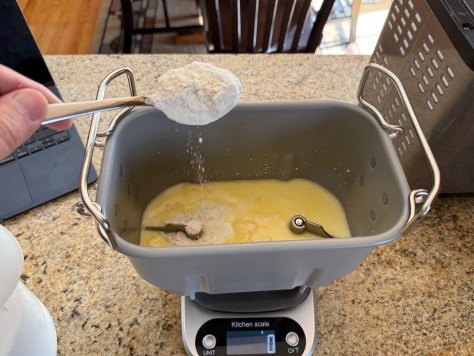
Add 259 grams of warm (not hot) milk to your pan. I heated the milk for around 20 seconds in the microwave and tested it with my finger to make sure it wasn’t too hot.
I then softened 57 grams of butter and added it to the pan. Once again making sure that it was not too hot, as that can kill the yeast.
I added the flour until I had 360 grams of bread flour. Weighing flour is always the best option even if you use volume measurement for your other ingredients. Remember to tare between measurements and the scale will zero out.
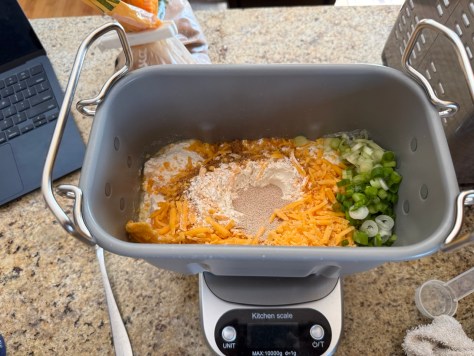
In went the cheese. I’m using a strong cheddar. You want to use a strongly flavored cheese. Weight? 112 grams.
Now, 13 grams of brown sugar.
Then 9 grams of salt. You need to be careful with the salt and it may make more sense to use a measuring spoon (1 and 1/2 teaspoons) as too much salt can really mess up the bread. A spill could have ruined my recipe. I was being brave today and weighed it directly in my pan.
Finally, 4.5 grams of bread machine yeast. I volume measured this out. I’m not sure if my scales are that accurate when weighing small amounts of ingredients. In general, I probably should measure out small ingredients like salt and yeast. Remember, I’m just a dad baking, so I experiment a bit. This time I weighed my salt, but measured my yeast.
Lastly, I added a couple of thinly sliced green onions. I did three stalks. The kneading process will chop the onions up into tiny pieces. I used the basic (white) setting on the bread maker.
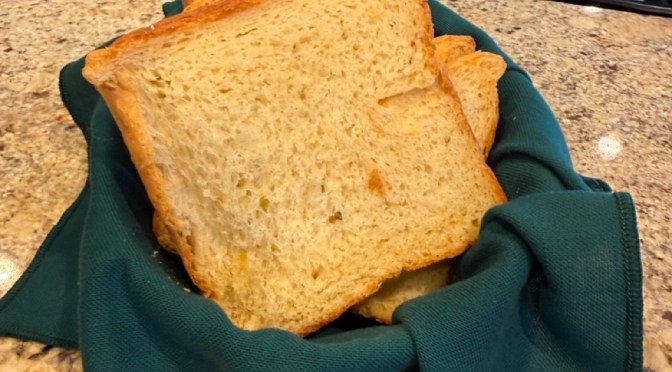
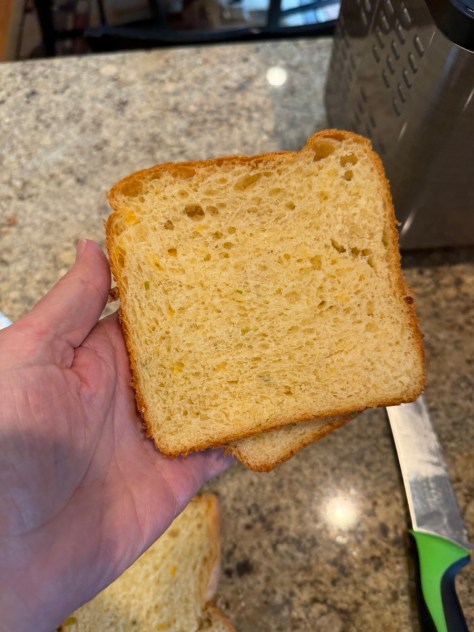
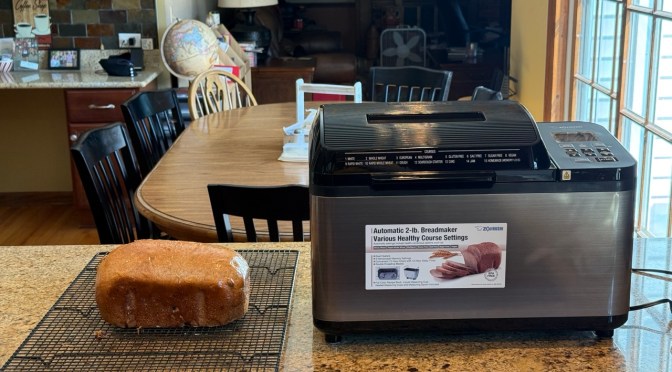
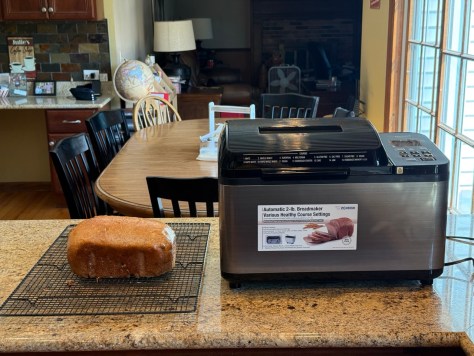
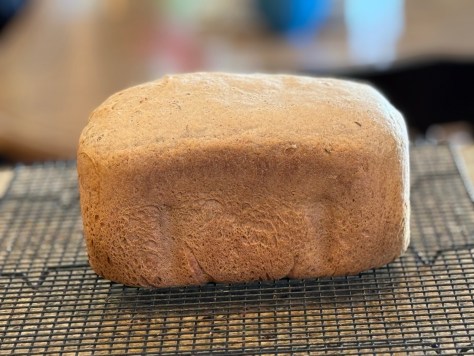
Here is the bread. The golden color is from the cheddar cheese. I think it turned out pretty well.
Ready to be served to accompany our spaghetti dinner. The family approved and said it would be fine to serve to company. Is this the one? Well, it certainly is a contender.
Have you ever heard the term, “Don’t let opportunity kick you in the butt?” A while back an opportunity presented itself to me in the form of a gift. What was the gift? A bone! Now, dear reader, you are probably thinking that I have fallen off my rocker, but I can assure you that I’m sitting steady. Let me explain further.
My sister was hosting a party and had a large ham as the main course. She asked me, “Do you want the ham bone for soup?” “Sure,” I replied. She also threw in a bag of scrap ham meat as my brother-in-law is pescatarian, and she knew that she wouldn’t be using it to make another meal. They went into my freezer.
I decided that yesterday was the day that I would use the ham bone to make a delicious Navy Bean Soup. Inflation and the Trump Tariff Taxes are making grocery prices go through the roof and I’m on a money saving mission.
Bean dishes are cheap and offer so many benefits. They are an excellent source of protein and fiber, contain all sorts of minerals, plus they are good for gut health.
You can buy canned beans inexpensively, and I certainly do that. However, dried beans are a better bargain. This soup uses dried beans that have been soaked overnight. I’ll talk more about that later.
There are as many ways to prepare a bean soup as there are beans in a pot. The recipe that I chose was from a website called “BudgetBites.com.” The website was recommended by my daughter who is trying to save money by cooking her own food. She is a chip off the old block. I have tried a few of the site’s recipes with good results.
Oh, and that ham bone? It went missing from our freezer. Both my wife and I tore the compartment apart, but the bone was not to be found. We did find the ham scraps, so we substituted them with good results. The great thing about home cooking is there are no rules. If the end result tastes good, then all is good.
Let’s get into the recipe!
Here is the recipe. The author is Marsha McDougal.
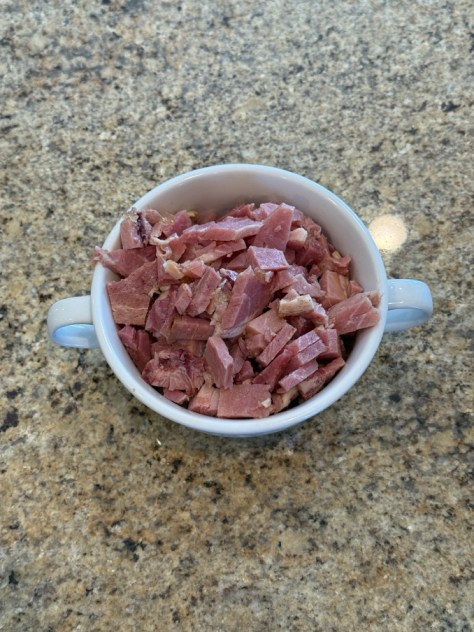
Instead of a ham hock I used the ham scraps that my sister generously gave me.
Here are the spices that we used. In addition to the ones listed in the recipe I added a very small amount of chili pepper flakes and a sad broken bay leaf. Spices can add a lot of depth to a dish. You can buy spices for less if you shop the house brands at Walmart, Aldi, and Dollar Stores. If you know that you are going to use a lot of a particular spice you can buy a large container cheaply at Sam’s Club, Costco, or on Amazon. Ethnic stores and the ethnic aisles in standard grocery stores often have spices for less than at the typical spice section in the store. Lastly, you don’t have to use all of the spices if you choose. You can just use salt and pepper. If I had to add just more more spice to this soup (beyond salt and pepper), it would probably be oregano. A little of this spice adds so much to so many dishes.
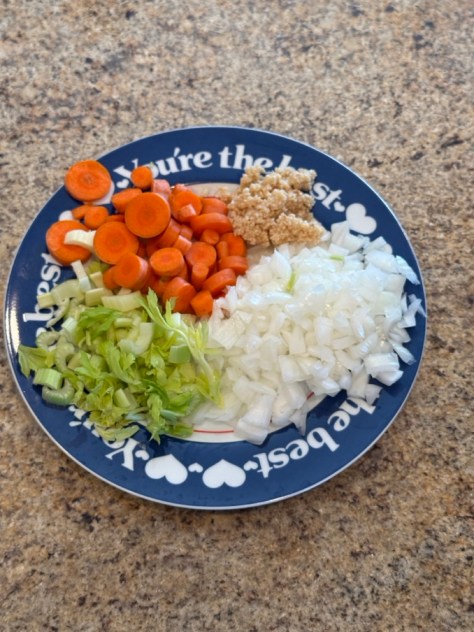
This recipe uses a classic mirepoix (celery, onions, and carrots). We almost always have those vegetables on hand and they store well. Additionally, this plate has some jar garlic. Is jar garlic as good as fresh? No, but it still is good and I always have it on hand.
The recipe calls for chicken broth, but I used Better than Bouillon chicken base. Sadly, this jar was almost empty. Luckily, I had some ham base so I added some of that to make up for the reduced amount of chicken base. It is OK to substitute as long as you don’t go too-far-afield.
I sauteed the ham in a little oil. I wanted it to get a bit crisp to intensify the flavor since I didn’t have a ham bone. I then added the mirepoix and softened the vegetables for a few minutes, stirring the mixture now and then. Finally, I added the garlic and stirred that around for a minute or two. You can see that I’m using a big pot. I like cooking in a Dutch oven, but you can use any large pot that you have. You will also need a lid for the pot.
Here you can see the garlic being added. I’m a bit excessive when it comes to garlic. You don’t have to be.
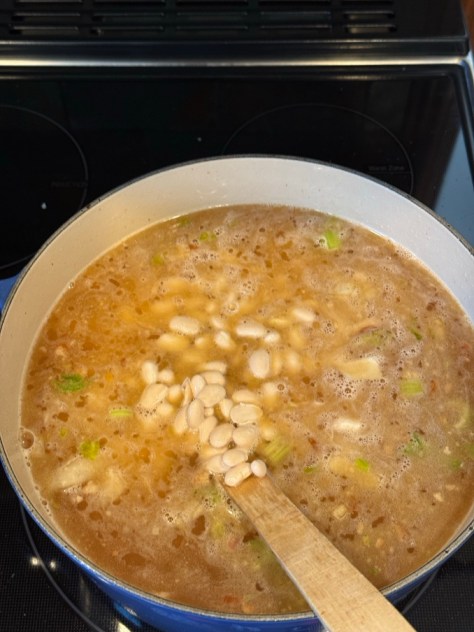
Now 6 cups of chicken broth. I used 6 cups of water and whatever chicken Better than Bouillon that I could scrape out of the jar. I added a spoonful of the ham Better than Bouillon to make up the difference. In went the Navy beans. I had soaked the beans overnight and dumped out that water before adding the beans to the pot. When it comes to dry beans, pick out any damaged beans before soaking. You may find a little rock or two; get rid of those too.
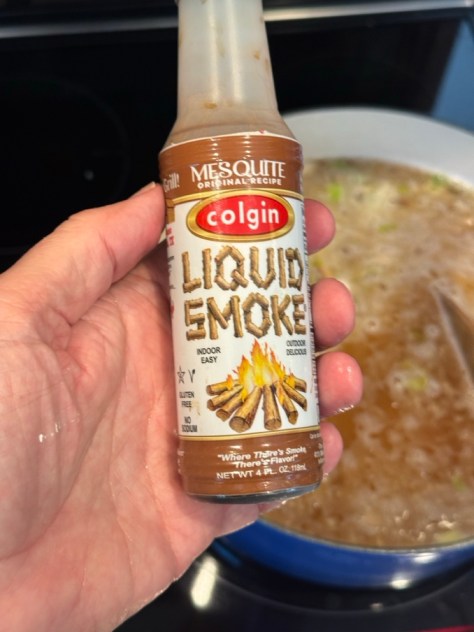
I added a few drops of liquid smoke (totally optional) to add a smoky flavor. Never add too much of this stuff or your food will taste like burnt wood.
In went the spices. Remember, if you don’t have all of them, use what you have. However, these are spices that you can use in so many dishes. If you eventually build up your spice rack, consider these as essentials.
That’s it! So easy. Now bring the pot to a boil and then turn it down to a simmer. Place the pot’s cover. It will take about ninety minutes for the beans to completely cook, so you may want to stir the pot on occasion. I actually left mine cooking for around two and a half hours as I made it early. To thicken the soup I smashed some of the beans using my wooden spoon. When the soup is done adjust the salt level. It is always better to use less salt at the start of a recipe and add what’s needed at the end. This soup didn’t need any extra salt because the ham was salty as was the soup base.
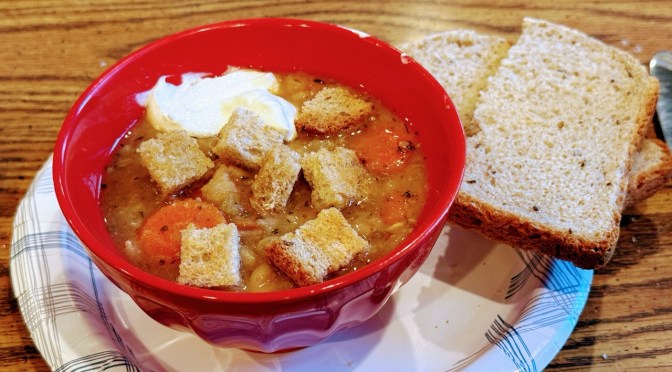
Here it is, all served up. We had some sour cream, so I added a dollop of that plus some croutons that I made earlier. As an accompaniment I served some of my homemade rye bread, but you do you. This was a delicious weekday dinner. You could make it in a slow cooker or an Instant Pot with a little modification of the liquids. Three of us ate our fill and there is plenty left over for lunches or whatever.
You don’t have to eat garbage to save money. This soup was absolutely delicious and tasted so much better than something out of a can.
As I mentioned in previous blogs, three things excite me: I love to learn, I love to create, and I love to teach. That’s my jam.
I enjoy delving beyond the superficial and exploring various topics in depth. Some of my interests are mainstream, while others are not.
As a child, I was fascinated by watching my mom knead yeasted bread dough on the kitchen table. However, kneading dough by hand is not my thing.
One of the few items that I got from my divorce in the 1980s was a large food processor, as my ex was not a cook and didn’t want it. I studied that gadget and prepared many foods using it, including kneading bread dough. When you are a dirt-poor resident physician living on generic food, the prospect of bakery-quality bread is compelling.
My love of machines, along with my love of food, got me interested in bread makers, and I did a deep dive to understand them in the 1990s and early 2000s. I explored many machines in my study, from expensive to bargain, most of which I gave away when my interest waned.
For many years after that, I continued to bake bread, making many loaves at a time, first with a Kitchenaid, and then with a Bosch Universal mixer. Now, my kids are out of the house, and I no longer need such productivity.
For many years I made six loaves at a time of 100% Whole Wheat Bread using my Bosch Universal Mixer.
I’m not a professional chef, and I’m sure that many know a lot more about bread-making than I do. However, I do know more than some, and I would like to offer that knowledge in this post. Remember, this is my opinion; you may have a different one.
About a year ago, I rediscovered my remaining bread makers on a basement shelf and was once again fascinated by these simple gadgets that could do something extraordinary: make delicious bread at the touch of a button. I got hooked again.
I have used many different brands of bread machines. After baking hundreds of loaves in various machines, I’m here to state that all bread makers have the potential to produce an excellent loaf of bread if their instructions are followed precisely. If you don’t believe me, just check out the many YouTube videos showing folks getting great results with every brand under the sun.
If I believe that all bread makers can make a great loaf of bread, why would I ever buy a premium machine, like a Zojirushi? Let me use a car example. Both a Yugo and a Lexus will get you to the same place in the same amount of time. However, the Lexus will get you there in style, and it will likely be more reliable as well.
I thrifted a vintage Japanese-manufactured Regal bread maker for $14. Although not as well-built as my Zojirushi machines, it was still built like a tank. I recently tested an inexpensive and newer Briskind bread maker. It makes a perfectly nice loaf of bread, but it is light as a feather and feels a bit cheap. How long will it last with regular use? You can watch teardown videos for cheaper brands where the low-quality drive belt has shredded or some other part has failed. This usually means that it is time to send the bread maker to a landfill.
This thrifted Regal machine was made in Japan and is built like a tank. It was likely manufactured in the mid-1990s.This recent Briskind model made a decent loaf of bread, but it is light as a feather, and I wonder about the quality of its components.
I have Zojirushi machines from the early 2000s that still work perfectly. Additionally, Zojirushi sells replacement pans and paddles and also has a bread maker repair service. If you have the cash and know that you’re committed to bread machine bread making, it is reasonable to consider a Zojirushi machine.
Currently, Zojirushi offers four models of bread makers. Two of them make 1-pound loaves, and the other two make 2-pound loaves. I’ll only be discussing the 2-pound machines, as those are the ones with which I have experience. Specifically, I’ll be talking about the Zojirushi Supreme and the Zojirushi Virtuoso (Plus).
I did some research before this post to get some others’ answers on the benefits of one model over the other. YouTube comparison videos were primarily based on repeating the manufacturer’s listed feature sets; therefore, they were of no use to me, as they provided zero actual usage information. Contributors on sites like Quora, Reddit, and Amazon Reviews commented when someone asked if they should buy the Supreme or the Virtuoso, stating, “Get the Virtuoso, there is no comparison,” and “Get the Virtuoso, you won’t regret it.” But why? Clearly, those commenters had a Virtuoso and were happy with it. But would they have been just as pleased with a Supreme? Commercial review sites often list the Virtuoso Plus as the number one bread machine, but they don’t examine the two models side by side. I could find only one review that examined both; America’s Test Kitchen preferred the Zojirushi Supreme over the Virtuoso Plus due to its more straightforward user interface.
Please do not use AI to explore the differences or capabilities of any of these machines. I found multiple serious errors in the information provided by AI search engines during my research for this post.
I have owned and tested all four versions of these Zojirushi machines, so I feel that I can offer a fair opinion.
I have used both the X20 (discontinued in 2010) and CEC20 (current model) versions of the Supreme machines, as well as the PAC20 (discontinued in 2018) and PDC20 (current model) versions of the Virtuoso (Plus). All make an excellent loaf of bread.
Zojirushi bread makers have unique features. However, some of these features have drifted down to less expensive bread machines. Innovations tend to do that. Beyond the classic features that all bread makers have, here are a few more unique ones that both the Supreme and the Virtuoso/Virtuoso Plus share:
-Preheat. Zojirushi bread makers will heat up and warm ingredients before they start the kneading cycle. A few other machines that feature this option include models from Panasonic, Breadman, and Brevelle.
-Custom courses (baking programs). These machines have three custom courses, allowing the end-user to program all aspects of a baking program in lieu of using the factory-programmed courses. Most will never need this function, but if you are serious about bread-making or need to adapt a recipe to your bread machine, this option could be invaluable. Several models from other manufacturers can also do this, including some machines from Breadman, Panasonic, Brevelle, Vevor, and others.
-Sourdough starter course. You use the machine to quickly incubate a yeast-based sourdough starter, allowing you to make a sourdough-like bread the same day. I believe that some Cuisinart machines also have this feature.
-Twin kneading paddles. All Zojirushi 2-pound machines feature bread pans with two kneading paddles, which produce a loaf more similar in shape to bakery bread. This makes the machines slightly more mechanically complicated and sometimes leads to an uneven loaf top. However, the loaf shape is a definite aesthetic plus over other bread makers. Several other brands have models that use a similar double paddle system, including Vevor, West Bend, and Saki.
Zojirushi machines omit some of the cycles, like “sweet dough,” that you can find on many other machines. However, their Basic white bread course, combined with their crust color control, does a good job with many types of bread.
In addition to bread-making programs, Zojirushi 2-pound bread makers also have a Jam course and a Cake/Quick Bread course. These programs are also available on many other bread makers.
Other brands may have programs for everything from stir-frying to making rice. Most of us will not use all of these extras, as it is usually better to do these tasks more traditionally.
What is the difference between the X20 Supreme (discontinued) and the CEC20 Supreme (current) models?
The X20 was the earlier version of the CEC20, and for the life of me, I can’t see a difference between the two. They appear identical, offer the same options, and perform similarly in my tests. I’m guessing (and this is a guess) that some internals have been changed.
Should you buy a used X20 instead of a CEC20, as a used X20 will be cheaper? You would have to decide if the cost savings are worth having an older machine. In my limited sample, the X20 remains an excellent performer.
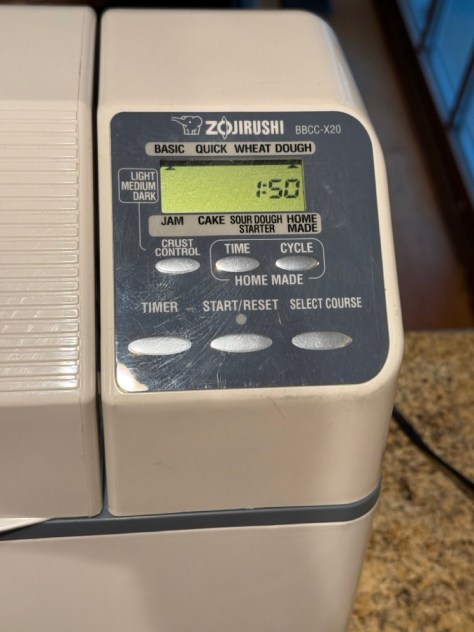
The Zojirushi X20 has a control panel that is identical to the CEC20 and performs similarly to the newer model, in my opinion. Here is the control panel from the CEC20. It is the same as the X20.
What is the difference between the Supreme models and the Virtuoso models?
The Virtuoso bread makers add the following features:
Making a loaf using the Virtuoso Plus.The Virtuoso looks very similar to the Virtuoso Plus, but the user interface is a bit different.
Top Heater
Both the older Virtuoso and the newer Virtuoso Plus have a top heating element to more evenly brown the top of a loaf of bread. All breadmakers must have the ability to brown the tops of their bread adequately, and they all incorporate passive or active systems to achieve this.
In the case of the less expensive Zojirushi Supreme, a passive convection system is utilized, where heat rises from the baking chamber and the outer wall space. It is then vented through the bread maker’s cover.
The dedicated top heating element in the Virtuoso machines does a slightly better top-browning job, but the system used in the Supreme also works well. The top heating element is not a deal breaker, in my opinion.
Gluten Free Course (program)
Kneading bread dough helps gluten form from glutenin and gliadin, yielding a delightful chewy yet tender slice of bread. However, gluten-free bread doesn’t have gluten, so the kneading cycle is really just a mixing cycle when making this type of loaf. Additionally, long multiple rises are not helpful, so this course focuses on the final rise. You could program a Supreme machine to do the same thing, but it is more convenient to have a dedicated button for this purpose. Other bloggers on the internet report that using this cycle gives a better finished product than using the Basic course (white bread) when making gluten-free bread.
Baking Pan With Handles
Both the Supreme and the Virtuoso have top-notch baking pans. They are heavyweight and have an excellent system to mate with the bread maker. However, the Virtuoso Machines took a step further by providing exceptionally high-quality handles on the bread pan. The non-handle pans on the Supreme work fine, but the handles on the Virtuoso are a nice addition.
Real Time Clock
Most breadmakers only provide the time to completion when you select a course (program). For instance, a display may show 3:25 when you choose a white bread (Basic) course. If you start your machine at 10:00 AM, you need to mentally add three hours and twenty-five minutes to determine the finish time (1:25 PM). Honestly, this is no big deal. However, the Virtuoso Machines will give you the actual time of completion. If you start the bread at 10:00 AM, and the bake is three and twenty-five minutes, the completion time will read “1:25 PM” on the display of Virtuoso machines.
Pause On Cover Lifting
Kneading will pause when you lift the cover to “take a peek” on Virtuoso machines. On the Supreme, the kneading keeps on going.
Shape Cycle
The homemade option allows you to create a custom course where you can program the timing of each step of the baking process. Both the Supreme and the Virtuoso machines allow you to do this. However, the Virtuoso adds the ability to add a step called Shape after kneading. This will enable you to remove the dough and reshape it if you wish. I don’t believe that there is a way to replicate this Shape function on the Supreme models.
The Virtuoso Plus offers the following features in addition to the older Virtuoso machine.
The user interface on the Virtuoso Plus is cleaner than that of the older Virtuoso.
Cleaner-looking button interface
The buttons on the Virtuoso Plus have a cleaner look compared to the slightly more cluttered look of the buttons on the Virtuoso.
Multiple New Courses on the Virtuoso Plus
Many less expensive bread makers have long offered a dozen or more programs, catering to a wide range of options, ranging from sweet breads to pasta dough. However, traditional courses like Basic, Whole Wheat, and Dough do everything that most of us need. The one exception is the Gluten-Free course mentioned above, as gluten-free bread is a hybrid between a dough and a batter.
Zojirushi didn’t just copy a bunch of programs from other companies; they tried to be different with “healthy options’ like Vegan Bread course, as well as specialty courses like Multigrain and European Loaf. However, another blogger tested these courses against the standard Basic course and generally found little difference in the breads made with the dedicated courses vs. the Basic one.
It is possible that, under some conditions, a dedicated course may yield a better loaf, but that is unclear. Most of us just want regular bread. Using the standard Basic bread course, I have made a variety of white breads, herb breads, cheese breads, and raisin breads. Using the Whole Wheat course, I have created multiple types of whole wheat bread, 7-grain bread, oatmeal bread, and rye bread. I have made many different doughs using the dough cycle, too. If you are a typical baker, you may not need all those additional courses, and it isn’t clear (except for the Gluten-Free course) that they are significantly better than using the standard courses on the Supreme model. In some ways, all of the extra courses feel more like gimmicks rather than essential additions. But that is just my opinion. Your mileage may vary.
Ending thoughts
Zojirushi machines are pricey, and if you are just testing the bread machine waters, you may be better served by a less expensive brand, either new or thrifted. However, if you are in for the long haul, then the additional quality of a Zojirushi machine may be for you.
I have used all four models, and the one additional Virtuoso/Virtuoso Plus feature that may be useful for some is the Gluten-Free course. If you don’t need that feature, you might consider the Supreme model, which is considerably less expensive and offers most of the abilities of the Virtuoso machines.
In my opinion, I don’t believe that the bread coming out of a Virtuoso machine is significantly better than the bread coming out of a Supreme machine. Let me once again use a car analogy. Let’s say you knew what model of car you wanted, but you had to decide what trim level you were going to buy. You could choose between the base model, which had all of the basics covered, or you could buy the platinum version, with many little refinements that made it just a bit nicer. Some would say, “I will save thousands as the basic car has everything that I need.” Others will say, “I want all of those little extras, and I’m willing to spend the extra cash to get them.” If you are in the first category, get the Supreme. If you are in the latter category, go with the Virtuoso Plus.
Should you consider the used market? I would say yes, but there are risks. Check sites like ebay, and Facebook Marketplace. If you keep searching over time you can find machines for significantly less than others of the same model on the same site. Just make sure that you read the description carefully and that the paddle and kneading blade are included, and in good shape.
All bread makers are devices that make our lives better by allowing us to bake delicious, homemade bread with the touch of a button. I accept their imperfections, like the paddle holes in the bottom of the bread. If you want artisan loaves, then bake by hand. And, yes, I know that you can remove the dough from a machine and hand-form it. I’m just trying to make a point that most of us use bread machines to provide home-made bread for our families, not to enter into contests. Additionally, most just want bread, and decent basic machines accomplish that function well.
How about a slice of warm bread with a little butter and jam?
My grandparents didn’t speak English. Well, I guess they did speak English but they chose to only use their native tongue at home. Sadly, this meant that I knew little about them or their former lives in Eastern Europe.
The one connection to my heritage was through the wonderful foods that my grandmother made.
My grandparents saved and bought a two flat on the west side of Chicago where they raised their family of seven children in a tiny upstairs apartment. Three minuscule bedrooms, a living room, and a kitchen big enough for a large table and a built in china cabinet. There was a old fashioned farmer’s sink, a white refrigerator with a rounded top, and a stove. My early memories were of a stove that possibly used wood or coal, but later on I remember a gas stove that had some sort of a heater built into it. I don’t think their apartment had any sort of central heat, and they relied on space heaters to keep warm in the winter.
My grandmother was a short woman, and to me, appeared to be a bit stout. She was always in motion getting this or that. My grandparents were elderly by the time I was around, and my grandfather spent most of his time in bed. I remember him as a frail man. However, he was quite strong in his younger days.
The kitchen, was the heart of the house. When my parents would visit we would all sit around the kitchen table. Coffee was served along with some sort of homemade strudel, a rolled coffee cake called a kolache, or jam filled cookies called kolachky. I was offered coffee, even at a young age. Mine was usually equal parts coffee and milk with an overdose of sugar. The adults drank theirs black.
I was probably six in this photo, and even then, I would drink coffee when I visited my grandparents.
My grandmother wore her hair pulled back in a bun, and unless she was going out, she wore one of her house dresses that had tiny patterns on them. Some were pink, others yellow, but all in the exact same style. Over her house dress would be some sort of an apron. Hair bun, house dress, and apron, I thought of them as the required uniform for grandmothers.
A birthday party for my grandmother, likely in the late 1940s.My grandparents, circa 1950s?My grandfather is standing, and seated directly below him is my grandmother. By the style of the outfits, I’m guessing the 1920s.
When she would see me she would smile and say, “Good boy,” at which point she would give me a hug. She smelled vaguely of yeast and garlic. It was a pleasant smell.
Many years later I learned that both my grandmother and my grandfather spoke fluent English. In fact, my sister told me that my grandfather didn’t even have an accent. I believe that he wanted the grand kids to learn their native tongue so he never spoke English around us. None of us took the hint.
My parents lived in my grandparent’s downstairs apartment until my oldest sister was nine. She has fond memories of going upstairs and being pampered by our aunts, who were teens at that time. This was during the war years and she recalls sitting on the front porch with my aunts and soldiers who were on leave, “I have a photograph of that somewhere,” she told me.
My aunts had cleaning duties on Saturday and my sister would go upstairs and watch them as they meticulously washed and dusted the entire apartment. When all was done my Aunt Susie would play on the piano “Lilli Marlene, ” “The Parade of the Wooden Soldiers.” and a few other tunes, a recollection that my sister cherishes to this day. Apparently, an unnamed soldier had sent my Aunt Lil the “Lilli Marlene” piano music, since her name will Lillian. I’m guessing that this was from a hopeful but unsuccessful suitor, as she eventually married my Uncle Steve.
My sister remembers my grandmother making bakery every Saturday. She would set up a folding table and place it in the kitchen next to the china cabinet. My grandmother would heap flour on the table and make a crater in the center of the flour mountain. There she would add her liquids, which varied depending if she was making a sweet bread, or her luscious light rye. She did this all from memory; no recipe or measuring cups or spoons were required. She knew how much liquids to add, and when the knead was done by the touch of her hand. I had dozens, possibly hundreds of slices of her rye bread over the years and I never remember a single one being less than perfect.
Here, my Uncle Jim is holding one of my grandmother’s rounds of light rye bread.
I’m 15 years younger than my oldest sister, and my aunts were long married by the time that I came around. However, my grandmother’s habits continued. She was always busy, always making things from scratch. She would still can vegetables from her Victory Garden, grind her own hamburger meat, make her own noodles, and bake her own bakery.
Her bread is my fondest memory of her. I remember that the light rye bread was often dotted with caraway seeds that added their own distinct flavor. She would bake it into a giant round, so large that it had to cut into reasonable chunks before slicing. The bread had a hard crust and a solid, yet soft interior. It was heaven in a slice and was delicious with cold butter, or served up in a ham, hard boiled egg, and horseradish sandwich.
In memory of my grandmother I decided to make a light rye in the bread maker. My goal was to make a bread similar to her’s as a homage, rather than trying to duplicate her recipe. Let’s be honest, there were no bread makers when she was making bread, and if one did exist it is unlikely that she would have used it.
This bread tastes very similar to hers, but the crumb is a bit lighter and more spongy. The crust, however, is dead on. Here is the recipe that I used from the Zojirushi bread maker manual:
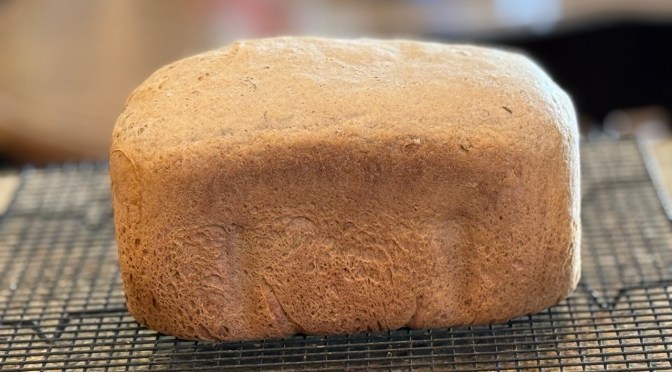
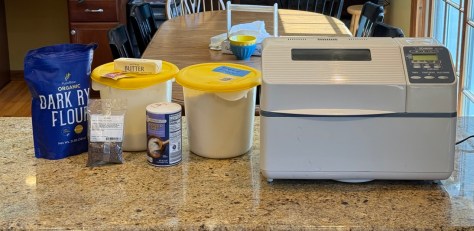
The ingredients are very simple. Use the the Active Dry Yeast amount listed. The Rapid Rise Amount is for when you are using the “Quick Wheat” setting on the bread maker. Since all of the ingredients were listed in grams, I was able to weigh everything, including the water. No mess, and so easy!Here is everything in the bread maker. Remember, liquids on the bottom, then dry ingredients, finally yeast in a little well made in the flour. I set the course to “Basic Wheat” and pressed start. That was it!The finished loaf. Not the beautiful round that my grandma made, but a lot easier!You can see that the crumb is soft and airy. Childhood memories restored!
Most families have their own traditions, as does ours. Their significance may or may not be recognizable to others, but they are still important.
One of our traditions centers around our birthday celebrations. When someone in our family has a birthday they get to choose the dinner menu for their special day. The rest of us work as a team to make that dinner for the celebrant. Our labor is part of the gift that we give them.
Inflation, the Trump tariff taxes, and other factors have made beef prices skyrocket through the roof and now we think twice when considering hamburgers for dinner. Steak has become a rare luxury item in our home, so it is no surprise that it is a frequently requested item for a birthday dinner.
We recently celebrated my daughter’s birthday. This was her chosen menu:
Steak, salad, broccoli, real mashed potatoes, cut up strawberries, yeast rolls and Rainbow cake.
What is Rainbow cake? When my kids were very young my wife had a major operation that left her bed bound for many weeks. I took off time from work to not only take care of her, but also our small children, one who was still in diapers. I wanted things to be as normal as possible for our children, and I came up with activities that we could do ranging from going to the zoo to having picnics at our local park. I did all of the cooking during that time and one day I came up with the idea of making a rainbow cake. I added a magical descriptions about the cake concerning the power of the rainbow, and the cake became a hit. In fact, some of my kids request that I still make Rainbow cake for their birthdays to this very day.
My daughter enjoying a slice of Rainbow cake for her birthday.
All of the above is just background for the reason of this post, which is another writing to encourage you to save money by using a bread maker.
I have done several posts showing how easy and inexpensive it is to make bakery quality bread using a bread maker. Today, I’ll write about using the dough function to make other yeasted products. In this case, dinner rolls.
I don’t think that I have made dinner rolls in over a decade, so don’t expect perfection. The bread maker easily makes a perfect dough, but dinner rolls are still more work than pressing a button as you have to form them, and bake them in the oven.
I found a traditional recipe from an author named “Sally” that looked good, so I went with that. Honestly, they turned out delicious. They were exponentially better than commercial dinner rolls and significantly better than those from the grocery store bakery. Rich, yet light, they had a slightly sweet and eggy flavor and were a dynamite addition to our birthday feast. For me, they were extremely nostalgic, as they reminded me of the wonderful rolls that my mom made so many years ago.
I was too lazy to cost out this recipe, but I know that they these rolls are significantly less expensive than comparable ones purchased from a good bakery. The level of work is a bit more than the “press and forget” bread from a bread maker. But since the machine does all of the heavy lifting, it is a pleasure to make them.
Consider giving this recipe a try, and you will elevate a simple dinner into something special. Let’s take a look at the recipe.
This recipe is for a traditional bake. To convert the recipe for a bread maker remember to add your liquid ingredients first, followed by the dry ingredients and the yeast last.
I measured the milk and added the butter to it. I microwaved the mixture for around 15 seconds until the milk was warm to touch but not hot.
Into the baking pan it went.
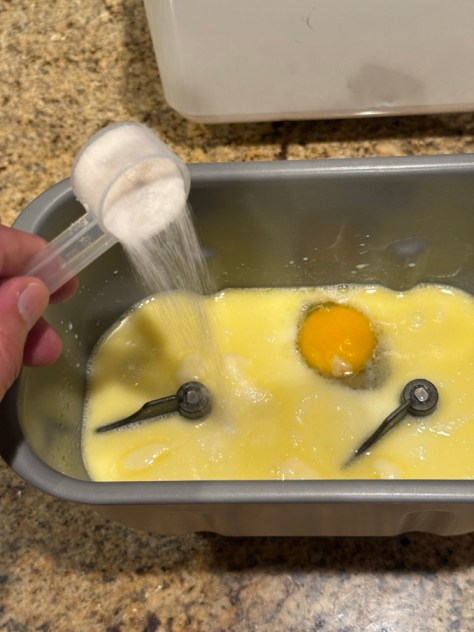
In went an egg and then the salt.
Next, I added the sugar.
I weighed the flour, as that is the most accurate way to measure it.
Lastly, in went the yeast.
I selected the basic dough course and pressed start.
This is an extra step, but do it if you have time. After the dough was kneading for 5-10 minutes I checked it. It was looking a bit slack. There was still dough that wasn’t incorporating into the dough ball. This can happen even with careful measuring for a variety of reasons ranging from humidity, to variations in the brand of flour, to the size of the egg. If I did nothing the dough would probably be OK, but fixing it is easy.
I added about one tablespoon of flour and waited about 30 seconds to see if I needed to add more. That one tablespoon was enough, all was good.
Now the machine was on its own. I would come back when it beeped that it was done making the dough.
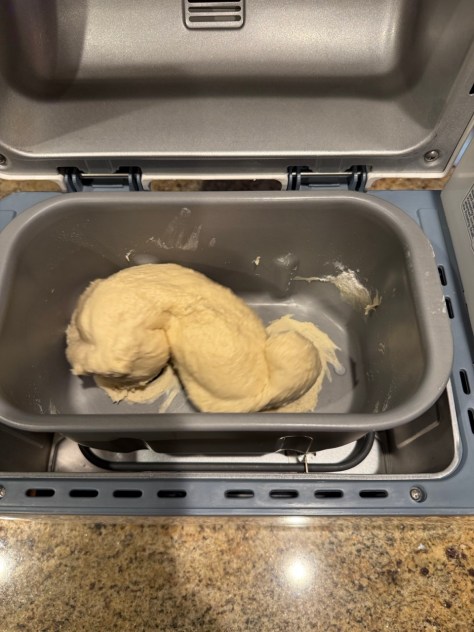
Here is the dough all puffy and beautiful.
I placed the dough on a lightly floured surface and allowed it to rest for around 10 minutes. This makes it more “cooperative” with shaping.
The next step involved a pastry scraper. This is a very inexpensive gadget with many uses. If you don’t have one you can just use a knife.
The dough was divided into 12 pieces. You can use a scale to be precises, but I just eyeballed it.
The edges of each piece was pinched together, and then I rolled the dough in my hand to form a nice ball.
The dough balls were placed in a 9 x 13 pan that I had sprayed with some cooking spray. Yes, not professionally shaped, but good enough. Don’t let perfectionism prevent you from bread making!
I covered the pan and placed it in a draft-free location and allowed the buns to double in size. I think it took between 30-40 minutes (I lost track of time).
I then baked them at 350F (175C) for 20-25 minutes. My oven may vary from yours so keep an eye on your rolls.
The rolls were a hit at dinner. The amount of work was more than making a bread maker loaf, but it was still very easy. The biggest drawback was that I had to be around when the dough was rising and then baking. Neither was a big deal.
One of my favorite things to do is to dive deeply into a topic to gain a broader understanding of it. My fascination may last a day, a week, or sometimes decades. Eventually, I’ll feel that I have learned enough, and I’ll move on to another topic. However, it is not uncommon for me to return to an area of former interest years later, and so it is with bread makers.
I became interested in bread makers sometime in the 1990s, and that interest lasted for quite a few years. I was fascinated that someone had developed a home appliance that could automate the laborious process of bread-making using a simple, consumer-oriented machine. I was intrigued not only by the process of making the bread, but also by the mechanics of the bread makers, as well as how they differed from each other. As a result, I had an extensive collection, most of which I purchased used or on closeout. I also requested and received some premium machines as Christmas and birthday gifts. Over time, I gave away most of the bread makers, but saved a few on a basement shelf where they sat for over a decade, only to be rediscovered about a year ago.
During that interim, I continued to make bread but did so using a high-end mixer, often baking six loaves at a time. Now retired, with most of my kids out of the house, that industrial-level operation is no longer needed, and the single-loaf abilities of a bread machine once again are interesting to me.
I was pleased that my old machines worked, and so I am back on a bread machine baking journey. Along the way, I have had to rely on my old knowledge as well as new skills to optimize my loaves. This post is to share some of that knowledge with you.
Are some brands of machines better than others?
The top 4 high-end brands, in my opinion, are Panasonic, Breadman (now discontinued?), Brevelle, and Zijurushi. I have extensively used all but the Brevelle brand, and I am very familiar with them. I have also used more cost-friendly machines from Oster, Toastmaster, and Regal, among others.
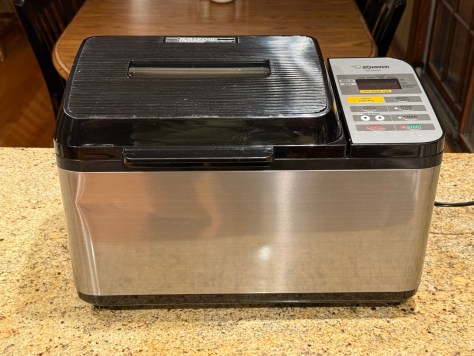
This Zojirushi bread maker is a well loved classic.
The expensive brands are first to innovate features and may offer a better build. I have examined the bread made from both high-end and cost-friendly machines, and the costly machines produce a better loaf, but the difference is minor. However, their overall build quality and innovative features may be enough to sway you to pay a higher price. Note that premium features often migrate to cost-friendly brands over time. For instance, you can now find fruit and nut dispensers, end-user programming, and twin paddle loaf pans on a number of breadmakers in the $100 range.
The bottom line is, if you have a cost-friendly brand, fear not, you can still get it to produce a very nice loaf of bread.
Does the shape of the loaf pan matter?
Early bread machines had a vertical “skyscraper” pan that produced a rectangular loaf with slices similar to sandwich bread or a Pullman loaf. They kneaded the dough well, as the shape of the pan kept the dough in contact with the kneading paddle. These machines yielded bread with uniform slices, but the bread, being square, had more of an industrial look.
This thrifted Regal bread maker cost $14 and is still in excellent condition. It makes a perfectly fine vertical-style loaf. All of the early bread makers had vertical pans, including this Regal machine, and you can still find some newer machines with this style of pan. It makes a squarish slice that cuts nicely, but looks a bit industrial. However, this style of loaf pan possibly does the best job when it comes to kneading and making a loaf with consistently sized slices. However, its bread’s poor aesthetics were likely its downfall in popularity.
Single paddle horizontal loaves were then introduced and are the most popular form factor today. The bread from these machines resembled a traditional loaf, which made it more appealing. However, the loaves were often very tall, necessitating the end-user to cut the bread in half so it could fit in a toaster.
I first saw a twin paddle horizontal loaf pan on a Zojirushi machine. This design produces a loaf that most closely approximates the standard loaf that you would buy at a bakery, as it is both horizontal and the correct height. The downside of this machine is that it creates two holes in the bottom of your bread instead of one due to its twin paddles. Also, it is more likely to make bread with an uneven top (in my opinion).
The twin paddles on this Zojirushi pan allow it to be a bit longer, making its bread resemble a traditional bakery loaf the most.
None of the above problems impacts the deliciousness of the final product. Your choice of pan is strictly a matter of preference.
How many programs do you need on your machine?
Breadmakers have gained an ever-expanding number of programs, some for specialty breads and others that do tasks ranging from making jam to cooking rice. Most specialty bread programs are not significantly different from standard programs and may be unnecessary. Additionally, I have no plans to stir-fry or make jam in my breadmaker. The three essential programs that every machine should have are basic (white bread), whole grain/multi-grain, and dough. Some may want a program for gluten-free bread, if that is the reason they are buying a machine. I have made many different bread types using the standard settings on multiple bread makers with success. Some of the extra programs seem more gimmicky than anything else to me.
You can do all sorts of things using the dough program. Here I made the dough in the bread maker and then formed it into hamburger buns that I baked in the oven.
Additional stuff
Bread makers sometimes have convenience features that you may want. Some Breadman, Panasonic, and other brands feature an automatic seed and fruit bin that drops these ingredients into the bread dough at just the right time. Other bread makers, like many of the Zojirushi units, can be programmed to the user’s baking specifications. Many machines have crust darkness controls, delay timers, warming features, fast bread cycles, and other options that some may find desirable.
My problem
When I returned to bread maker bread making, I had a few clinkers, but most of my loaves were delicious. However, they often seemed much shorter than the ones I saw on YouTube. This led me to dig deeper into the topic once again, and I have come up with some solutions.
But first acceptance!
Realize that a bread made from freshly ground whole wheat will never rise as high as a bread made from commercially milled white bread flour. The same can be said of bread loaded with seeds, cheese, or other weighty additions. Yeast can only do so much heavy lifting. However, it is possible to optimize these breads so that they can be the best that they can be.
Use the right recipe source
Your machine will come with a variety of recipes that have been tested with that machine. Start there, as you are likely to have the greatest success, and you will gain an understanding of how dough performs in your bread maker. I have used recipes submitted by others on the internet with good results, as well as recipes from known sources, like Better Homes and Gardens or a flour or yeast company’s website. Remember, you can download instruction/recipe manuals for many bread makers by searching for them online.
Recent cookbooks (published in 2024 and 2025) on Amazon from unknown sources may be problematic, as some are now created with AI, and the recipes may not have been thoroughly tested. Make sure that you read the book’s reviews carefully when buying a newly published book. Likewise, you may have to do some trial and error, adapting Grandma’s famous bread recipe.
Using a recipe from a bread maker’s cookbook is a great way to start your bread-making journey, as it is designed to be as foolproof as possible. This recipe makes a wonderful light wheat bread. I leave out the basil for general-purpose sandwich and toast making.
About flour
Flour is simply a vegetable product made from milling a vegetable down into a fine powder. Most often, the vegetable is a grain of some sort. There are many different types of flour, with common ones being wheat (of various kinds), buckwheat, and rye. However, flours can be made from other grains, like spelt, and even nuts, like almonds. Each of these flours will have its own unique characteristics.
Wheat flour is often categorized by the amount of gluten that it has. Bread flour contains around 13% gluten, AP flour has around 11% gluten, and cake flour has around 8% gluten. Gluten is what gives bread its remarkable chewy tenderness. This characteristic is excellent for bread; not so good for cake, as no one wants a chewy cake. Hence, less gluten in cake flour.
Some folks have gluten allergies and can’t eat breads made from flours that contain gluten. They eat breads made using more complicated gluten-free recipes, which are a compromise as they don’t have the same bready characteristics as gluten-containing breads.
You can make gluten-free bread using a bread maker’s basic cycle, but because the bread doesn’t contain gluten, it doesn’t require all the kneading that develops the gluten in traditional bread. A gluten-free bread program reduces the kneading times, which may result in a better gluten-free loaf. If you have Celiac disease and are primarily making bread to produce gluten-free bread, you may want a machine with a gluten-free bread program.
The chemistry
Bread making has existed for thousands of years and has been the staff of life and main calorie source for many different cultures. Flour is mixed with water and yeast and kneaded. The kneading process alters several proteins in the bread, specifically glutenin and gliadin which form gluten. This results in an elastic dough and a deliciously chewy and spongy baked bread.
The yeast, being a live organism, utilizes the sugars and starches in the dough and produces carbon dioxide, a harmless gas. This gas causes bubbles in the dough, making the bread rise and expand. Baking the bread kills the yeast, leaving us with a delicious, light loaf of bread.
Other ingredients can be added to the bread to modify it. Salt adds flavor and controls yeast growth, while sugar adds sweetness and helps fuel the yeast. Eggs and milk add richness and can alter the texture of the bread. Butter and oils add richness, flavor, and tenderness. Spices add flavor, and seeds and nuts contribute texture.
If you understand how yeast grows and how ingredients impact yeast, you can solve most of your bread maker problems.
Common bread machine bread issues
-The clinker. In this example, the bread never seemed to rise and is a hard, horrible baked mess. Causes: This is often caused by using bad yeast, forgetting to add yeast, improper mixing, leaving the paddle out of the machine, or insufficient liquid.
-The collapse. In this example, the bread seems to rise rapidly, but then collapses during the baking process. Causes: This is often caused by excessive yeast, or too warm a proofing temperature, overproofing, or dough that is too slack.
-The shorty. In this example, the bread does rise, but not to an expected level. Causes: Insufficient or poor-quality yeast, inadequate liquid in the dough, insufficient proofing time, inadequate gluten development, insufficient kneading time, or unfavorable baking conditions.
This bread was still delicious, but it should have been at least 50% taller.
-The uneven top. In this example, the bread’s top is uneven or bumpy. Causes: This is common in bread machine bread, especially bread from those machines with two paddles. You can smooth out the dough before the final rise, or do what I do, which is nothing. On dual paddle machines, some say that pointing the paddles in the same direction at the start of baking solves this problem, but Zojirushi says it doesn’t make a difference.
-The paddle holes. Causes: The kneading paddles create holes in the bottom of the bread. You can remove the paddles at the start of the last rise to minimize the holes, or do nothing. I do nothing; it is not a big deal.
-The yuck. In this example, something went terribly wrong. The bread is too salty, bland, or otherwise disgusting. Causes: Bad ingredients, spoiled ingredients, or user error.
The good news is that we know that the machine is doing what it does correctly, so the above problems are most likely due to user error or, rarely, environmental issues.
Yeast issues
Yeast is a living microscopic organism. The dried yeast that we buy is a cultivated strain of yeast known to produce a flavorful bread product. Yeast manufacturers carefully grow yeast in a solution and then remove the water by dehydration. The yeast is ground into a fine powder. Dried yeast is still alive, but in a suspended state. Adding water will hydrate the yeast and revive it. Provide a bit of sugar in the water, and the yeast will start to metabolize the sugar and produce carbon dioxide bubbles.
Yeast will eventually die in a suspended state, but you can lengthen the time before its demise by refrigerating the yeast or, better yet, freezing it. You can take it directly out of the freezer and use it in your recipe.
Yeast exists everywhere, and it is floating around the room that you are sitting in right now. Sourdough is bread made from this natural yeast that is allowed to grow in a solution of flour and water. Making sourdough is an art, but the result is a delicious, crusty, slightly sour bread.
You can buy commercial yeast in soft “cakes,” but these are now hard to find. Dried yeast is readily available in packets, jars, and “bricks.” The bricks are substantially less expensive than individual packets. Yeast comes in two forms: Active and Instant. Instant yeast is sometimes rebranded as Rapid-Rise or Bread Maker Yeast.
Bread-making machines will specify which type (Active or Instant) to use. Typically, active yeast must be activated in water before use, but it can be added without activation in a bread maker. Instant Yeast does not have to be activated to be used in baking. The main difference between the two yeasts is that Instant yeast is pulverized into smaller granules.
These two forms of yeast products have become more similar over the years, and some home bread makers directly substitute one for the other. However, others are more strict and use different amounts when switching from one type to the other, and some avoid substituting altogether.
Dead yeast is the most common reason why your bread will not rise properly, and this is easily testable. Add a small amount of yeast to warm (not hot) water that has a pinch of sugar in it. Wait a bit, if your mixture starts to have bubbles, it is good. No bubbles, and the yeast is dead and useless. Yeast within its expiration date can still be bad if stored in a hot place in your home, a store, or in a warehouse.
I buy yeast in bulk as it is significantly less expensive. I store it in the freezer to increase its freshness.
The measurement issue
Another widespread end-user problem when bread-making is measurement error.
In the US, it is common to measure by the volume of ingredients using a measuring cup. This is especially error-prone when measuring flour, which can be packed fluffy or solid in a cup, significantly changing the amount of flour added to a recipe. Additionally, flour can attract water in a humid environment or lose water in a dry climate, which impacts its volume. Add other errors, such as not leveling the cup, and it is easy to understand why this method is less than ideal.
A much better way to measure is by weight, in grams. This is also a more straightforward method, as you can place your baking pan on a digital kitchen scale and then tare the scale, which sets the display at zero. Add the amount of flour in grams for a more accurate measurement.
I now weigh almost all my ingredients, including liquids. Not only is it more accurate, but there is less cleanup. I simply tare the scale and add ingredient one, then tare the scale back to zero and weigh the next ingredient, and so forth.
I have an older scale that can bounce back and forth a few grams, so I still use volume measurements when weighing anything less than 20 grams. Therefore, when measuring my salt and yeast, I still use measuring spoons. For everything else, I use the scale, and it has definitely resulted in better bakes in my bread machine.
You can find many volume-to-weight conversion tables on the internet. Here are some common ones:
Bread flour 1 cup = 120 grams
AP flour 1 cup = 120 grams
Water 1 cup = 227 grams
Milk 1 cup = 227 grams
Butter ½ cup = 113 grams
Sugar 1 cup = 198 grams
Yeast 2 ¼ tsp = 7 grams
Salt 1 T = 8-18 grams, depending on the salt type
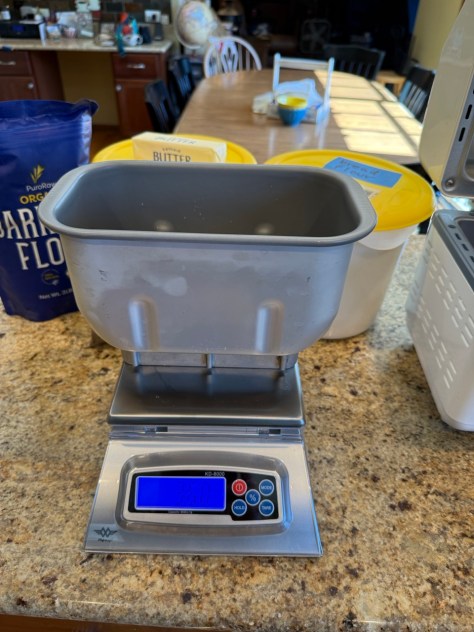
Place your pan on a kitchen scale and press tare, and the scale will zero out. You can then weigh your ingredient. Press tare again for the next ingredient. The weight for this flour was supposed to be 340 grams, and I have 342 grams. Such a small difference will not harm the bread. My scale is old, and I don’t trust it to properly weigh tiny amounts. If the item is less than 20 grams, I use measuring spoons.
Ingredient temperature issues
Only a few bread makers have an ingredient warming feature. Yeast, being a living organism, is sensitive to temperature fluctuations. Too hot, and you kill the yeast. Too cold, and you slow its growth. The ideal temperature range for yeast is between 80° F and 90° F (27° C and 32° C); however, going up to 110 ° F (43 ° C) is typically OK, and some dry yeasts may prefer this slightly warmer environment. If the temperature is too hot for you to put your finger in a liquid, it is too hot for the yeast. Conversely, if you are adding cold milk and butter to your mix, don’t expect the yeast to be happy. Try to have ingredients at room temperature or a bit warmer when making bread.
Environmental issue
If your environment is too hot or too cold, or if your machine is placed next to something too hot or cold, it will impact your rise. This is usually an easy problem to solve using common sense.
An additional measuring issue
You can measure everything correctly and still be off. Many bread machine bakers will check their machine after 5-10 minutes of initial kneading. If the dough ball looks too liquidy, with the dough not completely incorporated into a ball, or too dry, with a ratty-looking ball or a lot of raw flour present, this is the time to fix it. For liquidy dough, add a tablespoon of flour and wait 30 seconds; if the dough doesn’t all form into a ball, repeat until it does. Do the same if the dough is too dry, but add a tablespoon of water in place of the flour every 30 seconds until the ball is smooth and roundish. Once you achieve a smooth ball, you can close the lid and go about your business. The machine will do the rest of the work on its own.
Your dough should look like the above. Add flour slowly in small amounts; if it is too slack, add water in small amounts; if too dry.
If you see a lot of flour stuck to the sides of the pan, you can use a silicone spatula to knock it down into the pan at the same time.
Wrong setting issues
I already stated that most of us only need a few program settings on our machines. However, you still need to use the right setting. Whole wheat bread needs different kneading and rising times compared to white bread. If you try to make whole wheat bread using the “basic” setting, you will likely be disappointed with your results.
Bread flour vs. All Purpose (AP) flour
Bread flour has a bit more gluten, and this will give you a better product and a better rise. Many recipes will ask you to use bread flour for this reason. However, I have often used regular AP flour even when the recipe calls for bread flour. Would my bread have been better with bread flour? Probably, but it was still excellent with AP flour.
Ingredient concerns
We already talked about bad yeast, but it is possible that another ingredient that you are using is not up to standard. This is most common with flour. It is easy to try a different brand or batch of flour if you are concerned about this.
I have a problem with my city water, and I’m guessing that the water treatment chemicals inhibit yeast growth. To compensate, I very slightly increase my yeast and very slightly reduce my salt, which is yeast-inhibiting, in my recipes. If a recipe calls for two teaspoons of yeast and 2.5 teaspoons of salt, I may change that to 2.25 teaspoons of yeast and 2.25 teaspoons of salt. Another option that I could try would be to use distilled or filtered water.
Salt issues
Salt adds flavor, but it also inhibits yeast growth. Because it can inhibit yeast, it is also used to modulate yeast growth. Too little and the yeast will overgrow, too much and the yeast is inhibited or dies. All salts (table, Kosher, sea salt, etc) are the same chemical, sodium chloride. However, the granular sizes of different salts vary significantly. A tablespoon of one type of salt may have more or less actual salt than another. For instance, table salt is finer and therefore more concentrated than Kosher salt. If a recipe calls for one teaspoon of Kosher salt, the conversion is to use around ½ of a teaspoon of table salt. Doing a one-to-one conversion will lead to too much salt, and this could inhibit the bread from rising. Conversely, going in the opposite direction can lead to overproofing and having a loaf collapse.
It is essential to separate the dry salt and yeast when loading your bread maker. I put the salt on one edge of the pan and place the yeast in a little depression in the middle of the pan. If they touch when they start mixing, the strong initial concentration of the salt could kill the yeast. Separating the two dry ingredients prevents that from happening.
To protect the yeast, I place the salt along one edge of the pan and the yeast in a little hole in the middle of the flour.
Order ingredient concerns
Bread makers require that you add ingredients in the order listed. Some of this is because some delayed recipes can sit for hours before baking. You don’t want your yeast bubbling away or your powdered milk going sour. Develop good baking habits and add the ingredients in the order listed.
Adding extras
There are products called dough enhancers designed to improve your bake. These are a combination of ingredients that may contain several ingredients like Vital Wheat Gluten, Vitamin C (Ascorbic Acid), lecithin, yeast nutrients, and diastatic malt. However, you can use these additions separately if you wish. I sometimes add a tiny bit (less than 1/8th of a teaspoon) of ascorbic acid, which helps my rise. Additionally, Vital Wheat Gluten (VWG) added at 1 tablespoon/2 cups AP flour can turn AP flour into bread flour. VWG can also help with the rise of breads made with 100% whole wheat flour. Diastatic malt can aid in rise and texture. Lecithin can assist in the texture and tenderness of the bread. All of these are optional, but one or several may help if you have tried more conservative options and you are still not getting the results that you want.
Adding fruits and nuts
If you add fruits and nuts at the beginning of your baking, the paddle will chop them up too much. Some machines can drop them in at the right time, and others will beep to tell you that it is time to add them. This is usually towards the end of kneading.
If your fruits and nuts are clumping towards the bottom of your finished loaves, toss them in a bit of flour before adding them to your dough. This is especially useful for sticky ingredients like raisins.
Dealing with an uneven top
This can happen with any machine, but the dual paddle ones are more susceptible. Honestly, an uneven top doesn’t bother me a bit. However, if it bothers you, you can smooth the top of the bread at the start of the final rise.
Bread machines are more likely to make a loaf with an uneven top. This doesn’t bother me at all. If it bothers you you can redistribute the dough before the machine’s final rise.
Soggy bread issues
Leaving your bread in the machine after it is baked or immediately sticking hot bread in a plastic wrapper will result in a soggy loaf. It is best to cool it out of the pan on a rack if you want a crisp crust. I often leave it in the pan for 5-10 minutes first, which causes less tearing at the paddle site. If you like a softer crust, wrap the bread in a clean dish towel to cool.
Mold and stale bread issues
I have found 3-week-old store-bought bread at the bottom of our bread basket that was perfectly edible. That is scary. Homemade bread is fresh and natural and doesn’t have preservatives. When stored properly, expect 3-4 days before you need to turn the bread into bread crumbs, French toast, or bread pudding.
The best way to store bread is in a cool, dry place in a container with some ventilation to prevent mold growth. There are many options, including a bread box, a bread bag, or wrapping the bread in a clean kitchen towel. I use a cake cover that has a vent hole on its top. If the bread looks good at the 5-day mark, I may still eat it, but I’ll toast it first to make it more palatable.
I store my bread under a cake dome that his an air hole.
If the bread is thoroughly cooled, you can store it in a plastic bag or Tupperware container; however, this will soften the crust, and your chances of getting moldy bread will increase.
Storing bread in plastic will keep it fresher for longer, but it will also increase the likelihood of mold growth.
Another way to preserve bread is to freeze it or freeze half of it. Thawing on the counter will give you bread nearly as fresh as when it was baked.
Cutting the entire loaf into slices will hasten its demise as you have more surface area to dry out. However, I do that as my family won’t eat it unless it is convenient. It is a compromise that I have to make.
My family won’t use my bread if they have to slice it themselves. Although not ideal, I pre-slice my bread. I use a slicing guide as I tend to cut on a slant. Slicing as needed will keep your bread fresh longer, but “ya gatta do what ya gatta do!”
There you have it – a collection of tips to turn you into bread machine experts.
It amazes me how inexpensive bread is when you make it yourself. Yes, you can buy a loaf of bread for a couple of bucks at the supermarket, but that bread is awful and has almost no substance.
To buy bread that has bread like qualities expect to pay anywhere from $4-$10 a loaf.
You can make homemade bread for a fraction of those costs, and customize it to suite your tastes and needs. However, making bread can be a labor intensive process. You can circumvent the labor by using a bread machine.
I have been rediscovering my bread maker, which is over 20 years old. Additionally, I found another used bread maker at a thrift store for only $14 which works well. As you know, I like to play around with machines.
My bread maker has to be at least 20 years old.
I picked up this bread maker at a second hand store for $14 and it works surprisingly well. It even came with its original guide and recipe book. In fact, today’s recipe is from that book!
The wonderful thing about a bread maker is that you add the ingredients, which takes a few minutes, and press a button. Everything is then done automatically. Imagine having your house filled with the aroma of freshly baked bread. It is quite intoxicating.
I have been experimenting with a lot of different loaves from simple white to pesto bread. I made an excellent 7 grain bread that was considerably less expensive than its store bought counterpart. However, I wondered if I could reduce the cost further by using oatmeal as my multi-grain component. I followed a recipe in the Regal bread maker manual/cookbook and it turned out with great success. The cost of the loaf? Only $1.02!
Here is the recipe:
9-11 ounces water
1.5 teaspoon salt
2 tablespoons honey
1.5 tablespoons butter or margarine
2/3 cup quick oats
3 and 1/4 cups bread or AP flour (I used AP flour)
2 teaspoons active dry yeast
Add ingredients in the order listed and use the white bread or “basic” cycle. This recipe is suitable for a bread maker that can make a 1.5 or 2 pound loaf.
Start with 10 ounces of water. If you want to do things right, check the dough after it has been kneaded for around 5 minutes. If the dough looks ratty and not in a smooth ball add more water, about 1 tablespoon and wait 30 seconds before you add the next tablespoon. Stop when the the dough forms a ball. If the dough looks too wet, add a tablespoon of flour in the same manner that you would add the water. You are looking for a smooth ball similar to the photo below.
Let the bread cool for around 20 minutes before attempting to slice it. A serrated knife makes slicing easy. If the paddle is stuck in the bread carefully remove it using something like a plastic spoon as you don’t want to scratch the non-stick coating on the paddle. I take the pan out of the machine as soon as the bread is done. Then, I usually leave the bread in the pan for 5-10 minutes before trying to remove it. This results in less tearing of the bread at the paddle site.
The bread was really delicious. It is best to slice as you go as homemade bread lacks the preservatives that store-bought breads have. However, my family is more likely to use the bread if it is pre-sliced. I like to store it in a container that protects it while having a bit of air circulation. This keeps it the freshest and minimizes mold. The bread is best on day one and two, and usable as excellent toast on day 3 and possibly 4. After that save remains for croutons, bread pudding, stuffing, bread crumbs, and French toast. Remember, you can always freeze part of the loaf if you can’t consume it all in a couple of days.
I’m keeping mine fresh using a cake dome that has a little air hole in the top. Others use a bread box that has ventilation holes, while others use a bread bag. Plastic bags will keep it the softest the longest, but plastic traps moisture and promotes mold. However, I have stored my bread that way too.
Parents, please read this if you have kids who are in or plan to go to college. It could make the difference between them having a good life vs. a life of despair.
My parents impressed on me the need for a higher education. I remember my mother telling me, “You can lose a fortune, but no one can take away your degree.”
She was singing to the choir; I knew I had limited talents, and I also knew I needed to utilize those skills if I were to have a successful life. I wasn’t athletic, I am too truthful to be a salesperson, and I’m an introvert. The things that interested me were uncommon. However, school came easily for me. I seemed to understand things that others didn’t, and I had a knack for doing well on standardized tests.
Understanding how stuff worked and how seemingly unrelated things connected was as exciting to me as watching the Super Bowl was to someone else. I have always become wholly absorbed in learning the most trivial things and becoming an expert on a topic.
I grew up in an era where science was king and America was at the forefront of science. A time when it was thought that anyone could do anything. When it came time to go to college, my attendance was not in question. However, my resources were. Those resources were limited not only financially but also informationally. I had little understanding of where to go or how to pay for it. My father made that decision easy. “You are going to a community college,” he said. And so it was written. The community college was nearly free in terms of tuition costs. I had been working as a janitor during the summers and had enough money to buy a new 1972 Pinto for $2,700. College plus a car? Life was good.
To be honest, I enjoyed my 2 years at a community college. I made good friends, had a lot of fun, and did well. But what next? I still didn’t understand how the higher education system was wired. I knew that I would need to go to a state school to complete my degree, as tuition was lower. I applied to exactly one school, and to be honest, I’m unclear why I chose that school. I thought it was because my best friend, John, was going there. John now tells me that I was the one to convince him to continue his education. Perhaps it was just fate.
The 1974 tuition for that school was roughly $500/year ($3,270 in today’s money). My parents agreed to cover that, but I was responsible for my personal expenses, from clothing to shampoo. Naturally, I was expected to finish in 2 years, which I did. Just like the community college, I did very well in school. What next?
I was a Biology/Chemistry student, and I knew graduate school was needed to go further. I planned to become a university professor, and the graduate school I had my sights on would pay me to attend and even provide a stipend. I worked hard in grad school and did well, but felt that I was being called in a different direction. I left with a Master’s degree and didn’t pursue the PhD that I had initially intended. I applied and got accepted into medical school, which was roughly $14,000 a year. I actually debated going to that school, as other schools that I considered were in the $10,000/year range. However, I believe that my career as a doctor would allow me to repay a reasonable student loan. It turned out that my school made this burden even easier.
Due to circumstances, parental pressure, and self-luck, I made a lot of good financial decisions when it came to my educational choices. I entered medical school debt-free. I knew that I would have medical school loans, but taking them out was a reasonable decision.
During my decades of psychiatric practice, I have worked with every age range, from teens to seniors. My career has allowed me to gain insight into what teens think, their emotional maturity, and their understanding of the real world. I’m here to report that their knowledge of the real world was not that different from mine at their age. In other words, not very good. Almost all had a feeble concept of finances and how student loans would impact them or their parents.
Universities have steadily increased their tuition, far exceeding inflation and, in fact, surpassing many other costs, including those for housing and health. Part of this was due to the readily available and ever-expanding student loan machine, which eventually included parent PLUS loans. Student loans were originally a government program, but have long become privatized. The government guarantees the loans, and they are unforgivable by bankruptcy.
Colleges and universities saw this windfall, and tuition has reached astronomical proportions. Students are enticed by the promotion of the “college experience,” which often seems marketed more like a vacation than an education. Colleges promote their fancy dorms, deluxe gyms, and football teams more than their libraries.
The US News and World Report became an artificial college rating benchmark, and schools saw ways to manipulate their rankings to allow even higher tuitions for those places deemed highly competitive.
The old dogma that a college degree was necessary to have a good life was not countered by the realities of astronomical tuition prices or the fact that many degrees didn’t justify their high cost in the real world. Yes, if you were wealthy, a degree in Art History might be a fine option, but does it make sense to incur tremendous debt for a potentially low-paying job? That’s assuming that you could find a job in your field of expertise. No one seems to be talking about that reality.
There have always been professions that fluctuate in demand, such as teaching, engineering, healthcare, computer science, and the like. However, many of these graduates are now facing difficulties in finding employment, yet they still have to repay their student loans, which begin six months after graduation.
We have been charmed by colleges that showcase their beautiful campuses, fun parties, and happy student life. The reality is that any college can provide a great experience, or not; it depends on the student. I was treating a college student who was attending the same university that my daughter was going to. That student said that the place was terrible and unfriendly. My daughter had the opposite experience and still sees friends from that school regularly. She thought it was a wonderful place. It is what you do in college that makes it a good experience, not where it is.
You may think that I’m a super-frugal guy. That isn’t the case. However, I was fortunate to be raised in a family of limited means. We delayed our gratification for things we wanted, my mother cooked most meals from scratch, and we repaired things or did without. Life went on, and I knew that happiness wasn’t equated to my latest credit card purchase. Having stuff is excellent as long as it doesn’t become a means to an end or a financial burden.
I live in a nice town, and in a nice house. My kids attended good schools. We go on vacations. I use a credit card. However, I never have a balance on a credit card, and we now consider foods like steak as a special occasion food. Trust me, there are many delicious foods that aren’t $15 a pound! We are not deprived.
However, it would have been easy to have changed my life situation. If I ran up my credit cards, went on trips via loans, or got into BNPL in the past, my current life would be significantly different. Society says we must buy, buy, buy, buy, and experience the exotic. Why is that? It’s not to make you happy, it makes the rich richer and you poorer. More importantly, it leads to tremendous stress. That trinket you bought on Amazon, the one you lost interest in five minutes after receiving it, well, now you have to pay for it.
Our lack of financial knowledge starts early, and opportunities to increase our knowledge are often ignored. One of the greatest failures that can destroy a life is poor college financial decisions. We want our kids to succeed and be happy. We want them to have a good life, but our efforts can sometimes have the opposite effect.
College is not an experience; it is a place to gain a higher education that can be applied to help create a better life and hopefully benefit society. There are many other options that can achieve this. Learning a trade, going to a community college to obtain a certificate, attending a technical school, being self-taught, and so much more.
Now, you may be thinking that I’m saying you shouldn’t go to college. No, not at all. I’m saying that other options may be suitable for some individuals. Options that will cost less and produce a better outcome. So many kids are forced into college only to waste money and never get a degree. Why is that?
My kids were academically gifted, and I knew that they would have merit opportunities when it came to college choices. I began to discuss higher education with them when they were in middle school.
My wife is a professional, but she took 12 years off to raise our kids. That was a mutual decision that we will never regret. However, this meant that I not only had to work harder, but it also meant that our overall income was much less than what it could have been. When she did return to work, she initially did so part-time. I continued to wholly support our family, and every penny that she made for several years went into a college fund for our kids. Although substantial, it was small compared to the potential costs of sending three students to college.
When my kids were approaching college, we did more research. It was clear that they would be going beyond bachelor’s degrees, and we discovered that getting into a good post-graduate school depended more on their grades, test scores, and activities rather than the university that they attended.
Because of their academic excellence, they got into top-tier undergraduate schools; however, any scholarships offered by these schools would only cover a portion of their overall tuition expenses. However, great but less nationally known schools wanted them and were willing to give them free rides, as my kids’ academic credentials would help the schools’ admission statistics (I know, this sounds crazy, but it’s true).
It’s tough for an 18-year-old who could attend a school with bragging rights to decide between that school and another. They lack the mature financial understanding of a seasoned adult, and signing a loan for tuition doesn’t carry the same significance as if they had to withdraw that cash from their savings account. Likewise, high schools want their students to attend the most prestigious colleges, as it enhances the school’s reputation, and colleges are more concerned about collecting tuition rather than loan repayments.
Loan companies make a substantial profit on student loans, some of which have loan terms similar to those of payday loans. I read about one woman who paid $1000 a month for 10 years and actually owed more money than she borrowed after that period. There are many stories of people who are in 100K debt, or much more, with degrees that only offer low-paying jobs.
A line among student loan companies is “forbearance, forbearance, forbearance!” If someone can’t afford to pay back their loan, reduce the installment. Of course, the company makes more money on interest in the process.
My kids graduated from college debt-free and all went on to higher levels of education. However, now they had the tools to make informed decisions. One went on to a professional school which did have a sizeable tuition. She was accepted at multiple schools and chose the one that was the best balance between excellence and affordability. She does owe a considerable amount, but she has already crafted a plan to pay off her debt as quickly as possible. This plan was not made easy by the loan companies. She wanted to set up automatic payments, but they said they could only do this for the minimum amount, and not any other amount. This would mean she would accrue an astronomical amount of interest. She found a way to subvert that plan, but it was not with the lender’s help.
Here are some tips:
-Please look at college like any other investment and discuss this frankly with your pre-college and college-age kids.
-Explore the benefits of a particular degree. A student may want to study medieval languages, but is there a job available for them upon graduation?
-Run the loan numbers with your kids. There are calculators on the internet that can do this for you at the touch of a button.
-Start talking to them early about college and money; add information as they can handle it.
-I never told our kids that they couldn’t go to a particular school. What I did was to show them how much money we could contribute and then examine the financial burden that they would have to bear, depending on the school. For instance, school “A” might cost them 70,000 in student loans even with that school’s scholarship, while school “B” would essentially be free.
-I let them know that I would help them in any rational way that I could, but I would not sign parent PLUS loans, as I was getting close to retirement, and it didn’t make any fiscal sense for me.
In the end, they not only made good college choices, but also good financial choices. But what if they weren’t academically gifted and couldn’t get merit scholarships?
-Does your child have a clear idea of what they want to do with a college degree? If not, other alternatives, such as a gap year, may be a reasonable option.
-Consider a community college that can offer two years of general education classes at a fraction of the cost of a university. They can transfer to a 4-year college afterwards.
-Consider a local college to save on room and board costs.
-Consider the school that offers the best financial aid and quality of education combination rather than the highest-ranked school to which your child was accepted.
-Consider a trade school or certificate program. Many do very well with these options. I know of people in the trades who have a better lifestyle than mine. That is especially true for those who have some business skills and start their own companies.
-Avoid parental narcissism. “My kid has to go to the best school, as it gives me bragging rights!”
-Explore all of the many college scholarships offered. Those small scholarships can add up to big money, and many go unclaimed.
-Does your kid have special talents? I have known several kids who received free rides, including room and board, due to their athletic abilities. I have a friend with a very musically talented son who will certainly receive a scholarship.
-Be practical about a degree. My friend’s musically talented son could make it big, or not. For him, it would be beneficial to also have a degree in music education as a backup.
I could provide you with more options and statistics on the topic, but the movie linked below does a much better job than I could. Please watch it with your college-bound and college-attending students and discuss its content.
I believe that a successfully raised child becomes a kind, empathic adult who can support themselves. Expecting an 18-year-old to make a decision that will result in over $100,000 in debt is not reasonable.
We have a whole generation of recent college graduates who, because of student-loan debt, can’t get married, buy a house, or have kids. Is that what we want for our children?
Please watch this video with you kids and discuss it afterwards. It may save you and your children a lot of future grief!
Peace
Mike
Me graduating from medical school. So young and with hair!
I have now written several post on making bread using a bread maker. I’m a gadget guy who has a couple of bread makers as I like to compare how different machines work. Along these lines my $14 thrifted bread maker works well as does my Zojirushi Virtuoso, which is considered a top of the line machine.
Today, I’ll make some bread in the Zojirushi machine and explore the differences between it and my $14 thrifted bargain.
Here is the recipe that I’m using today.
Remember to add the ingredients in the order listed. I’m using the whole wheat setting on the Zojirushi. The Zojirushi frequently wins top awards for the quality of the bread that it produces. It has a unique twin paddle system that makes a loaf shaped similar to the bread that you would buy at a bakery. It also has a second heating element in the lid to help with browning of the bread. You can create your own bread programs on the Zojirushi. Lastly, it has a pre-warm cycle that heats up all of the ingredients before it starts the kneading process. How important are these features? Let’s make some bread and find out.
I like to weigh my flour to get a more accurate measurement. You can weight all of your ingredients, but many of my recipes are in standard volume measurements and I’m usually too lazy to convert every single ingredient.
To 9 ounces of water I added 1.5 teaspoons of salt.
And 1.5 tablespoons of oil. I’m using olive oil here.
The recipe calls for 2 tablespoons of molasses, but I’m using honey. If you use the same measuring spoon that you used for the oil, the honey will easily slide out.
I thought I would try adding 1/8 teaspoon of ascorbic acid as this can help with rise and has some some mold fighting qualities. This step is completely optional.
Now its time to add the flour, which I did by weight. Half whole wheat and half bread flour, two cups each.
In went the two teaspoons of active dry yeast.
A bread maker is a set it and forget it gadget. However, since I’m using this recipe for the first time I wanted to make sure that the dough looks good. If there was a lot of flour remaining or if the dough ball looked “ratty” I would have added a tablespoon of water and repeat this step until I had a nice smooth ball like the one above. If the dough looked too wet and was not forming a clean ball I would add a tablespoon of flour and repeat after 30 seconds until it looked like the above.
Into the bread maker it went on the whole wheat setting.
The bread turned out well, it was soft with a good crumb.
Here are my conclusions on my $14 thrifted Regal machine versus my top of the line Zojirushi Virtuoso.
-Both can make a decent loaf of bread.
-The $14 thrifted machine has a vertical pan, so when you slice the bread you get a square slice that reminds me of square sandwich bread. The Zojirushi machine makes a long loaf that resembles bakery bread. Its somewhat unique double paddle pan creates a more traditional loaf than most other horizontal pan machines with a single paddle. Those slices can be quite tall. Note, if you cut those tall slices in half they fit just fine in a toaster.
-Both machines bake the bread well, but the Zojirushi has a finer and more even crumb.
-Some say that the double paddles on the Zojirushi kneads a better dough. However, I don’t see much of a difference.
-The top heating element on the Zojirushi does brown the top of the bread a bit better, but not enough to make it an important feature in my opinion. I have also used the Zojirushi Supreme which doesn’t have a top heater and it seems to brown the top of the bread well too.
-The Zojirushi allows you to program three additions “courses” (programs) where you can determine all aspects of the kneading, raising, and baking process. This is pretty cool if you are a baking nerd.
-The Zojirushi machines is much heavier and robust than my thrifted machine. It will likely last longer.
-Usually the paddles followed by the bread pan are the first things that need to be replaced on a bread maker. Zoljirushi will sell you these replacement parts, while most other companies won’t. However, they are quite expensive, close to the cost of a new off-brand bread maker.
-The Zojirushi sometimes makes a lopsided loaf. This doesn’t happen with the thrifted machine as the pan is vertical.
In conclusion: Yes, the Zojirushi Virtuosos makes the best loaf, but my $14 thrifted machine also does a fine job. If you are into making bread machine bread get the Zojirushi. However, it is quite expensive. I picked up mine used for much less than the retail price. If you want to save some money but still want a Zojirushi consider the Zojirushi Supreme which is basically the same machine as the Virtuoso, but without the top heater. Additionally, it has a few less “courses” (programs). However, the only additional program that is worth considering on the Virtuoso is the gluten free program. But you can program one of the memories in the Supreme to do the same thing.
With all of my praise for the Zojirushi I have to say that my thrifted machine makes fine bread and great dough. Unless you are a nerd like me it is hard to justify the additional expense of the Zojirushi machines. However, you do you.
I recently wrote a post encouraging the consideration of home baking using a bread maker. A big part of this effort is to offer people options as they feel ever pushed by inflation and the Trump tariff taxes.
Being raised in a one-income family of seven, I learned ways to stretch a dollar without feeling like I was being punished. With a bit of ingenuity, it is possible to have a good life without spending a lot of money. What could be a better mood lifter than homemade bread, pizza, and rolls?
If you have read my other posts, you know I love machines, especially kitchen gadgets. OK, I love power tools too. My rediscovered bread makers were high-end in their time, and I am accustomed to high bread standards. At the same time, it makes little sense to encourage potentially struggling readers to drop hundreds of dollars on a bread machine to “save money.” That is why it was interesting for me to see all of the used machines on the market for less than the cost of breakfast for two at a dive restaurant.
Taking a few precautionary steps can help you obtain a decent machine for next to nothing. I wanted to prove this to myself using my own hard-earned cash. I stopped by a local second-hand store and spied a Regal bread maker, likely from the 1990s. I checked it out in the store and decided that it was worth my $14. Today I’ll walk you through the process so you can also make an informed decision if you decide to take the used bread maker plunge.
First, do a visual inspection. Normal wear and tear is OK, but avoid machines that look dented or abused. This Regal machine was dusty, but it cleaned up nicely with a little TLC. The bread maker came with its original box and recipe guide, another plus! This suggests that the former owner treated the machine with care.
Check out the inside. Make sure that the machine has both its bread pan and its kneading paddle. Make sure that the bread pan can lock in place. This model’s pan had to be twisted in. Remove the bread pan and examine the baking chamber. Crumbs are normal, but avoid machines where the interior looks burnt or smells burnt. This machine was pretty clean.
This machine was made in Japan, so it is likely a quality build.
Check to see if the machine does what you need it to do. You mostly need a standard white bread program, a whole wheat program, and a dough program. This unit has a few other options too. I was able to plug in the machine at the store and test the display and buttons. Everything seemed to work.
Examine the unit for any hidden damage. In this machine the plastic pins that held the cover in place were broken. However, this did not impact the functioning of the machine.
Bread pans are expensive to replace and it is likely that an old model like this one wouldn’t have replacement parts anyway. Make sure that the non-stick coating on the pan looks good and that the paddle rotates freely.
I decided to make a small loaf just to see if the machine worked. The loaf baked properly, but it was a bit smaller than expected. However, that can be corrected with a little ingredient tweaking.
The texture was not quite as good as my expensive bread makers, but the crust was good, the bread was fully cooked, and it was delicious. This bread maker makes the older style vertical loaf, but that works if you cut the bread perpendicular to the pan (as above). It makes up to a 2 pound loaf, which is another plus at this price.
All in all, an amazing value for $14. This small purchase opens up a world of fantastic homemade breads of all types as well as dough perfect for rolls, pizza, and baguettes. It also features a few extra cycles for foods like quick breads, and sweet breads. A great purchase!
Check out your local thrift store or Facebook Marketplace to find your bread maker today! You could get stuck with a broken machine, but at this price… well, you have to sometimes take a few risks in life.