As parents, our job is to parent, and one of those jobs is to teach our kids life skills. When my wife returned to the paid workfoce I resumed the task of making meals. However, I didn’t do it solo; I involved my kids, and meal-making time became a fun and educational experience in Kunaland. Teaching your kids how to cook is vital, especially amid today’s inflation and the Trump tariff taxes. Yes, buying groceries has become ridiculously expensive, but going out to eat is even more costly.
I like making simple meals on weekdays. I’m a competent cook, but I’m not a hobby chef. Casseroles and hot dishes are perfect as they are often one-pot meals with plenty of leftovers. This recipe makes a 9 x 13 casserole, but it could be halved. It fed three of us for dinner. My son will take a large leftover portion for his school lunch, and there will be a couple of extra portions beyond that.
I was going to make a more upscale tuna noodle casserole, which I may do in a future post. However, I decided on this one as it is as easy as “dump and go.” It is a perfect recipe to teach your kids very basic cooking skills. No kids, or are they already grown? Tuna noodle casserole is still a perfect comfort food. There are many variations on this recipe, so don’t fret if you need to substitute or even omit an ingredient. A person who will remain nameless in my house hates peas. I love peas, but out of deference to her, I substituted a can of corn. Ops, did I just reveal the pea hater?
This recipe is from “All Recipes.” There are many variations on this theme.
Cook the noodles according to the instructions on the package.
These are the other ingredients. I drained the vegetables and tuna. Not shown is the onion. I didn’t have an onion, so I chopped up a small shallot. I’m using canned corn, but peas would be better. Don’t forget, I have a pea hater.
Put all of the ingredients in a big bowl. If you have kids, they will love dumping everything into the bowl and mixing it up. If you like a creamier casserole, add about 1/2 C of milk. I’m only adding 1/2 of the cheese and reserving the rest for the topping. Preheat your oven to 350°F (175 °C).
Add the cooked and drained noodles and mix.
Place it evenly in a 9 x 13 pan. I sprayed some cooking spray on the dish to make clean-up a bit easier, but that isn’t totally necessary.
Top with crushed potato chips. You could use other toppings such as bread crumbs/melted butter or crackers/melted butter. Don’t have any of that? You could also forgo the topping, but it does add something.
Top with half of the cheese. You could also add all of the cheese to the casserole mix and forgo the cheese topping.
Bake at 350°F (175°C) for 15-20 minutes. Let it stand for around 10 minutes before serving.
I also made a small loaf of my bran and flaxseed bread in my bread maker to go along with the casserole.
Served up. A simple meal, but very comforting on a wintery day. Yes, I know… I like my butter.
I love Panera’s squash soup, and I always feel a bit sad when the season is over and the soup is retired for the year. However, it is one of the easiest soups to make if you have an Instant Pot, and it is entirely adaptable to cooking on the stove or even in a slow cooker. You will need to add more time for the vegetables to soften completely if you try one of these alternative methods.
This recipe makes quite a bit of soup, and it is inexpensive. However, with inflation and the Trump tariff taxes, some may have to economize further. This very flexible recipe can be modified in a variety of ways to fit your tastes and your budget.
I made some homemade French bread to serve with the soup, but a store-bought French, Italian, or sourdough bread would also be nice.
Check out the recipe, this one is from thedizzycook.com. However, you can find over a dozen other variations on this soup theme. Here is the recipe.
Using a potato peeler, peel the waxed skin off a couple of medium-sized butternut squash until you reach the bright orange meat.
Using a sharp knife, trim off the squash’s bottom and top. Cut the squash in half. Use a tablespoon to remove the seeds and membranes, then discard them. I’m sure there’s a way to bake the seeds, like pumpkin seeds, but the yield would be too small to bother with.
Cut up the shallots and the peeled carrots into large chunks. I have shallots, but you could use an onion if that is what you have on hand.
Sauté the shallots in a bit of cooking oil until they are translucent, then add the carrots and squash to the Instant Pot (or other pressure cooker).
Add the various spices. I’m using “tube ginger” for convenience. Instead of honey, I added around one tablespoon of brown sugar. For fun, I added a shake of nutmeg and cinnamon. It is OK to substitute and be creative as long as you don’t go too far afield.
I added the apple juice. We don’t drink much juice, so this little 8-ounce “lunch box” apple juice worked out well.
I added the broth, but used chicken instead of vegetable broth. Why? Because that is what I had on hand. Pro tip: I have a big jar of “Better than Bouillon” that I typically use when I need broth (mix with warm water). It takes up little space and keeps well in the fridge. It is less expensive than those boxes of broth, and I always have it on hand. It will add some salt to the recipe, so go light on adding salt and adjust it when the dish is done.
I pressure-cooked on high for 15 minutes, then let the soup rest for 15 minutes more. I released the pressure and tested the vegetables to make sure that they were super tender.
I pulled out my 35-year-old Vitamix to blend the soup. You could use any blender or even a stick blender. I had to blend it in batches. I also added a couple of ounces of cream cheese I found in the fridge, along with about 1/4 cup of half-and-half. These added richness to the soup, though optional. I returned the blended soup to the Instant Pot and adjusted the seasonings. In my case, I added about one tablespoon more of brown sugar because the Panera soup is on the sweet side. However, adjust the soup to your preference.
Here it is, all creamy and delicious, served with homemade French bread. The bread was as easy as adding a few ingredients to a bread machine, pressing a button or two, and walking away. By the way, I added some nuts and a drizzle of half-and-half just for the presentation.
Squash soup is perfect on a cold day. This recipe makes quite a bit and can be frozen if needed. It was delicious!
Another in my series to battle grocery inflation and the Trump tariff taxes. Live your best life!
The combination of inflation, ‘shrinkflation,’ and the Trump tariff taxes is increasing food budgets to out-of-control proportions for many U.S. citizens. Generations have been raised on convenient, ultra-processed foods that are tasty, easy to prepare, and inexpensive. However, they are not only unhealthy, but they have also been steadily increasing in price. Food costs are now so high that individuals and families are struggling to afford enough for their weekly meals.
I was raised in the 1960s in a family of 7 with one parent who worked outside of the home. We always ate well because my parents practiced skills that they learned during the Great Depression. Convenience foods were available, but not to the same extent as they are today. It was common to eat at home and prepare food from scratch.
I found myself in an unusual situation, as I was retired yet still had children living with me. Feeding them nutritious food was important, and I also wanted to teach them some of the money-saving skills that I learned as a child.
Cooking basic foods from scratch is a critical skill to have to survive inflation and the Trump tariff taxes. It still “hurts” to go grocery shopping, but I know that there will be food on the table. Currently, my one son is in grad school and at home, but my other kids frequently visit, and I’m always happy to feed them a meal.
In today’s post, I share a recipe for lentil soup with sausage. This recipe is very flexible and can be made with a variety of sausages, including cut-up hot dogs. Additionally, it can be made as a vegetarian dish by omitting the meat and using a vegetable broth. It relies on lentils, which are very inexpensive, and whatever sausage you have on hand. Unlike beans, lentils don’t require soaking, and they easily cook in this soup in under an hour.
I made this soup yesterday, and three of us ate to our fill. There is a lot of soup left for lunches, and I’m certain I’ll have to freeze some in vacuum bags for future meals. This recipe makes quite a bit.
Lentils come in a variety of colors and varieties. Although they have slightly different characteristics, they are all high in carbohydrates, protein, and fiber. They are also excellent sources of some vitamins and minerals and are low in fat.
You can buy lentils in cooked in cans, but they are the most inexpensive when purchased dry. All grocery stores sell lentils, and you can find them in the same area where dried beans are kept. A pound of dry lentils yields approximately 2.5 cups. Many recipes use one to one and a half cups of lentils, and you can buy a pound of them for around $1.50, even less if you have access to a bulk store.
One pound of dry lentils for only $155? That is a bargain!
Lentils are grown in the US, with Montana being the largest producer. Inflation has impacted costs, but the Trump tariff taxes will have a less significant impact on their price. Unfortunately, the U.S. exports a lot of lentils and that will be impacted by retaliatory tariffs from other countries. This may negatively impact independent farmers.
I make this soup in a heavy pot called a Dutch Oven. My Dutch oven is pricey, but you can find inexpensive ones online and at places like HomeGoods. Inexpensive Dutch ovens may have less durable enamel, but they will perform just as well as the high-priced versions. Don’t have a Dutch oven? Use a large pot with a lid. Like many soup recipes, this recipe can also be made in an Instant Pot or slow cooker. If you go those routes, you may need to adjust liquid levels, and you will need to adjust cooking times. Simply Google for a recipe, for instance, “Lentil soup recipe for an Instant Pot” to get an idea of the changes you need to make. Of course, you can use your found recipe, but I know this one tastes great, even if you modify it somewhat.
Sausage Lentil Soup
-Cooking oil
-1 pound sausage. You can use more or less. If you are using a smoked sausage, such as Polish sausage, you can slice it and add it directly to the soup. However, I like to brown it as it adds to the flavor. If you are using fresh sausage, such as Italian sausage, you need to brown it first. Use whatever sausage you like. I have made this soup with hot dog slices that I browned, and it was delicious. Also, don’t get hung up on the amount of sausage. I had a package of Polish sausage in the fridge that was 13 ounces, and it was enough.
Use whatever sausage you have on hand. This package was only 13 ounces, but it was still enough to make a delicious soup.
-1 onion, any type, diced. I had some red onion, so that is what I used.
-2 to 3 stalks of celery sliced. A great way to use up limp celery. Don’t have any fresh? Use dehydrated.
-3-4 carrots diced.
-jar garlic, heaping spoonful. Of course, you can use a couple of cloves of fresh garlic or even some powdered garlic. This is home cooking after all.
-heaping spoon of tomato paste. Don’t have it? Omit it.
-1 tablespoon of Italian seasoning. You can also use Oregano, but cut down the amount to a teaspoon.
-½ teaspoon of fennel seed. You can omit this, but it really adds to the soup.
-1 or 2 bay leaves. You can omit these, but they add a subtle “something.”
-¼ teaspoon red pepper flakes. You can omit this, but it really adds to the soup. If you like foods to be “hot,” you can up the flakes to around ½ teaspoon or a bit more.
-1/2 teaspoon of black pepper.
-1 teaspoon salt to start. Adjust this seasoning at the end of cooking. Remember, you can always add salt, but you can’t remove it. If you are using chicken bouillon, start with even less salt, as bouillon is salty.
-28 oz can of tomatoes. If using whole, break them up.
-5 cups chicken stock. I only had four cups, and so I added a cup of water; all was good. You can use vegetable stock, chicken bouillon/water (reduced your salt content), or even water alone if that is what you have. Stock does add complexity and flavor.
-1 and ½ cup dry lentils that you rinse in water (using a sieve or colander).
-Some greens like spinach, kale, or even salad greens (optional).
Dice carrots and onion, and slice celery. Slice the sausage of your choice. If using a fresh sausage, remove the skin and brown it. Browning a smoked sausage is optional, but I think it adds flavor. Soften onions in a little oil. Then add carrots and celery. Continue to cook for a few more minutes or until they slightly soften.Add garlic and spices and briefly cook, being careful not to burn either.Add the tomatoes. I also had an overripe tomato that I chopped up and added. No sense in wasting it just because it was no longer sandwich-worthy. Mix it all together.Add the broth (or water) and the sausage meat. I brown the Polish sausage for more flavor, but it is not required if the sausage is already cooked. You will need to brown fresh sausages, like Italian sausage. Add the rinsed lentils to the soup.Bring the mixture to a boil and then reduce the heat to a simmer. Cover and cook for around an hour. You can simmer much longer than that if you wish. If you like a thick soup, you can remove 1/3 of the soup (minus the meat), blend it in a blender, and return it to the pot. I thought my soup was thick enough without blending. I added some greens at the very end of cooking to add some color. Stir them in and they will wilt in a minute or two.Ready to serve.Plated and served with some oyster crackers and homemade bread. Delicious! You can add a drizzle of olive oil to the top of your bowl for extra luxury.
Soup is a great way to stretch your budget and there are many different soups so you will never tire of it. You can be very flexible when making soups and still get a good result. The more times you make any soup the more comfortable you will become in adjusting and substituting. Plus, soup is really easy to make. Once in a pot, it does its own thing and there is no problem cooking it for a long time as that often enhances its flavor.
If you have been following my posts, you know that I have been on a mission to help people cope with inflation and the Trump tariff taxes. I have been writing about everything from making your own bread to saving on cleaning projects.
One of the expenses we all have to deal with is food. It is clear to just about everyone that eating out regularly is an avoidable expense, and that goes for fast food, too. But what to do if you feel insecure about cooking?
I have been posting inexpensive and straightforward recipes to demonstrate how easy it is to make food from scratch. This post does the same; it is one of the easiest recipes you can make, yet it looks like you spent hours preparing a fancy Sunday dinner. Come with me on this recipe journey! Today we are making roasted chicken with vegetables.
A friend of mine just told me that the $100 beef tenderloin that I usually buy for Christmas dinner is now $190! I had to catch my breath. At this time, chicken is still reasonable, with whole chicken selling for $1.46 a pound. Yes, you are paying for some bones, but that chicken carcass can become another meal by turning it into soup!
If you are starting your cooking journey, this is a good place to start, as preparation is straightforward, and it is a “set it and forget it” dinner that looks impressive.
One item that you may want to consider for many cooking tasks is a food thermometer. I have had mine for many years and I think it was under $15. This one is selling for less than $6 and it is an Amazon choice item. If you don’t want to buy on-line you can find food thermometers at any hardware or big box store. They take the guesswork out of cooking, and are a very worthwhile investment.
Today’s recipe will be roasted chicken with vegetables. Let’s start with the vegetables.
Chop up an onion and add it to a pot. I’m using a Dutch oven, which is ideal, but you could use any big oven-safe pot with a cover. If you don’t have one, you could use a baking dish with some aluminum foil to cover it.
Add to the pot some cut-up carrots and small potatoes. You could also use regular-sized potatoes that you cut up. These potatoes were thin-skinned, so I didn’t bother to peel them. Wash your vegetables in water first. Peel the potatoes if they are thick-skinned.
Add some cooking oil. I’m using avocado oil, but you can use any cooking oil that you have on hand. I used a couple of tablespoons of oil.
Sprinkled on some spices. Around one teaspoon of rosemary, a sprinkle of salt and pepper, and a big sprinkle of garlic powder. I mixed it all up so all of the vegetables were covered. If you only have salt and pepper, that’s OK too.
Now it was time for the chicken. You can use just about any spices that you like. Smear some cooking oil on the chicken and sprinkle salt and pepper on it (inside and outside). I added some smoked paprika and garlic powder, but there are many other options, including oregano or Italian seasoning. Here again, if you have only salt and pepper, that’s fine. However, some spices will definitely add some interest to the chicken.
Cover and place in a 375°F (190 °C) oven for 45 minutes.
Then uncover to brown, and continue to cook for 30-40 minutes or until the internal temperature is 165°F (75 °C). It is normal to go a bit over 165°F; that’s OK.
Remove the chicken and, after letting it stand for around 10 minutes, carve it. Carving isn’t hard, and it doesn’t have to be perfect. I hold the chicken down with a fork and use an 8″ Chef’s knife. You can use whatever you have.
Using a slotted spoon, remove the roasted vegetables. By the way, check to make sure that they are done by piercing some of them with a fork. If the fork enters easily, the vegetables are done. If they are still hard, continue to cook them, checking every 5 minutes until done.
Here is the complete meal. I added some steamed broccoli for color, and I’m also having a little of my homemade oatmeal bread. Delicious!
This was a nearly effortless dinner. Yet, it looked and tasted like I spent the hours making it. The leftover chicken carcass will be used to create a chicken soup in a day or two. I’ll even toss in the leftover carrots and potatoes (I’ll cut them up) into the soup. Why waste them, as they will add great flavor to the soup?
Consider making a roasted chicken. If you are cooking for one, you will have several dinners, chicken for sandwiches, and soup to boot. If you are cooking for a family, they will be impressed with your efforts.
Inflation and the Trump tariff taxes have impacted many areas, but price increases have been felt the most at the grocery store. Add to this beef shortages, and the cost of beef has gone through the roof.
Above, we have a “nothing special” pound of ground beef going for $9 a pound!
I have done posts on how to stretch your meat dollar. One way to to make a classic meat loaf which uses fillers like bread crumbs or oatmeal to bulk out a small amount of ground beef to proportions enough to feed a family. This is a useful strategy, but what is you could go a step further? What if you could find a very inexpensive substitute to replace 50% of your ground beef in a recipe? What if that replacement was healthy, high in protein and minerals, and offered fiber for gut health? That is today’s experiment.
TVP or textured vegetable protein was developed in the 1960s as a way to use up waste material from soybean oil production. After the oil was squeezed out of a soybean the solid matter that was left over was dehulled and turned into soybean flour. That flour was then treated to separate the protein which was heated and extruded through a mold. The extrusion process can be adjusted to make differed shapes, such as crumbles, strips, and chunks.
TVP can be made from various plants, but it is most commonly derived from soybeans. Soybean TVP is low in fats, high in complete proteins, and high in multiple minerals, including iron, magnesium, phosphorus, and potassium. Despite what you have heard, there is no need to worry about soy-based estrogens, as they are different from human estrogens.
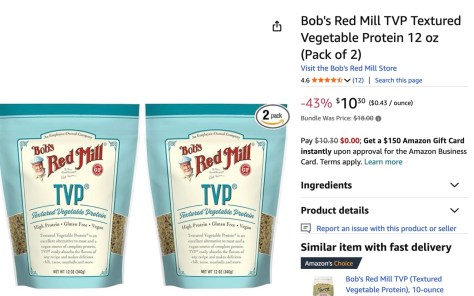
The cost of TVP is significantly less than that of ground beef. If you buy small amounts from a boutique health store, it will be more expensive than if you buy it in bulk. Shopping on Amazon, I found drastically different prices for TVP, which is interesting, as there isn’t a lot of difference between brands, as this is a very basic food product.
I find that 1 cup (100 grams) of dry TVP, when hydrated, is about the same bulk as 1 pound of ground beef. One pound is around 450 grams, so one pound of dry TVP makes (roughly) the equivalent of 4.5 pounds of hamburger.
This Bob’s Red Mill TVP sells for $6.88 a pound, so 1 pound of hamburger equivalent (using 100 grams of dry TVP) costs around $1.52.
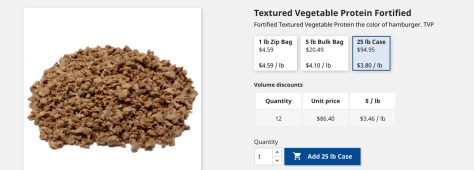
If you shop around, you can buy TVP in bulk. On this site, TVP is $3.80 a pound. For 100 grams of TVP (1 pound hamburger equivalent), the cost is 84 cents.
Looking for an even better bargain? This bulk bag of TVP is 50 pounds. One hundred grams of dry TVP (1 pound hamburger equivalent) costs only 37 cents! It is unlikely that you will buy 50 pounds of TVP, but it does have an extremely long shelf life. Additionally, you could buy a bag and split it in a group purchase.
TVP has essentially no flavor, and like its cousin, tofu, it picks up whatever flavor is in the dish. TVP is usually soaked in boiling water for around 10 minutes before using. I use a 1:1 ratio of TVP to water and find that adding two teaspoons of a bouillon like “Better Than Bouillon” to I cup of boiling water gives TVP a meaty taste. Vegetarians and vegans have created a variety of “soaks” for TVP that are meatless, yet add a meaty flavor. Since TVP comes in a variety of shapes it is possible to create all sorts of meat-like dishes using this ingredient.
You have probably eaten TVP many times, as it is often used as a meat extender in many frozen meals. The ingredient list on the package may say TVP, or textured vegetable protein, or TSP, or textured soy protein, or soy protein isolate, or soy chunks, or soy meat, as well as other terms. All of these names are synonyms for TVP.
TVP granules are readily available and can be found in many grocery stores. Chunks and strips can sometimes be found in health food stores and are available at online retailers.
TVP is best when combined with flavorful ingredients. Although it can stand alone as a “meat,” I find that it is easiest to use it as a substitute for 25-50% of the hamburger. In today’s example, I’ll be using it in a classic meatloaf recipe.
Let’s look at the easy process of substituting TVP for 50% of the hamburger in this meatloaf. recipe
Here you can see that 100 grams of TVP is the equivalent of one cup. As I mentioned above, I find that 1 cup of dry TVP, when hydrated, is approximately equivalent to 1 pound of hamburger.
I measured 1 cup (100 grams) of dry TVP into a bowl.
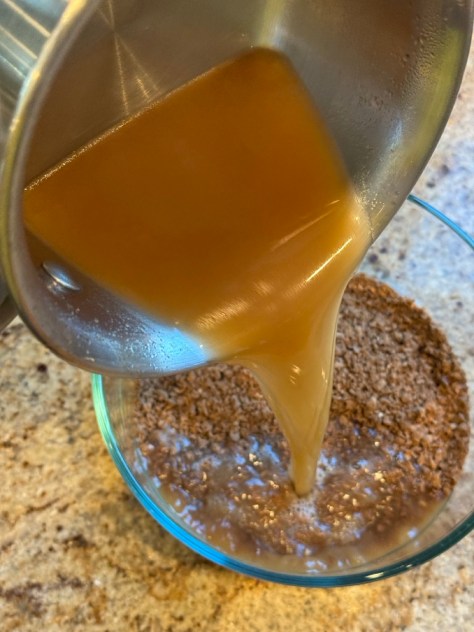
I added 1 cup of boiling beef broth (1 cup water and two teaspoons of “Better than Bouillon”), mixed, and let it sit for 10 minutes.
Here is a classic meatloaf recipe. The hydrated TVP is on the right at the 3 o’clock position. The recipe that I used had 1 pound of not too lean hamburger (don’t forget that TVP is very low in fat so you need the extra fat in the hamburger). One cup dry TVP hydrated to about 2 cups. One chopped up onion, 1 egg, 3/4 cup oatmeal, 8oz tomato sauce, 1/2 teaspoon salt, 1/4 teaspoon pepper, 1 teaspoon garlic powder. Mix it up (I use clean hands). Place in a 5″ x 9″ pan and top with catsup mixed with a little brown sugar. Bake at 350F (175C) for around 1 hour or until the internal temperature is at least 160F (71C).
Here it is out of the oven.
Served up with some mashed potatoes and vegetables.
I didn’t tell my family that I was using TVP. After they had a few bites I asked them how the meatloaf was. They all said, “Good.” I then told them that I added a special ingredient and asked them if they could guess what it was. They replied, “No, it just tastes like meatloaf.” They were surprised when I told them that 50 percent of the “meat” was TVP.
Granular/crumbled TVP can be used for many dishes beyond meatloaf. Spaghetti sauce, on top of a pizza, Sloppy Joes, chili —the list goes on. TVP chunks and strips can add variety when making TVP-containing dishes. Consider experimenting with this inexpensive, protein-rich, low-fat, high-fiber meat substitute.
Peace
Mike
Images are my own or from various websites and are used for educational purposes only.