
All posts by Dr. Mike

On Vandwelling, Part II

In my life, I have dreams, accomplishments, and disappointments.

I try to minimize disappointment by adopting three simple strategies. I can neutralize it. I can transform it from a disappointment into an accomplishment. I can merely accept it and move on. These are reasonable approaches that often, but not always, work.

There are problems that I need to act on immediately if I hope to have any chance of resolving them. However, sometimes a disappointment can convert itself on its own. In other words, it really wasn’t a disappointment; instead I was just misinterpreting the situation. Such a case is the case of my retirement fund.

Thirty years ago I established my retirement fund. No, I’m not talking about an IRA, I’m talking about an adventure fund. I put a chunk of money into an account as a seed, and I planned to add money to it on a regular basis until I had a sizeable nest egg. The fund was envisioned to establish some sort of retirement adventure plan. Perhaps I would purchase a second home in a beautiful location, maybe I would buy an ultra luxurious Class A RV. The designation for the fund was pretty open.

My savings plan never developed in the way that I wanted it to. Its value went up and down over the years, but the overall amount has remained mostly the same.

Over time the thought of a second home became more of a burden than a blessing, and after spending decades camping, I came to realize that I was happiest surrounded by nature.

My camping trips made me understand that I needed certain things to be comfortable. I wanted my bed to be off the ground. I wanted to have the ability to quickly access my gear so it would be at the ready for a spontaneous weekend trip. I wanted enough shelter to have a place to comfortably hang out in inclement weather.

I never used the onboard bathroom in my old camper, as it was a hassle to dump and clean the system. I never hooked up my camper’s kitchen, as I found it more enjoyable to cook on a picnic table. I never took advantage of some of my camper’s electronic features, like the cable TV connection, as I preferred the crackle of a campfire to the canned laughter of a sitcom.

When I started my search for the perfect camper, I was thinking in terms of 5 people traveling together. But that number quickly changed to 4 when I realized that it would be unlikely that my 21-year-old daughter would want to continue to take family camping trips with us.

Two years ago I bought a Ford Flex, which could tow 5000 pounds. I started to look at small campers/trailers that could sleep 4 and fell in love with a little Winnebago trailer called a Minnie Winnie. It was a marvel of compact design, and also light enough to be pulled by the Flex. However, something held me back, and I never bought it. My wife Julie is still working, which meant that I might be taking some solo trips, and the thought of backing up a trailer by myself created some anxiety in me. More recently, I have gained additional awareness. We have not gone on a family camping vacation for over 3 years, as we have traveled on other types of trips instead. It made little sense to build my plans of camping adventures based on accommodating a family. It made more sense to think in terms of one or two campers. I continued to look, but no option seemed right.

Time ticked on, and I tried to use the tool of acceptance. “I will accept the fact that I may never have another camper.”

My friend Tom also has a Ford Flex, in fact, his car was the inspiration for purchasing mine. Tom often travels with his son Charlie in his Flex, and he has developed a system to use it as a car camper.

His example got me experimenting with turning my Flex into a similar rolling home. With the back two rows of seats turned down I could fit nicely. An REI self-inflating mattress made a comfy bed, and the nooks and crannies of the vehicle served as places for gear storage. This system worked pretty well on several mini-trips, but it had its limitations. First was the hassle of converting and loading the car every time I wanted to use it. Second was the space factor. Yes, I had a comfy bed, but that was about it. If the weather was inclement, I was stuck outside. Third was the fact that this was strictly a solution for one person, no more. I’m well over 6 feet tall, and I take up a lot of space.

I had toyed with the idea of buying an old conversion van and modifying it. Tom had said that he would help me with the job, and as a general contractor, he has all of the skills and tools necessary for the task. However, I felt that such an extensive project would place an unreasonable burden on him.

The next part of the puzzle was solved by a random YouTube video that appeared in my “To Watch” feed. The video was from a lady who used a company called Wayfarer in Colorado Springs to install a simple modular conversion system in her Promaster City. Further searches led me to a video of the company’s conversion offering for a full-sized Promaster van. This modular kit could be installed in 2 hours and included all of the things that I would need in a home away from home. Just as importantly, it didn’t include things that I would never use, like an onboard bathroom. Of course, I was fearful, but I also felt excited.

Tom had found me a good deal on my Flex, and now he found me a good deal on a high-top Promaster. Two weeks ago I broke into my retirement nest egg and bought it. Today I’ll get a hitch installed for a bike carrier, in a few weeks I’ll have a couple of windows installed, and by the end of the month, I’ll have Wayfarer install their conversion systems. Tom and I will do the finishing touches (vent fan, shore electric, etc.). My dream is about to be realized!

If I had acted rashly, I would have made a mistake. By waiting, the disappointment that I felt transformed into the realization that an earlier decision would have been a wrong decision. I can park the new van in my driveway packed and ready to go. I can travel in it by myself with all of the necessary creature comforts. I can go on trips with Julie. I can caravan with Tom. The van is big enough for me to stand up in it. It has a comfy bed, lots of storage, and a simple, practical design. It is everything that I wanted, except I won’t have to spend several months building it out.

Time turned my disappointment into an accomplishment. I’ll post the conversion process as it proceeds. Life doesn’t have to be a struggle. Sometimes you just need to let life happen without trying to control every second of it. Dear reader, kick back and relax today and see what life gives you.

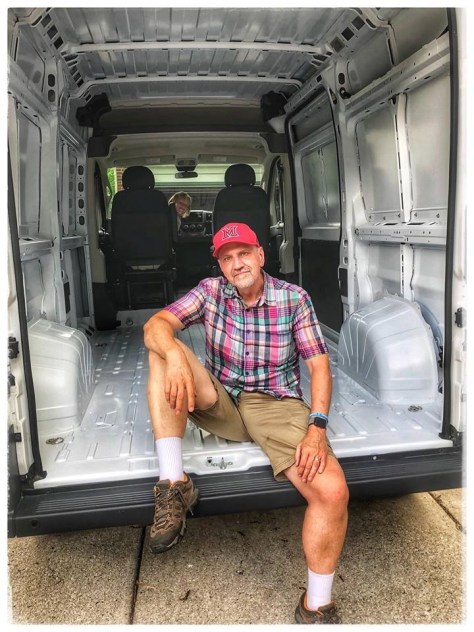
My new cargo van.
My future home?

What The Heck Is Going On With McDonald’s?

The following is my personal opinion.

I was a small child in the 1960s when McDonald’s opened a restaurant in my South Side Chicago neighborhood. As a kid, I was amazed by the concept of fast food. Clean, efficient, and in my child’s mind, delicious!

I was an adult when the River Road McDonald’s opened in my hometown of Naperville. Shining in its 1990s spender, I was once again amazed by the crew’s speed and accuracy. Rumor was that it served as a training site for McDonald’s corporate. By that point in my life, I was less impressed with the food. However, I was still sold on the core concepts of speed, reliability, consistency, and reasonable cost.

Fast forward to a few weeks ago. I am driving my family from Ohio back to Illinois. The kids are getting hungry, and so I pull off the expressway. A McDonald’s restaurant lies in our path. “How about McDonald’s?” I ask. Moans of displeasure erupt from the kids. They reluctantly agree, and I pull into the drive-thru line, which is moving at a snail’s pace. We reach the speaker, and something atypical happens, the order taker gets our order correct on my first try. This has become so unusual that my wife comments to me about it.

After a very long crawl, we reach the window and get our order. My wife does a visual check, and everything looks in order. We pull away.

Julie bites into her regular cheeseburger and sighs, “They got the order wrong.” Her sandwich is missing most of its condiments. “Do you want me to go back?” I ask. “No, let’s just keep going.” The next moment my son sighs, “This isn’t a double quarter pounder with cheese, it is a single.” The second error signals our return to the restaurant. My wife takes the offending sandwiches and goes into the restaurant. She is gone for a very long time. On her return, she apologizes for her delay by noting that they had to make her sandwich from scratch.

Now on the highway, I hear a sheik and an anxious laugh from her, “Well I guess they got me for complaining!” I look over to find that her cheeseburger has all of the right condiments, but it is missing the burger! What has happened to McDonald’s?

This is not an isolated incident, which brings me to my local McDonald’s on River Road. On Friday mornings I often stop there to purchase a coffee and a breakfast burrito. On Tuesday evenings I used to stop there to buy dinner for myself and two of my kids.

The morning lines can be very long, likely caused by the second window sometimes having to do the double duties of cash collection and food distribution. The morning shift seems to have the typical problems that fast food restaurants have. For instance, not including the salsa packet in my burrito order. I have also had to remind them that my order was incomplete, and on several occasions, I have had to tell them that they hadn’t collected my payment! These kinds of errors speak of poorly trained, underpaid, and overworked employees.

However, my Tuesday evening experiences have been worse. Yes, some of the above happens in the evenings too. I have gotten grossly incorrect orders with missing items, wrong items, and items that should have been tossed because they were too old or incorrectly made (for instance, fries so salty that they were inedible). Worse have been the times that defy any sort of quality control. My son has gotten double quarter pounders made with regular sized hamburger patties. I have had several instances where my Southwestern Salad looked like trash, appearing like a salad that had fallen on the floor and was then picked up and put back into its container. Not only did these salads look like a mess, but they were also missing the chicken. Yes, this has happened on more than one occasion from this location.

I bet you are thinking, “Why are you complaining here, you should be talking to McDonald’s!” It is true that on many occasions I have just eaten what I was given because I was tired or in a rush. However, over the last year, I have talked to staff, a manager, corporate, and I even wrote a personal letter to the CEO. Bottom line, It is my opinion that McDonald’s could care less that their product and their customers.

I go to the River Road McDonald’s because it is close and convenient. I don’t want extra layers of grief (like having to return to the store). When I have returned with a wrong order, I’m given the right food, but the workers seem more bothered than apologetic. With one of the “garbage” salad experiences, I asked to speak directly to the manager. She barely made eye contact with me. When she returned with a new salad, she mumbled a very weak “Sorry for the inconvenience.”

In another instance, I wrote out a complaint on the corporate website. The result? A few weeks later I received a postcard/coupon for a free value meal without any explanation. The postcard peeved me enough to do some research and get the name of the CEO of McDonald’s, who I wrote directly expressing my concerns. In that letter, I clearly stated where the store came up short. I appealed to the CEO, one businessman to another.

I have written the heads of corporations in the past, but this is hardly a regular occurrence. Usually, the results of my efforts have been positive…. Editor’s note: in the spirit of full disclosure I did have one experience that was equally bad, that was when I wrote the CEO of Comcast for a friend. A year later he is still paying for services that he can’t use, as the building where he was renting his office was sold, forcing him to relocate…. I write a good letter that is fair and balanced, and it appears that most CEOs appreciate it when someone takes the time to contact them about a real concern. They seem to understand that customers are what makes a company successful.

My response from the CEO of McDonald’s was the most generic of replies from a customer service representative. The letter wasn’t even signed with a real signature. It stated that McCorp preferred having the store deal with local complaints. That was that.

“Dr. Mike, why not protest with your feet?” Dear reader, McDonald’s are everywhere, and they are very convenient. It is unlikely that I will completely stop going to them because of these factors. However, I am definitely going to them much less than I did before, and I order less when I do go. I find myself driving longer distances to go to other fast food places (Portillo’s anyone?), and I now cook on Tuesday evenings. Think about what I just said, it has become more convenient for me to prepare a meal than to deal with long lines and wrong orders. That does not bode well for McDonald’s whose success was based on fast, reliable service.

I recently watched a video on the most loved and hated fast food restaurants. The most hated fast food restaurant is now McDonald’s. Advertising and a clown can’t make up for horrible service.

Are all McDonald’s as bad as these two? I would say, no. I have gone to other McDonald’s where the lines have moved, and my order was correct. I have gone to still other McDonald’s and received terrible service and bad food. When I look at both the good and the bad, it is my opinion is that McDonald’s is definitely declining. No one in my family looks forward to going to McDonald’s or eating their food.

McDonald’s defined the concept of fast food. They did this not only with their speed of delivery but also with their consistency and reliability. The McDonald’s of the past was able to convince us that they were our local McDonald’s, rather than a sterile extension of a corporate behemoth. Our kids wanted their Happy Meals, we wanted to feed our families easily. Such a simple concept, once achieved, now lost.

An American icon, gone wrong. Shame on you McDonald’s and shame on your CEO. The reply that I received from the letter that I sent him suggests a significant lack of interest on his part. The food and service that I receive from his restaurants seem to confirm that suggestion.

I always try to find the good in bad. The good here is that I’m cooking more at home, and choosing restaurants that appear to have better and somewhat healthier offerings. I guess that is something to be grateful for.

Dear readers, what has your experience been with the Golden Arches?

My local McDonald’s

Kathy’s Story: Life As A Caregiver

Life doesn’t always turn out the way that you expect it to. This is the story of Kathy.

Kathy sits across from me sipping a herbal tea, at 71 she is active and tells me that she is going dancing after our interview. Kathy has been a widow for 4 years, and she is trying to adjust to her new life.

She met her husband at a dance when she was 19. He was the older brother of one of her friends, and after the dance, he got her phone number from his sister.

Dave asked Kathy out on their first date by posing her a question. “If you can tell me the color of a red pencil, then you can go out with me.” She liked her husband Dave because he was smart, funny, and a little sarcastic. “I got tired of the sarcastic part pretty early on, and I let him know that.” Dave had a significant limp from a bout of childhood Polio. He was born before the advent of the Polio vaccine and contracted the disease as a baby. Growing up he worked hard to compensate for his handicap by regularly working out in his homemade basement gym.

On the surface, Kathy felt that they were dating casually. However, six months into the relationship she ended a connection with another man. Clearly, there was a part of her that knew that there was something special about her future husband.

She was still in school, and Dave returned to college studying at Lewis University. Kathy recalls a letter that he sent her around their 3 month anniversary. In the letter, he thanked her for the brownies that she made him and told her that he would also like some cookies. Although humorous, that simple comment foretold of things to come.

They had little money, and it took them 6 years to save enough to get married. Dave eventually became a special education teacher, and Kathy taught elementary education, both for the Chicago public schools.

They saved and bought a home on a large lot in the country. They traveled a bit. They raised a family. This was the American dream of the 1980s. Dave loved to eat. In fact, Kathy says that he was obsessed with eating. Dave started to gain weight and went from thin to morbidly obese. Along with his obesity came diabetes. Along with diabetes came diabetic neuropathy. Along with diabetic neuropathy came immobility. He was already limited by the aftermath of his polio, but his neuropathy made him disabled. It became difficult for him to walk or maintain his balance. This made it hard for him to contribute in a meaningful way at home.

Slowly, but progressively, more and more of the home tasks fell on her. This is how she describes a typical morning in those days:

“I would get up at 4 AM and walk the dog. Then I would throw clothes in the clothes washer, and empty the dishwasher. In those days I made a lot of oven breakfasts, and so that would be cooking. After breakfast, I would get my kids ready and drive them to school or the sitters. Then I would go to my full-time teaching job.”

Kathy was feeling tired and stressed. Despite this, she put one foot in front of the other and pushed forward. “I didn’t think about it, I just did it.”

Dave’s condition continued to worsen and his doctors came up with a new diagnosis, Post Polio Syndrome. Post Polio Syndrome is a syndrome that occurs many years after a person has contracted Polio and it is characterized by muscle weakness, fatigue, and pain. Dave went from using crutches to being a wheelchair user in 1996. It was becoming increasingly difficult for him to get out of the house, and once out he could only go to handicap accessible locations. This was not only difficult for him but his entire family.

Kathy continued to push forward, but her life was becoming further limited, and she was avoiding social gatherings because of the enormous difficulty in transporting Dave. Her world was closing in.

In 2009 she started to notice another change in Dave, he was beginning to stutter. Dave was a bright and inquisitive individual, but now his logic seemed way off. Simple things, like learning how to use an electric wheelchair, were beyond him. He was complaining of vision problems, although his eyes tested OK. He had trouble writing. In 2011 an ophthalmologist examined him and thought that he may have Parkinson’s Disease which can be confused with another illness called PSP. Dave was seen by a Neurologist who did an MRI of his brain. That test showed an unusual hummingbird pattern which is the classic sign of PSP or Progressive Supranuclear Palsy, a disease that destroys part of the brain. This explained the stuttering, lack of coordination, problems with logic, and the fact that Dave had gone from being a nice person to a nasty one. Dave started to show a lack of empathy, and at the same time, he was becoming progressively needier. If Kathy was out of his sight for a moment, he would bang on the walls or call her cell phone to get her attention.

She now had caregivers coming in, but they were only present 3 hours a day. “Sometimes that was the only time I could sleep as Dave would often be up at night.” Another symptom of PSP is dementia. Kathy’s situation was similar to someone who had a spouse with Alzheimer’s disease. It was a tough time. She had discovered a Facebook group for PSP caregivers, and that served as a lifeline for her. “Connecting with other caregivers, I started to understand that Dave’s behaviors were due to his disease.”

The course of PSP runs from 6-15 years, and on August 17, 2014, Dave passed away at home.

Kathy spent much of her marriage taking care of Dave, and through the process became ever more isolated from the outside world. A part of her wanted to live, to experience, to explore. In many ways, she was like a person who had been released from prison after spending 20 years in confinement. She had a desire to move forward, but her life had been so structured that she didn’t know how. “My friends in the PSP group talk about this. That first year is go, go,go. It is like you are trying to make up for all of the years that you couldn’t do anything. You move forward, and you make mistakes. I joined a dating site, but I didn’t understand that there are predators that lurk on these sites. Let’s just say that I got hurt.”

Kathy continues to move forward, but at times it is difficult to know what forward is. She is starting to do things for herself. She travels more, she has joined a gym, she is taking dancing lessons, she casually dates, she learned how to swim, she learned how to ride a horse, she is a regular at a senior MeetUp group. Despite this she is lonely. She has gone from being a caregiver to being free. However, being a caregiver was her identity. She has lost her identity.

“I decided that it was time to talk to someone who could help me figure out where I go from here. I need to accept that fact that I may never have another partner. I need to be happy with myself.”

Kathy says that she is still a work in progress. She continues to expand her experiences, but at a less frantic pace. She is enjoying her friends, family, and grandkids. She continues to learn and grow.

We never know where life will take us. Every day is a gift. Good days have bad in them. Bad days have good in them. It is our task to extract what good that we can from every day, as we will never be given that day again.

Kathy is a heroic person who is trying to live by that philosophy. I wish her well.

If you have a story that you would like to tell me please click here for more information.  It is free and it is a way to preserve your legacy. 

To read more stories click here.  

Kathy

On Living In A Cargo Van

I moved to the far western suburbs of Chicago 30 years ago. Many things in my life have changed since that move. I married 25 years ago. I had three more children. I purchased a house. However, there is one thing that I did before all of the above that has remained to today. That one thing is my retirement camper fund.

I have a pool of money that I established over 30 years ago. The fund amount is sensible, but not tremendous. It has served as my “dream fund,” a fund to build a dream on.

When I approached my retirement, I started to think in earnest about that money and how I would use it. I have the heart of a country boy, and I am the most content when I am in nature. My spirit has always gravitated out west, and I am drawn to places there. Would I want to move there permanently? The truth is that I want to live close to where my kids are. For me, relationships trump scenery. However, that doesn’t mean that I wouldn’t want to spend extended periods of time exploring the National Parks and other scenic wonders.

My ease with the outdoors offers me the advantage of doing these explorations relatively cheaply. I have a senior pass for the National Parks, and I have camped my entire life. I have owned campers in the past, so I have a good idea of what I need when it comes to creature comforts.

If I camp for more than a few days, I need to be in something that keeps me off the ground. I am also a “compartment” kind of guy, and I like the idea of having most of the things that I need at the ready and organized. I don’t mind cooking, so I need some sort of ability to do that. Naturally, I need a way to charge my camera, phone, and other gadgets.

With proper ventilation and a 12-volt fan, I can likely survive without AC. My last camper had a bathroom, but I never used it. It was more straightforward to use the campground’s provided facilities. Refrigeration would be helpful, but I’m teaching myself how to make real meals using my own dehydrated foods and off the shelf products. I can’t go for an extended period eating only granola bars and beef jerky.

What I have discovered from my years of camping is that I don’t need a lot to thrive. At home, I am a gadget lover because I like exploring innovation. However, on the road, I practice KISS (Keep It Simple, Stupid!).

The primary goal of my retirement fund was to purchase some sort of camper. Pop-up, trailer, RV? I have toyed with all of the above, and each has its advantages and disadvantages.

My fund is not generous enough to buy a new RV, but I could afford an older C class. They are the best RV value, but they are big and bulky. I would likely have to tow a car, a hassle that I don’t want to do.

A pop-up could be a solution, but do I really want to constantly setup and teardown at 65?

I looked at trailers, and they seem to be an (almost) perfect option. However, there is my backing up problem. Dear reader, I understand the mechanics of backing up a trailer, and I am able to back one up. However, I need a backing up guide. If my wife is with me, I can get my camper where I want it.

You may remember that I am dyslexic. This problem impacts my senses of position and space. It is challenging for me to conceptualize where a trailer is relative to its tow vehicle. When I back up a trailer by myself, I have to continually get out of the car, visualize where the trailer is, back up a bit more, and repeat. It is very frustrating. I marvel at my friend Tom’s backing up ability. I have been with him many times when he had to back up a considerable construction trailer; he is a real pro. He has offered to teach me his tricks, but I will always have my spatial problem.

My needs have also changed over the years. I started to seriously look at options two years ago . At that time I felt that I needed something that would sleep my entire family, as our favorite vacations had been grand camping adventures. However, we have not had a big family campout for over three years. Even overnight campouts are limited, as my kids now have lives of their own.

It is sad for me to think about the end of our big family camping trips. However, when a door closes a window opens. If I accept this reality, I also can refocus my efforts on ways to camp that allow travel for one or two.

A “Class B” camper comes to mind. These are tricked out vans that offer all of life’s conveniences in miniature. Full kitchens, bathrooms, built-in entertainment systems. However, they are costly, and many of their luxuries (like the bathroom) are not needed by me.

For the last year, I have been talking to my friend, Tom, about building out a cargo van. He is willing to help, and he has the skills that I lack. At one point he found me an old mini-bus that could be converted, but I was too chicken to pull the trigger. Even with Tom’s expert help the conversion process could be lengthy and daunting.

Every camper option seems doable,, but I always find something to keep me from moving forward. That is until this last week.

I stumbled on a YouTube video from a company that makes a modular system for the Dodge Promaster van. This is a relatively inexpensive cargo van that boasts a “tall” version that has an interior height of over 6 feet. Their system locks modules into floor tracks, and the whole interior is easily removable. The kit includes the floor, wall and ceiling panels, a platform bed, a simple kitchen, and a seat/storage box. The best thing is that it can be installed in 2 hours.

Cargo vans have only two seats, but for those now rare family trips, we could use a second transport car, and a tent for other campers. If needed, I could sell my current car and use the van as my primary vehicle. I am moving into retirement, and my transportation needs are simple.

I mentioned the option to Julie, and she seemed reasonably receptive. We have been married for a long time, and we no longer find it necessary to “make our points” with each other. Well, at least most of the time.

Dear reader, I’m not sure where this will all lead me, but I’m pretty excited about it. Tom said he would go with me to check out some Promasters at the local Dodge dealership, and I have sent an email to Wayfarer Vans, the company in Colorado who makes and installs the conversion kit. This option seems like the right balance of convenience and price. Say a little prayer for me so that I make the right decision.

When I started writing this blog, I talked about traveling to National Parks to photograph and write about them. This could bring me one step closer to that dream. My plans have moved slower than I initially expected, but they are definitely moving in the right direction. Fingers crossed.

Our time on this planet is short. I have spent my life in service of others, and it is still hard for me to think about my personal needs. I can’t always do what I want. However, I don’t want to draw my dying breath considering, “Why didn’t I do that? Why didn’t I experience that? Why didn’t I try that?” Dear reader, I am working hard to live my life to its fullest. You never know what tomorrow brings.

I’m learning how to dehydrate my own food.
I’m 6’2″ and I fit!
I want to photograph and write about nature.

When Children Go Off To College

The hotel was geographically close, but it still took almost 40 minutes to get to our destination as we had to transit on rural roads. We were then met by road construction when we arrived. I always feel uncomfortable when I’m not familiar with my environment, and road construction makes that unfamiliarity more intense.

A turn here, a detour there; finally the parking garage. Once out of the car we followed the herds of people as they meandered towards the middle of campus. We arrived at the student center where most of our meetings were scheduled. A large red brick building in a classic Georgian style. It was time for college orientation to begin.

Grace will be my third to go off to college, and it has become more difficult for me with each child. When my oldest daughter went to school, I had three little ones still at home. My next daughter had already been away at a magnet STEM boarding high school before she left for college. It was still tough to see her go from a campus that was 20 miles away to one that was over 1000 miles away.

My Grace has been at home for the duration, along with my son Will. My last two kids have liked doing things with me, and we continuously have turned small events into adventures. A trip to Walmart can become an exploration, making dinner together can serve as a time to bond and laugh. Since my wife returned to the workforce (she would correct me at this point telling me that I should say “paid workforce”), We have often been like three musketeers. Naturally, as they have gotten older, their friends have taken up more of their time, but we still do things together. Being with them is a total pleasure for me.

Now, my Grace will be 5 hours away by car. Indeed a doable trip on a weekend, but not around the block.

I remember going to my college orientation many years ago. It was an information only experience. I went with my friend John, who was also attending the same university. No parents, no sleepover in a dorm room, no team building exercises.

When I turned 18, I was considered an adult. Currently, we define people in their 20s as “emerging adults,” who still need parental support. College orientation is now designed to ease fears. Providing information is secondary, as all of that information is on the university’s website.

We attended sessions with my daughter, and apart. The two-day affair included her spending a night in a dorm room, while we returned to our hotel. A harbinger of things to come.

I am fortunate to have kids who are motivated and dedicated. I know my daughter has all of the skills needed to have a successful college career. I am overjoyed that she is moving forward. I am intensely sad that she is leaving. At times my mind goes in crazy directions. “What if she marries someone locally and doesn’t return to Illinois?” “What if she decides that her dad isn’t the fun adventurer of her youth and just a boring old man to be avoided?” “What if…”. I understand that these thoughts have no place in my mind, but they are present anyway.

This is a problem that modern parents face. A hundred years ago our children would return home with their spouses to work on the family farm. When I was growing up in Chicago, it was common for family members to buy houses on the same block. Now, our children may live in another city, state, or even country. This fact of life made only slightly more tolerable by the innovations of FaceTime, texting, and Facebook.

Our goal as parents is to help our children become successful and independent adults. This is my goal, but like most things in life, an independent child is a coin that has two sides.

My kids are transitioning from precocious but dependent children to mature and independent adults. In our conversations, they now explain things to me. In our adventures, they fully contribute. In our chores, they are equally responsible. This is the way it should be. Is it wrong for me to want this for them and also to want them to think of me as their father who is there for them? Who can pick them up when they fall? Who has wisdom that they not only need but want? I hope that they will continue to comprehend how significant they are to me, and how very much I love them.

Each day brings me new experiences and new things to learn. At whatever level that I am allowed, I will maintain my connection with my children. They may be striving towards their future, but that doesn’t mean that they have to give up their past.

I Screwed Up

It is easy to screw up, but it is more difficult to admit it. How can I grow as an authentic person if I don’t acknowledge my mistakes? It is not my life’s goal to be perfect, but I believe that I should learn from my errors. Unfortunately, I have found that it is easy to learn a lesson, and still repeat the same mistake. I think this is the nature of being a human being.

I woke up foggy and forced myself to place my feet on the ground. After a few moments, I stumbled into the bathroom. Once inside I issued a command to my Google Assistant. “Hey Google, good morning!” After a few seconds, she said, “Good morning, Mike!” then she recited the weather, told me my calendar appointments, and finally read me the news. On this particular morning, she announced, “Scattered thunderstorms today.” I took note and proceeded to get dressed.

At 4 AM in the morning, I am routine driven, as my ability to problem solve is compromised. The last thing that I do before my morning walk is to check the computer. A story caught my eye, and I became distracted. I glanced up at the time and realized that I was running late. On shoes, on ball cap, on jacket, and out the door, I bounded.

I was a few doors down the block when I realized that it was drizzling. I could have returned home for an umbrella, but I decided to continue forward. In my gut, I knew that this was the wrong decision. Because I was feeling lazy, I convinced myself that the rain was light and my cotton jacket would protect me.

If you have been reading my blog, you know that I am a planner and preparer. I’m obsessive, and solving problems gives me a degree of pleasure. When I committed to walk/exercise on a daily basis, I worked out many scenarios so I could accomplish my objective in most any situation. For rainy weather, I have a raincoat, waterproof shoes, an umbrella, and even rain pants. It is simple for me to don my rain gear, I was only a few houses down the block. Logic said “Turn back,” laziness said, “Move forward.”

I made it to the Starbucks and was only a little damp. Triumph! I thought. My friend, Tom, stopped by for coffee and we started to chat. He was also running late and was in a hurry to get to his job site.

We parted ways, and I started the 35-minute walk back home. The rain began in earnest, and with each block, it picked up in ferocity. I was becoming more soaked and uncomfortable. The cool breeze now felt damp and icy; I was starting to tremble. The only option was to continue to walk, so I moved forward.

By the time that I reached my front door, I was so wet that even my underwear was soaked. I was shaking and my jaw was chattering. Once inside I headed straight for the bathroom and washed off the cold with a long and steamy hot shower. Somewhat rejuvenated, I put on dry clothes and went to work.

Behaviors repeat themselves in both significant and insignificant ways. If I can learn from my minor mistakes, I can avoid more significant ones. There were many lessons that my screw up taught me. With a little thought, I could have left the house properly attired. With a bit of effort, I could have returned to my home to re-outfit myself. I could have challenged my problem of asking people for help and pressed my friend, Tom, for a ride. I could have called Julie when I was at Starbucks to request a pickup. Any of the above and I would have avoided getting soaked. However, once I started to walk back home I was compelled to complete my hike, as waiting around for a ride would have just made things worse. I could no longer solve the problem, and now I had to correct the outcome.

Here are some things that I learned from my rainy day screw up.
-I need to pay attention and stay on task.
-I should correct small problems before they become bigger ones.
-I should ask for help when needed. People who care about me won’t mind a little inconvenience if they know that I’m genuinely in need.
-If I ignore the first three rules and wind up with a problem, it is my responsibility to come up with a reasonable solution to that problem.

These rules are not only applicable to stormy days but also other life problems, both big and small. I need to be more mindful and aware. Fixing unnecessary problems is a waste of time and energy. At the same time, I need to accept that fact that I am human and I will screw up. Finding the balanced between these two poles can be difficult, but finding this balance is necessary to have a happy life. I want to avoid problems, but I don’t want to plan every scenario so wholly that I lose the joy of spontaneity.

Dear reader, are you a planner, or a fixer? Have you found the right balance in your life? What lessons did life teach you today?

The rain increased with every block that I walked.
So much rain that the river flooded my walking path.

Terry’s Story: Building A Guitar Museum

This is the story of Terry, and his 40-year desire to create a school and museum so he can share with others his love of stringed musical instruments.

I enter Terry’s music store, and he is pouring over an ordering catalog. He writes down items in a spiral notebook and then places a call to his music house’s customer service representative. From what I can tell he is ordering guitar strings, guitar tuners, and perhaps a pick-up or two. Terry is 65 and does all of his ordering the old school way, as he doesn’t own a computer.

After about 10 minutes he invites me to sit in a chair towards the back of his La Salle, Illinois store, which is called “The Guitar Junkyard.” It is a shop filled with every imaginable type of guitar and stringed instrument. Guitars are hanging from the walls, the ceiling, and on racks. Old looking one, new looking ones, fancy ones, handmade looking ones. Guitars are everywhere; they visually represent his life of collecting.

Terry always loved music, but as a child, he didn’t think that this would be his life. Terry was raised in the affluent Chicago suburb of Hinsdale. He went to Iowa State University in Ames because his parents expected him to go to college, but he always felt that he was more of a “hands-on” type of guy. Like many teenagers, he wasn’t sure what he wanted to major in. His choice was based on rules of elimination. English was crossed off because he didn’t like the rigid rules required. Meteorology was eliminated because of the excessive chemistry load. He was left with an anthropology major. He had been playing the guitar since he was a child, and so he decided on a music minor. Terry considers himself an ethnomusicologist, based on these areas of study.

In 1972 Terry taught himself the banjo. In 1974 he joined a bluegrass group in Ames as a banjo player, The group was locally successful. Terry was now working as a carpenter, and the band served as a nice counterpoint.

A good friend was managing a music store in Ames. He called Terry with a request to run the store for him for a couple of weeks as he had a family emergency and needed to travel out of state. Initially, Terry was reluctant; he had no business knowledge. His friend convinced him that it would be easy, and it would only be for a short time. This would be a turning point for Terry.

The friend never returned, and Terry was given the store manager job. The owner arranged to have someone train Terry on the business side of the store, and he was off on a new and unexpected career. Terry adjusted to his new job but found it too slow-paced. He started to buy junk guitars for the sole purpose of learning how to fix them. Eventually, he became an expert guitar repairman. Terry specifically refers to himself this way as opposed to calling himself a luthier. Terry had a steady job and was playing music on the weekends. His wife had advanced herself too, eventually earning a Ph.D. Life was good.

For every up, there is a down. After two years the store owner decided to close the Ames store, and Terry was out of a job. Around this time his bluegrass band was starting to fall apart. Once again, things were changing for Terry.

With a small bank loan, he started his music store, which became a successful enterprise. Around the same time, he was approached by another band, “The Warren County String Ticklers” to play the guitar and sing. Terry was a busy guy, running the store during the week and playing gigs at night and on the weekends. The Ticklers were popular locally leading to TV appearances on Iowa Public Television. Life was once again excellent, and it was about to get better.

Illinois Public Television was in the process of putting together a show for Jethro Burns, of Homer and Jethro fame, and they need a band for him. Through their Iowa TV connections, the Ticklers were chosen for the job. The show, called “Country Music Hall,” was a success and the band started to tour with Jethro. County fairs, state fairs, TV appearances, and more. Terry was traveling with an “A” level performer, and he was having the time of his life. His store was thriving, his wife’s career was advancing. Terry was on a successful fast track.

Life started to unravel by the mid-80s. Jethro Burns became ill and had to leave the tour for an extended period, and various members of the Ticklers were abandoning the band for various reasons. Although Terry loved working in the band, he was tired of the band life. Set-up, tear-down, fast food, long hours. It was exhausting, but more importantly, it kept him away from his friends, wife, and son. “About 3% of musicians become professional, but only about 0.1% reach a level of enough success where they can have a pampered life on the road.”

His wife got a job for the Department of Agriculture, and the family left for Washington DC for a three-year commitment. Terry left an employee in charge of his store, which quickly went from making a profit to being in debt. At one point he had to return to Iowa for two months, to save his business. “I found a drawer of bounced checks and people said that the shop was often closed during business hours. Apparently, my employee was making more money at the local pool hall than at the music store.”

Eventually, his wife’s Washington job ended, and she returned to Iowa State University. Terry’s shop was in the green, but this phase was also short-lived and a new twist that was about to happen. His wife’s university job ended, and she had to find a new one. One of her job offers was in Illinois, close to her family who lived in the LaSalle area. Terry packed up his shop and moved it to LaSalle, where it remains today.

All of this time Terry was collecting guitars and other string instruments. He says, “I only need one of each type.” Unfortunately, there are countless varieties to be had. Construction techniques can differ, body shape can vary, ornamentation can change. “When I make money I don’t pay myself; I buy another instrument.” This explains the expansive number of instruments in his shop.

Terry says that he has wanted to create a museum and teaching center for many years. The building that he rents for his store is for sale, and Terry is in the process of buying it. He envisions a museum on the first floor and his music store on the second.

Most of his instruments are not collector quality, but they all tell a story. He would like to allow people to play them and experience their differences. Also, he would like to share some of his talents. As a professional performer, he understands that there is more to playing on stage than plucking an instrument. He envisions a center that teaches the art of performance. As a self-taught guitar repairman, he plans a teaching program that could train future instrument fixers.

He would like to create a foundation to manage his museum and collection. His eventual goal would be to be the director of instrument repair. “I could leave the running of the place to someone else.”

Will Terry succeed in his quest? The outcome is unknown. He has the instruments, and he will soon own the space. He feels that he will have enough capital to make the fundamental changes needed to turn his shop into a museum. What is less clear is if he can draw enough people to LaSalle, Illinois to sustain the museum. He is very close to Starved Rock State Park. A park that gets over 3 million visitors a year. He is thinking of ways of attracting those visitors to his museum which he plans to call, The String Instrument Museum for Preservation, Luthiery Education” or SIMPLE. He wants to use the tagline, Music is SIMPLE.

Terry is 65, but he is still dreaming. Sitting in a rocking chair is not in his plans. He has wanted to establish his museum since his college days, and he is now a few steps closer to achieving his goal. His concept is novel, a place to showcase a diverse collection of string instruments, rather than one that displays museum-quality pieces. He wants to bring his type of music appreciation to the general public.

At the end of the interview, I asked Terry if he had any life regrets. “Are you sorry that you didn’t continue in anthropology, or as a professional musician?” After a long and thoughtful pause, he just said, “No.” Terry is right where he wants to be.

I wish Terry well in his plans and his future.

In life there are many ups and downs. It is how we view these twists and turns that determine our life satisfaction.

Terry’s music store:
The Guitar Junkyard
1049 8th St
LaSalle, IL

If you would like me to write your story, click here.

Terry
A massive collection.

On Father’s Day

Yesterday was Father’s Day, and I am a father of 4. If you are not a dad, you may consider the holiday a “Hallmark holiday.” An event designed by businesses to get you to buy things. If you are a dad, you probably understand that it is more than that.

Established over a 100 years ago it was an attempt by a daughter to honor her dad, who raised six children on his own. Her initial success was moderate at best, and after many years, she abandoned the concept as her life moved on. She eventually returned to the idea in the 1930s and started to promote it anew. This time retailers were on board as they saw the advantage of a day that could mean additional gift purchases. In 1972 President Richard Nixon officially declared it a national holiday. Although used by the business world to hawk products, it also can be an excellent way to celebrate the father or father figure in your life. Father’s Day celebrations don’t have to include expensive gifts and commercial greeting cards!

For many years my wife traveled with my kids to Minnesota on Father’s Day to spend time with her family. Unfortunately, I had to work and was home alone. I don’t believe in letting other people control my happiness. It was important to my wife to be in Minnesota, and so she was. However, I could still make the day significant for me. I started to go on “great adventures” with my sister Carol. We would get into my car and drive in a random direction. We would stop anywhere that looked interesting, to explore. We would culminate our exploration by discovering a random local restaurant. Some were great, some less so. Either way, it was wonderful fun. I have delightful memories from those “Father’s Day” celebrations, as does my sister. In the last few years, Julie has not traveled on Father’s Day weekend, and I have shifted to a more traditional celebratory day.

I have become older and more sentimental so Father’s Day has become ever more significant to me. My family has risen to the occasions and Father’s Day gets the same treatment as any other significant family day from birthdays to Mother’s Day.

For these special days, the celebrant is typically honored with a meal of their choice. Frequently of the homemade variety, sometimes of the restaurant kind. My tastes run pretty basic, and I asked for chicken, mashed potatoes, and a salad. I also asked for a sugar-free dessert, as I gave up eating large quantities of sugar some years ago.

Last Father’s Day I was promised a new BBQ grill, as our current one is over 27 years old. The old grill now has two speeds, burn and not hot enough. I have replaced many of its innards over the years, but it is just too worn out to repair further. Cooking on it is like solving an advanced math problem. You need to calculate relative hot and cold spots on the grill and then move your food around to make sure one piece isn’t chard while another is raw. Life happens, and the grill never came. However, this year my wife informed me that a new one was ordered and was coming in the next two weeks. Yay!

My daughter Grace searched the internet and found a recipe for a sugar-free apple pie. My son William wrapped some gifts. Both Grace and William made me cards with the most beautiful sentiments inside. My wife made me dinner. My daughter, Anne, called in her greetings. My daughter Kathryn, who is studying abroad in Moscow, texted hers.

For me, it was a perfect day of celebrations. Yes, I was delighted to get the grill, but that was a minor part of my happiness. The majority of my good feelings came from the fact that people were willing to recognize me and expend effort to make me feel special. Some words written on a card, a phone call, a dinner, time together. Efforts that said that I was important enough to them for them to take time out for me. This is what mattered and this is what made the day awesome.

It takes so little to make someone feel special. In fact, I think it takes more energy to do the opposite. What does it take to wish someone a good day? What does it take to write a sentence or two in a celebratory greeting? What does it take to recognize someone for a job well done? Very little. So many times people will say that they are too busy to do these simple things. Too busy? Really? Likely not.

A gift of your time or goodwill is typically reciprocated by the receiver. Yes, there are “users” out there, but they can be quickly sniffed out. The Golden Rule has been around for over 2000 years. “Do unto others as you would have them do unto you.” Pretty simple, pretty straightforward. Why is it then that we see the Golden Rule ignored everywhere from our personal lives to our government? Practice it today; play it forward.

Shari’s Story: Living With Autoimmune Disease

It is 7 PM on a Thursday, and I am seated across Shari, a 46 years old woman with shockingly red curly hair. This is her story.

Shari grew up in the middle-class Chicago suburb of Downers Grove. She showed exceptional creative talents at an early age and would entertain her parents with her complex stories about bunnies. There was something different about Shari, an old soul with an inquisitive mind.

Early intelligence testing gave a partial answer. Shari was a genius. Coming from a family of achievers, she was right at home. Shari was in the top two percent of her high school class, a fact even more amazing as she was involved in over 20 clubs/activities while she worked a part-time job. Despite her accomplishments, Shari always found the most peace in simple things. She deliberately choose the smallest bedroom at her parent’s home and shunned excessive possessions.

College was expected, and she applied and was accepted to the University of Illinois, a premier university. Always a storyteller, she decided on a rhetoric major. As a concession to her father’s fears of unemployability she also took courses in accounting. As in high school, Shari excelled at the U of I. She overloaded herself with classes, worked different jobs, and even became a resident advisor for her dorm. “I took six years of classes in 4 years,” she told me. Her academic achievements at the U of I were significant enough for her to be named a Bronze Scholar, one of the university’s highest undergraduate honors.

Despite her success, something was not quite right. Late in her college career, she became ill to the point of requiring hospitalization. Despite her academic success she felt stressed, instead of accomplished. “I raced to the top of the mountain, and there was nothing there.”

More studies followed at the University College of Cork in Ireland where she obtained a certificate in Irish Studies. Then it was time to get a real job.

What jobs are available for rhetoric majors? Not many, and so she accepted a two-day temporary position at Ace Hardware corporate doing routine data entry. When you are smart, you can generalize what you know and see the bigger picture. In Shari’s case, she was able to use her accounting knowledge to see errors in the data that she was inputting into the computer. She told her supervisor what she observed and went from a two-day temp worker to a full-time position on her first day. Shari was entering the corporate world.

One task led to another, and soon she was designing complex databases and doing statistical analyses for Ace. At the same time, a romance was forming in her life. She met her first husband when she lived in Ireland. He traveled to the US so they could check out the viability of their connection. When his visa ran out, she quickly decided to marry him.

Unfortunately, the relationship was doomed. Her husband couldn’t hold down a job, and would impulsively spend money. She would react by working harder to pay down their debt. Shari learned more programming languages, and soon was working on mainframe computers. A lucrative but time demanding job in pre Y2K.

Wanting to do the right thing it wasn’t uncommon for her to work late in the night and then bring home additional work. The stress of unnecessary debt, extraordinarily long working hours and a difference in values eventually took its toll, and her marriage ended. Raised in a strict Roman Catholic household, the divorce was devastating to her.

More jobs, more responsibility, more challenges. Shari was being pulled by two forces that were equal, but opposite in direction. A desire to have a simple life, and a wish to do an outstanding job in the corporate world.

Along the way, she met her second husband. He was resentful that Shari had a circle of friends and convinced her to move so they could start anew and be on an equal playing field. Where did they move? They moved from Chicago to Australia. In Australia Shari did what she does best, learn. She finished a Master’s degree in creative writing at the prestigious University of Sydney and then went to work at the university. Shari told me that she loved living in Australia, as everything she needed was within an easy walk. A simple life was what made her happy.

She traveled to India on holiday and became ill. She returned to Australia sick and very weak. She found herself working from home, as she did not have the energy to get dressed and travel to work. This went on for many weeks. Slowly, and with the help of medical professionals, she recovered. However, something had changed, something was wrong. Also, her second marriage was now failing, and another divorce was on the horizon. The prospect of a second divorce was sobering.

Shari continued to work at the University of Sidney, and her brilliance promoted her. She was given important projects and a team to work under her. One of her hires was a man named Jason. A person who barely said two words to her while they worked together. But more on Jason later.

With a broken second marriage, she decided to leave her life in Australia and return to the United States. She left behind true friends and the basic life that she loved.

Now back in the US she once again got jobs in business and IT. Learning new systems quickly, always seeing the bigger picture, always overworking. After 18 months she returned to Australia to visit friends and co-workers. Her former employee Jason was at one of her welcoming dinners. “He seemed different, more talkative and engaged.” By the end of the evening, they were holding hands. Four years later they married.

Finally, it seemed like things were going her way. She was married to the love of her life, she had a small and manageable home in Downers Grove, and she had a good job.

Stress was working overtime in the background as she continued to overwork. In the first year of her marriage, she was hospitalized with a bout of Ulcerative Colitis. She developed chronic anemia. In 2012 she was hit by a severe, unknown malady that left her twitching, and uncoordinated. She couldn’t think straight and had no short-term memory. She was in constant pain, and she was continually sleeping. She went from being able to see the bigger picture to not knowing if she let her dog out. It was a horrible time for Shari.

She sought medical attention and diagnoses were made. Autoimmune thyroid disease, autoimmune neuropathy. She started to do her own research and determined that one of her problems was Hashimoto’s Encephalopathy (HE), a diagnosis later confirmed by her physicians. HE is an autoimmune disorder that causes an inflammation of the brain and produces neurological symptoms because of that inflammation. Other related problems emerged, Lyme Disease, Possibly PANDAS (another autoimmune disease caused by a Streptococcus infection). The combination of stress and infectious agents were creating a one, two punch that was making her life unmanageable. Her body was literally destroying itself.

Shari fought back. Using her own research, novel treatments, and an expert medical team, a multi-modal treatment emerged. Thyroid replacement hormone, steroids, neuro-cognitive training. These have all helped improve Shari’s functioning. However, her health is still fragile. She takes one step forward, only to slide backward with the slightest stress.

Shari is a giving person, but she can become over-involved helping others. She willingly helps friends and family, but her actions can result in an exacerbation of her autoimmune illnesses making her non-functional for days. She would like to be a financial contributor in her marriage, but even part-time work can be too stressful. She struggles with her current lack of functioning, her poor memory, her fatigue.

She says that many doctors missed her diagnoses; they only reviewed simple lab panels and didn’t delve further. She wants to advocate for others who are dealing with undiagnosed maladies. At this time she is a health coach for a young woman who suffers from another chronic disease, but Shari wonders what her next step should be. She knows that it can’t be fueled by the obsessive drive that gave her success but contributed to her sickness. Her illness has forced her to re-explore what has consistently made her happy in the past, a simple, basic life.

Despite her illness, she is grateful. Grateful for the beauty and majesty of nature, grateful for her caring friends, grateful for her loving family, and most of all grateful for her soulmate, Jason.

Life is what you make of it. Sometimes it is more important to celebrate what you have than to constantly grieve over what you have lost. Rejoice in today as will never be repeated.

Do you have a story that you would like me to tell?  If so, click here for more information on this project.


Shari