Inflation and Trump’s tariffs got you down? Cooking at home can save you money, but many have lost this skill and now consider home cooking to be microwaving a frozen dinner. If that is your home cooking life, you may think that the only way you can get a decent meal is by going out to a restaurant. However, many restaurant foods are the same pre-made, generic-tasting dishes from companies like Sysco (my personal opinion). They are no different from the food that you buy from the grocery store freezer cabinet.
Now, you may think that I’m some domestic wonder, part physician, part house husband. That would be inaccurate. I have always believed that both men and women should be capable of the routine tasks necessary for living.
I could always cook, and I am rarely intimidated by any challenge (OK, I am terrified of heights, so I’ll give you that). Julie is still working, and I’m retired, so it makes sense that I utilize some of my free time in this way. This also let me teach my kids how to cook. Skills they are now putting to good use as they live independently. Lastly, I’m a glass-half-full kind of guy. Some people find misery in everything. I do the opposite. Why not turn cooking into something fun? Play around with a gadget. Learn something new. Share the knowledge. Now, the “drudgery of cooking” is transformed into something completely different.
You don’t have to be a hobby cook to make dishes from scratch. The more you do it, the simpler it is to do. What may seem overwhelming at first becomes second nature over time. Everyone has to eat, and if you make your meals from scratch, you will have delicious food that is significantly less expensive than restaurant, frozen, or (now) even fast food. The recipes I post are effortless yet delicious.
This recipe for lemon garlic chicken (from Cooking with Coit) is straightforward to make and tastes like it was prepared at a nice restaurant. It uses a pressure cooker (Instant Pot). Should you run out and buy an electric pressure cooker? Well, you should, but you don’t have to. You can modify this recipe and make it on a burner, in a slow cooker, or in the oven. You need to increase the cooking times and such, but it is possible.
Here is the recipe!
Oh, by the way, you can make less if you wish. If you are only cooking for two, use four chicken thighs. If you are cooking for one, do the same and reheat the leftovers for easy follow-up meals.
Screenshot
Start by mixing the salt, pepper, garlic powder, and paprika. Dry the chicken thighs with a paper towel (it doesn’t have to be perfect) and sprinkle your spice blend on them.
Heat the Instant Pot using the saute mode and add some oil. Brown the chicken in batches, starting with the skin side down. It should only take a couple of minutes per side. When browned, remove the chicken to a plate.
Now, add the butter to the pan. Those crusty bits on the bottom of the pan are pure flavor gold. We will liberate them later in the recipe.
Add the onion and garlic and soften them. This will take a few minutes. The onions will get slightly translucent.
Add the Italian Seasoning and briefly cook the spice to release its flavor. This takes less than a minute. Make sure to stir, and don’t let the spice burn. I didn’t have enough Italian Seasoning, so I did one tablespoon of that and one tablespoon of oregano. You could try other spices like rosemary to change things up.
Deglaze the pot with the juice of one lemon (about 2 ounces). The acid in the juice will remove the very flavorful bits from the bottom of the pan. Use a wooden spoon or other non-damaging implement to scrape. Then add the 1/3rd cup of water.
Return the chicken to the pot. I was making eight thighs, so some of them were above the liquid. I spooned the “sauce” over the top pieces before pressure cooking.
Pressure-cook on high for 8 minutes, then perform a natural release. This means you allow the pot to drop pressure on its own. That will take around 10 minutes after the cooking time. If the pressure isn’t down after 10 minutes, it’s OK to release the pressure at that point. If you release the pressure too soon, the juices in the chicken will be forced out, making the meat a bit tougher. However, if you are in a hurry, you can do a quick release. You may have noticed that I’m not using an Instant Pot. All electric pressure cookers are similar enough. Buy the one that you like or use the one that you have. This recipe could also be made in a stove-top pressure cooker. If cooked on the stove, I would reduce the cooking time by approximately 1 minute, as they cook at a slightly higher pressure.
After cooking, remove the chicken to a serving plate. I like thicker sauces, so I mixed around one tablespoon of cornstarch in a little cold water. I turned the pot back on, sauté until the sauce bubbled, and mixed in the cornstarch. This made a nice, thick sauce. Pour the sauce over the cooked chicken.
Ready to serve and extremely simple to make. I added a little chopped parsley, but that is just for show.
Served with a simple rice pilaf and some broccoli. As good as (honestly better than) restaurant food.
Making food from scratch can be very easy. You know the quality, the ingredients, and it is less expensive. What else do you need?
Those of you who know me understand that I’m an introvert. However, that doesn’t mean that I don’t have any friends. I highly value my friends, and I’m fortunate that they tend to stick with me.
I graduated from college in the 1970s, and I have stayed close to some of my classmates since that time. We get together in various ways throughout the year. A few months back, we were invited to dinner at our friends Debbie and Val’s home, and it was a delightful evening. Debbie made a delicious dinner of homemade food. I’m sure it was a lot of work. A few nights ago, Debbie, Val, John, and Barb came over to our house for dinner.
Naturally, I wanted to serve them a nice dinner. At the same time, I didn’t want to spend the visit cooking in the kitchen. Most people like lasagna, but there is a big difference between the frozen stuff you can buy at the grocery store vs. the lasagna that you can order at a nice Italian restaurant. Homemade lasagna seemed like a good menu choice.
I could make the lasagna the day before and pop it into the oven when they arrived. I decided to serve the lasagna with some homemade cheddar cheese/onion/herb bread. Julie would make a substantial salad to complete the meal… and, of course, there would be snacks and dessert.
I found a recipe on Allrecipes.com labeled “The World’s Greatest Lasagna” with a 5-star rating. This was not a bargain recipe. However, the 9 x 13 dish served 6 of us that night, then my wife, son, and me the next day. There is still some left over for lunch or two. Also, there are many ways to reduce the cost of this dish if you are being blasted by inflation and the Trump tariff taxes, while keeping it a very acceptable weekday meal. Let’s get into it!
Here is the ingredient list from Allrecipes.com. I did modify a few things, which I’ll explain in the photos below.
Add some cooking oil to a large pot and heat it over medium heat. Add the onions, then the garlic to soften. Then add the ground beef and mild Italian sausage to brown. The only Italian sausage that I could find was in casings. I removed the sausage from the casings for this recipe. The packages of ground meat and sausage were heavier than the amounts listed in the recipe. I used them in their larger amounts; it is OK to be flexible.
Add the various spices and mix them in. Use only one teaspoon of the salt, the rest will be used in the Ricotta cheese mixture.
Chop up some parsley per the ingredient list. Add half to the above mixture.
Add the sugar. This doesn’t make the sauce sweet; it just tames down the acidity of the tomatoes (see next photo).
Add the various tomato products and mix in.
Add the water. I’m more of a cook-by-feel guy, so I’m just using one of the cans to measure the water. You do you!
This is what the sauce should look like at this point.
Bring the sauce to a gentle boil and then cover and turn down the heat to a simmer. Continue to cook the sauce for at least 1.5 hours to blend the flavors.
In a bowl, combine the remaining parsley, Ricotta cheese, 1/2 t of the salt, and egg. I had a bigger tub of ricotta, so I added two eggs. I also added around one teaspoon of Italian seasoning to the mixture.
Boil the lasagna noodles for around 8 minutes. Then drain and rinse in cold water to stop them from continuing to cook.
Start the layering. First cover the bottom of the pan with sauce, then noodles.
Then, a portion of the Ricotta cheese mixture. Portion the Ricotta cheese depending on how many layers you are doing. I was doing three layers.
Then some Mozzarella cheese.
Then some Parmesan cheese.
Continue to build your lasagna, ending with Mozzarella cheese. I did put some additional Parmesan cheese under the Mozzarella, instead of on top of it, for this last layer.
Heat an oven to 350°F (180°C). Cover the lasagna with aluminum foil and bake for around 30 minutes. Then uncover and bake for around 30 minutes more. If you are making a two-layer lasagna, reduce the cooking time to around 25/25 minutes. I used a thermometer to ensure the center of the dish reached at least 160°F (70°C). In my case, I cooked the lasagna for about 35 minutes with the foil off. The extra time was needed because the casserole had been refrigerated before baking.
I don’t know how a dish will turn out unless I have made it several times. This was my first time making lasagna in many years (sans the frozen stuff), so I relied on my wife and friends for their opinions. They all said it was delicious, so I call the lasagna a success.
It was a lot of work, but the second time around it would be much less, since I would know what I was doing. I highly recommend making it the day before for an effortless dinner party. The homemade sauce made it delicious, but you could substitute jar sauce. Additionally, you could use ground beef instead of the ground beef/Italian sausage mixture, or omit the meat for a more economical weekday meal.
Can you believe that we were once young college kids!
Here is a photo to prove it! I’m the guy with the mustache! So young, so young!
Dear daughter, how exciting that you picked up an Instant Pot on Black Friday week, and what a great price you got! You asked me to gather my recipes, but many are in my head. Also, I usually use the Internet and YouTube when I am making something new. Naturally, I’ll be happy to teach you any tricks I know, but it is easier for me to do so recipe by recipe than to compile a book, as I tend to “cook on the fly.”
I decided to take a different route and document the fundamentals of pressure cooking, as I believe that understanding the background and theory of something makes adaptive solutions come more easily. I also decided to do this in a post, as it can serve as a permanent reference for you, and it may help someone else who picks up an electric pressure cooker/Instant Pot over the holidays. Let’s get started!
History
Pressure cooking has been around for a very long time, but became available for home cooks in the late 1930s. Several pressure cookers were introduced then, but the one that took off was presented at the 1939 World’s Fair by the now Presto Corporation. It was more popular than a slightly earlier offering as it was easier to use.
People went wild for pressure cookers, which cooked much faster than traditional methods, and they flew off the shelves. However, WWII happened, and production of pressure cookers took a back seat to war production.
After the war, demand for pressure cookers was high, and a number of companies began manufacturing them. However, many used inferior materials or designs. This is when stories began circulating about “exploding bombs” in the kitchen. However, modern pressure cookers have multiple safety features and are very safe if used correctly.
Traditional stovetop pressure cookers have been around since then, but lost popularity when new gadgets, like the microwave oven and slow cooker, became popular in the 1970s and 1980s.
Consumer electric pressure cookers were introduced in the early 1990s, and the first Instant Pot was sold in 2010. It was a hit, as Amazon featured it during a Black Friday sale. The Instant Pot is just an electric pressure cooker with some additional programs. However, it launched the recent pressure-cooking craze.
There are now many clones of the Instant Pot. They all do similar things, but you may find that one’s feature set is more desirable than another.
My mom
Dear daughter, you never met my mom, but she was a great cook. She used a stovetop pressure cooker several times a week and made the most amazing dishes with it. That is why I’m so comfortable using a pressure cooker. I know you have seen me use our pressure cooker often, so I hope that experience was a good vibe for you, too!
How pressue cookers work
A pressure cooker is a sealed pot with a vent tube. When water boils, it creates steam in the pot, which pushes out the air through the vent tube. The pot then closes the vent and pressurizes (15 PSI for most stove-top units, 10-12 PSI for most electric units). Higher pressure allows water to boil at a higher temperature. For example, at sea level, water boils at 212°F, but at 15 PSI, it boils at 250°F.
Additionally, the steam in the pot eliminates the micro-air gap around foods. This combination allows food to cook much faster, often three times faster than by conventional methods. This method can also tenderize tough meats and cook dry beans without soaking. It does the above not only more quickly, but it also preserves flavors and vitamins.
The difference between stovetop and electric pressure cookers
Stovetop pressure cookers in the US operate at around 15 PSI, while electric pressure cookers range from 10-12 PSI. This means they will reach a lower operating temperature, so it will take slightly longer to cook something. This is usually not a big deal, but it has to be taken into account when using recipes, as some are written for stove-top units while others are for electric units. This difference is insignificant when the cooking time is short. It is more significant when cooking time is longer, as you may need to add 5-10 minutes to the suggested cooking time when converting a stove-top recipe to an Instant Pot recipe.
However, because the Instant Pot is so popular, there are numerous cookbooks and thousands of recipes on the Internet for electric pressure cookers, so it is always easy to find a recipe that suits your needs.
Lastly, since stove-top units are basically heavy-duty pots, they can function for decades. Your aunt, Nancy, used my mom’s 1950s pressure cooker into the late 1990s, until it was accidentally destroyed. You can’t expect that longevity from an electric appliance. However, you can still expect your Instant Pot to work for many, many years if you take care of it.
My electric pressure cooker isn’t an Instant Pot, but it functions just like an Instant Pot.Stovetop pressure cookers operate at a higher 15 PSI pressure and are more durable than an electric pressure cooker, but they are less convenient.
Do you need all of those functions?
Various Instant Pot models have different numbers of functions, but most are unnecessary and unused. I always set my times using the manual function. However, there may be some functions that could be useful.
Sauté: When you brown your meat or saute your vegetables, they release more flavor. Having a Saute function lets you do this right in the pot before you pressure cook. I often use this function. This is an unpressurized function.
The function I use most on my pressure cooker (beyond the pressure-cook function) is sauté.
Slow Cook: Most say a slow cooker does a better job than an Instant Pot set to slow cook. However, most electric pressure cookers have this function, which can be used in a pinch. This is an unpressurized function.
Egg/Rice functions: Many swear by making rice in an Instant Pot. You can also pressure steam eggs for perfect hard-boiled eggs. You don’t need a separate button to do these things; you can just manually set your pot. These are pressurized functions.
Yogurt: You can use your Instant Pot as a lower-temperature incubator to ferment yogurt. This function works well. This is an unpressureized function.
Sous Vide: You can program your Instant Pot to act as a water bath for sous vide cooking. However, many pots are only 6 quarts, and most sous vide enthusiasts would use a dedicated heater and a larger water bath. However, this function could be useful when cooking for one or two. This is an unpressurized function.
The bottom line is that most don’t need all of the functions, so don’t worry if you have fewer functions on your model compared to some other model. However, if you have a particular, unique need, perhaps you want to make your own yogurt, then look for those unique options.
What size pot is best?
I know you have a 6-quart pot, and that is the perfect size. However, electric pressure cookers come in many different sizes. With that said, I believe the 6-quart size is the most versatile for most people.
Pot-in-pot cooking
You can buy smaller cooking vessels that fit inside your main pot. These allow you to cook several different foods at once. I have been interested in trying that, but have not yet. However, it sounds interesting.
The “Burn” warning
If you don’t have enough liquid in the pot, or if the liquid is too thick, you may get a “Burn” warning. This means that the pot is overheating and won’t operate. Some recipes will tell you to add water/broth first and not mix the contents to avoid this.
Immediate release of pressure vs. release naturally
Some recipes will tell you to release immediately, others will ask you to release naturally.
When cooking delicate foods, you release the pressure immediately to halt cooking. When cooking other foods, like meats, you let the pressure drop naturally, as this keeps the meat juicier and less dry.
When the recipe tells me to release naturally, I usually unplug the pot after cooking time, as the “keep warm” setting may prolong this process. If the pressure hasn’t dropped in 10-15 minutes, I’ll usually release the pressure myself. For me, that is a good time vs. results compromise.
Thickening soups, stews, and sauces
You know I like soups and stews a bit thicker. If I need to thicken after cooking, I plug the pot back in and use the sauté function to bring the liquid back to a boil, then add my thickening agent. I can then cancel and go to “keep warm” or simply unplug the pot if I’m serving immediately.
Using the instruction manual
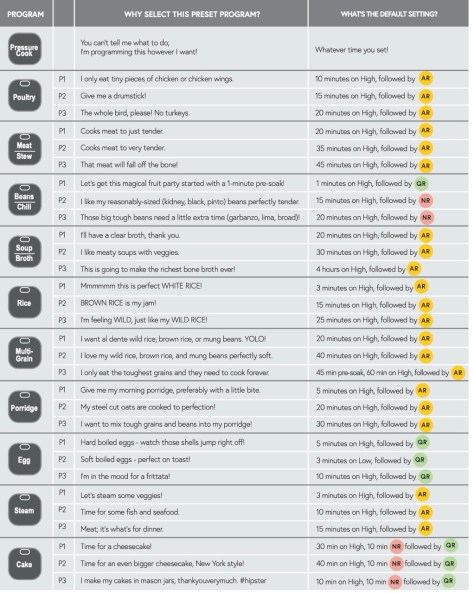
The instruction manual that came with your Instant Pot will have all sorts of useful information. Additionally, it will supply you with cooking timetables. How long to cook pork chops? Check the manual! What about black beans? Same, check the manual. It is a good idea to keep that booklet handy!
Your pressure cooker will come with valuable timing charts, so keep the manual handy.
Care of the device
My mom’s pot used a fragile rubber sealing ring, but new pots use much more durable silicone rings. I always pull these out and wash them separately. This can be done by hand or by placing them on the top rack of the dishwasher.
Please don’t store the pot with the gasket in and the lid closed. This will result in a smelly pot (remember your microbiology) and a squashed sealing ring that may not hold pressure. I always store my ring loose in the pot and install it into the lid at cooking time.
Rings will absorb food odors. If you plan to make many sweet and savory dishes, consider having both a savory and a sweet sealing ring. These rings are inexpensive and can be purchased from many places, including Amazon. Make sure you get the right ring for your particular pot, since they do come in different sizes.
You can wash the inner pot and the sealing ring (top rack only) in your dishwasher. However, the lid and regulator should be hand-washed. Naturally, the base should never be washed. Use a damp cloth to clean an unplugged unit.
How energy efficient is an Instant Pot
It’s good that your sciency dad likes to delve into such things. A while back, I experimented to determine just that. I tested several electric pressure cookers, a stovetop pressure cooker heated by an induction burner, several different sizes of crock pots, and a toaster oven. All were significantly more energy-efficient than a traditional oven, but that is no surprise. What was surprising was that the electric pressure cookers were considerably more efficient than the other appliances, including the slow cookers.
Slow cookers sip electricity, but the classic ones are constantly sipping. A pressure cooker uses a lot of energy to reach pressure, but then it rarely uses energy to maintain that pressure. The stovetop pressure cooker was also very efficient, but the electric one still beat it. However, either would be excellent in situations where you needed to conserve electricity. That is the case when I’m camping in my all-electric adventure van as I rely on batteries and solar panels to cook.
When I did my experiment, I assumed that I was cooking something that needed longer cooking, like a stew. If I were cooking something that only needed a few minutes of pressurized cooking, the pressure cooker would be less efficient, as it often takes 5-10 minutes on full power to reach pressure. A long cooking time offsets that initial energy use.
If my goal was to conserve energy, I would cook foods that require a long cooking time in a pressure cooker, but I would cook foods that require a short cooking time on the stove or in the microwave. Lastly, I’m not trying to be disrespectful of the humble slow cooker. It was relatively energy efficient, and it certainly has its place as a functional cooking appliance.
I used a Kill-A-Watt meter to measure the energy used by various small electrics. I compared several slow cookers, several pressure cookers, and a toaster oven to determine that electric pressure cookers were the most energy-efficient of the pack.
What can I cook in an Instant Pot
An amazing number of foods! If you can cook it in a slow cooker, you (most likely) can cook it in an Instant Pot, just much, much faster. Stews, soups, dry beans, rice, tough meats, etc.
You can also make dishes like one-pot spaghetti and steamed cakes, including cheesecake.
As you know, I have made many different things in our pot, ranging from countless soups, curries, and stews to St. Patrick’s Day corned beef and weekday stuffed peppers. The great thing about an Instant Pot is that it is a “set and forget” (sort of) device. Always be within earshot when using it, but you don’t have to monitor it as closely as a stovetop unit. The Instant Pot will reach pressure, cook, and then turn to keep warm all on its own.
Are all pressure cookers the same? What about a different brand electric pressure cooker?
Dear daughter, I know you have an Instant Pot, so I’m writing this section for others who may be reading this post. My electric pressure cooker is not an Instant Pot, but it works just like one.
Different machines may offer slightly different programs or features, but most don’t make much of a functional difference. The only features that may be important to some are the yogurt, slow cook, and sous vide functions, as they could be slightly different or absent on some machines. All machines have a sauté function, which is important.
Different machines may offer other options that the end user may or may not want. Most Instant Pots have a stainless steel cooking pot, while some other brands have a non-stick one. Some pots may have a broader base or locking handles for the inner pot. Additionally, different pots may have various types of knobs or switches to release the pressure. You will adjust to your particular pot as they all work well enough.
Remember, US stovetop pressure cookers use higher pressure, so cooking times will need to be slightly reduced when converting a recipe from an electric pressure cooker to a stovetop unit. Little conversion is needed for recipes that have short cooking times, but times may need to be shortened for longer cooking times. For instance, an Instant Pot recipe that calls for 60 minutes at high pressure may only need to be cooked for 50 minutes using a stove-top pressure cooker.
What about brand-X pots
When it comes to electric pressure cookers in the US, they are more similar than different. As far as I know, the vast majority of electric pressure cookers cycle between 10 and 12 PSI, so they will cook the same way as an Instant Pot.
Stovetop units made in the US operate at 15 PSI, but some European ones operate at lower pressures, often 12 PSI. This is similar to an Instant Pot, so cooking times would be the same. European stovetop brands with a strong presence in the US sometimes convert their pots to 15 PSI for the US market, so read the instructions that came with your pot.
Stovetop Chinese brands seem to be more variable, with some operating at 15 PSI and others as low as 8 PSI. If you decide to go with one of these pots, make sure you know its cooking PSI, as there is a significant difference in cooking times between 8 PSI and 15 PSI.
Conclusion
Dear daughter, it is great to see you embrace cooking from home. Pressure cookers are truly miraculous machines that can transform tough cuts of meat to tender morsels and speed up dishes that would typically require all day to less than an hour. I know you will master your Instant Pot in short order. For those other readers, I hope that this open letter has helped you understand this excellent device.
Dear reader. My daughter picked up an Instant Pot during Black Friday week and asked me for some recipes. I decided to do a post instead, as she could use it as a reference, and it may also help other newbies. The above is that post.
Images are my own or from the Mealthy Instruction Manual. All images are used for educational and entertainment purposes only.
My parents fed seven on a single salary, and much of that economy was due to my mother’s cleverness. Soups, stews, casseroles, and hot dishes are filling and delicious, and they make the most of their ingredients. Something essential during inflation and the Trump tariff taxes.
I was cleaning out our freezer to make room for new purchases when I came across a large block of ham I vacuum-sealed in April 2022. I thawed the ham and tasted it, and it was absolutely fine. That is the power of a vacuum sealer. However, now I had to do something with the thawed ham. The possibilities are many, but I thought I would go with a soup option on this blustery fall day.
I had a bag of dry 15-bean soup beans in the pantry, and that sounded like the perfect foil for the ham. This recipe makes an enormous amount of soup. Four of us ate it, and we put at least four portions in the fridge for future lunches. I also vacuum-sealed and froze another four portions for a future meal. All in all, a very economical dinner.
Let’s take a look at the recipe from http://valerieskitchen.com. I did make a few changes, which I’ll discuss in the following photos.
Several brands sell a 15-bean mix, or you may find a bag of 16-bean or 14-bean soup mix. They are all interchangeable. This bag was from Aldi, and the beans were of excellent quality. Always sort out flawed and broken beans and discard any little rocks. I have never found a rock, but it is always a good idea to look.
I soaked the beans overnight in double the water. Soaking is unnecessary if you use a pressure cooker. If you used unsoaked beans, you will need to increase your pressure-cooking time to about 40-50 minutes. If you plan on making this soup in a slow cooker or on the stove, you will need to soak the beans first. I believe soaking improves digestibility and reduces unpleasant bean “side effects.” It also reduces the pressure-cooking time to 30 minutes.
Here are the ingredients that I used. In addition to the recipe, I added 1/2 of a sweet pepper. I used an enormous amount of ham as I had defrosted a large block. However, about half of that could be used. You could use any other smoked meat, from bacon to smoked sausage. In fact, you could use cut-up hot dogs if you wished. The chicken broth was made from “Better Than Bouillon.”
Here is a close-up of the spices that I used. I added minimal salt, around 1/2 teaspoon. I was going to adjust the salt at the end of cooking, but the soup was salty enough just from the ham and bouillon. If you don’t have all of these spices, that’s OK. Use what you have. Oregano is an inexpensive and handy spice that adds interest to many dishes. I could have used just that, along with the salt and pepper. With that said, all of these spices are affordable if you buy the Walmart, Aldi, or Dollar Store brands. I didn’t use the seasoning packet that came with the beans, as that is mostly salt.
Using the saute function on my pressure cooker, I lightly browned the ham in a little oil.
I added the chopped onion and garlic and continued to cook the mixture for a few more minutes
In went the spices, which I cooked for about 1 minute more.
Then 8 oz of tomato sauce. Different recipes use different tomato options. Some use a can of crushed tomatoes, some use fresh tomatoes, and some use tomato paste. It makes no difference.
I added the rest of the vegetables.
Then the pre-soaked beans.
Finally, the chicken broth. I used about 6 cups of broth instead of the 4 cups of broth and 3 cups of water stated in the recipe. Less liquid was needed because the beans were already somewhat hydrated from pre-soaking.
I pressure-cooked the beans for 30 minutes, then waited 15 minutes to release the pressure. If I had not pre-soaked the beans, I would have pressure-cooked them for 40 minutes (or possibly 50 minutes). I used a wooden spoon to mash some of the beans to thicken the soup, but that is optional.
Here it is plated up. I served it with oyster crackers, a little cheese, and sour cream. I paired it with some of my homemade whole wheat bread. I like to break off chunks of the bread to dip in the soup; that’s just me. The great thing about soup is that it always tastes better the next day.
This batch was huge and will feed us for several meals. By vacuum-sealing and freezing a portion of the leftovers, I’ll be able to thaw the soup later for an easy, delicious meal.
I hope you know that no recipe is set in stone. You have many options to customize recipes based on your preferences or what you have on hand. Just try to pair like with like. If you don’t have 15-bean soup mix, try another dry bean that you do have. If you don’t have ham, try another flavorful meat. One idea is to save a ham bone and ham scraps from one meal and turn them into an almost-free future meal. Ham bones and scraps freeze well. If you vacuum seal them, they can last for years in the freezer.
Inflation and the Trump tariff taxes got you down? Cooking your own meals from scratch can help despite rising grocery prices. Homemade food is significantly less expensive than dining out, and in 2025, it is now cheaper than fast food. Additionally, it tastes better.
Paprikash is a simple Hungarian stew that originated hundreds of years ago. Peppers thrived in southern Hungary, and paprika is ground peppers. Sour cream was introduced into this simple dish at the turn of the last century, adding a bit of luxury to this humble stew.
Paprikash is a dish my mom made as part of her dinner rotation. You could call this part of my international dining experience, as we are not Hungarian. In that rotation was Chop Suey, which I thought was real Chinese food growing up, but it’s not. I was so sophisticated! (That is a joke.)
I love dishes that are simple to make, don’t require many ingredients, and are delicious. Chicken Paprikash fits that bill. I’m making it in a pressure cooker, which is what my mom did. However, it could also be made in other ways, for instance, using a heavy pot (Dutch oven) on the stove or in the oven. In that case, you would need to adjust the liquid a bit and stew the meat longer. Just search for a recipe that uses your particular cooking method. For example: “Chicken Paprikash made in the oven.”
You will find that there are no absolutes for this dish. Some recipes use more or less paprika, others use different chicken parts. Personally, I think this dish is best with bone-in chicken thighs, but I had boneless chicken breasts in the freezer, so I used those.
The best recipes are flexible, as they allow you to use up what you have or what is on sale. Most soups and stews fall into that category, and as you gain confidence in your cooking, you will soon be substituting ingredients while still achieving delicious results. Let’s move on to the recipe.
Easy Chicken Paprikash
This recipe is from the website dadcooksdinner.com
Here are the ingredients. They are pretty simple. I’m using cut-up boneless skinless chicken breasts, as that is what I had in the freezer. I’m seasoning the chicken with seasoned salt, which contains salt, pepper, and paprika (among other spices), for ease. I’m using paprika from the Walmart spice brand, as that is what I had, but a quality Hungarian paprika would be better. I’m mentioning substitutions to illustrate that it is OK to substitute. The result will be a bit different, but it will still be delicious. Substitute like with like. By the way, paprika is made from sweet peppers, so this dish is very mild and not hot.
Melt some butter in a pot. In this case, I’m using an electric pressure cooker (AKA Instant Pot) on the “sear” setting.
Brown the chicken in batches to prevent overcrowding; overcrowding steams the chicken rather than browning it. Remove it from the pot.
Sauté the onions for about 5 minutes, then add the garlic and cook for around 1 minute more. Garlic is high in sugar, so if you add it too soon, it will burn.
Add your spices and the tomato paste and cook for around 30 seconds. This “blooms” your spices. However, if you do this for too long, you will burn them, and you don’t want to do that.
Add the cup of chicken broth. I’m using hot water with some “Better Than Bouillon.” You could use real stock, boxed chicken broth, or even bouillon cubes. Use what you have on hand. Remember that bouillon concentrates are salty, so add salt sparingly. You can always add more salt when the dish is completed, but you can’t take it out. My finished dish was salty enough with the small amount of salt that I added along with the salt in “Better Than Bouillon.” Note: I only added around 1/2 teaspoon of salt, plus the seasoned salt that I used to season the raw chicken. This, with the “Better Than Bouillon,” was more than enough salt.
Return the browned chicken to the pot.
Pressure cook for 15 minutes on high. Let the pressure come down on its own. Alternatively, you can release the pressure 10-15 minutes after the cooking cycle has completed. That is what I did. If you release the pressure as soon as the cycle has finished, your chicken will be drier, as the sudden pressure change will force some of the juice out of the meat.
While the chicken was cooking, I boiled up some noodles on the stove. Noodles are traditional, but you could use any starch you have on hand: mashed or boiled potatoes, rice, or even toast as the base of the dish.
I mixed the sour cream with around a cup of the hot broth from the stew until smooth, then returned it to the pot. I tasted for a seasoning adjustment, but it wasn’t needed. I tend to like thicker stews and soups, so I thickened the stew by mixing a heaping tablespoon of cornstarch in around 1/3 of a cup of cold water and then poured (while mixing) that into the bubbling stew. This is an optional step.
Here it is, served with some of my homemade bread maker bran and flaxseed bread. My wife and daughter both said, “This is really rich and delicious,” without solicitation.
Cooking from scratch will become easier the more you do it. I hardly think about it. When you become confident in making one type of dish, making the next similar one is a snap. If you can make soup, you now have the skills to make stews. And so it goes.
Ease money stress by doing things that put you in charge. Cooking from scratch is one of those things.
Inflation, the Trump tariffs, and the country’s general negative disposition have me a bit down. It is time for me to return to a simpler time, and what better way than with a nostalgic meal?
This idea started a few weeks back when the family was watching an episode of “The Great British Baking Show.” During that episode, the contestants had to make school lunch items, including “school cake.” School cake is a cake with simple white frosting, set in a pool of custard.
The cake was especially evocative for Julie, who spent a semester in England during her undergraduate days. She was housed in a dorm, and they often served school cake for dessert. She has talked about it ever since.
It would be interesting to combine her school-day favorite with one of mine, Sloppy Joes. Since I was going to make the combo for dinner. I decided to class it up just a bit by making the buns and the cake from scratch. However, I was completely uncertain about the custard, as I had tried to make some in the past and was told it was incorrect. Because of this, we found some Birds Original Custard powder at the World Market. I would use that mix for the custard sauce.
Naturally, it would be just fine to make this meal more simply by buying the buns and using a cake mix. However, I had the time, so I decided to go the homemade route.
Let’s go through the recipes!
Homemade Hamburger Buns
Recipe from Ourlittlebluehome.com
I made the dough in a bread maker using the dough setting.
I divided the dough into six pieces (I really could have done seven or eight) and formed each piece into a ball, which I placed on a greased cookie sheet. I slightly flattened the dough balls, covered them, and let them rise for 30 minutes. I then brushed each bun with egg wash. I baked the buns at 350°F (175 °C) for around 12-15 minutes until nicely browned.
Here are my buns. These were Will’s favorite part of the meal. I did an entire post on making hamburger buns on October 10th. You can find that post here: https://www.drmikekuna.com/2025/10/10/
Homemade Sloppy Joes
Don’t use the canned stuff. Making Sloppy Joes from scratch is super easy.
Recipe from NatashasKitchen.com
I’m using frozen ground beef from a year ago. However, because I vacuum-sealed it, the meat was as fresh as if I had bought it yesterday.
These are kid-friendly, simple ingredients. A small onion, 1/2 of a pepper (traditionally green, but this is what was in the fridge), and some garlic.
The sauce is equally simple: Tomato sauce, yellow mustard, a little brown sugar, and some Worcestershire sauce. Just mix it all up.
I’m using an electric Dutch oven, but you can use a pot on the stove or even a frying pan.
Brown the hamburger, then season it with salt and pepper. Add the garlic and cook for a minute, then add the chopped pepper and onion, and continue cooking for about 5 minutes. Add the sauce mixture and bring the mixture to a boil, then down to a simmer for around 15 minutes. That’s it!
I toasted the buns in a toaster oven and heaped on the meat. I’m serving today’s meal with chips, but I also recall having these sandwiches with fries and sometimes tater tots. The Sloppy Joes were my favorite part of the meal.
And now for the dessert. I had tried to make school cake once before, but I had no reference point. I simply guessed. Today, I used Dame Prue Leith’s recipe, modified to a smaller quantity by the bakers at theviewfromgreatisland.com. This is a much heavier cake; it is more like a flat pound cake, but it was delicious!
Cream the softened butter, then slowly add the sugar, beating until light and fluffy. Then add the vanilla and mix in.
Add the eggs one at a time, mixing between additions.
Add the dry ingredients and mix until just combined
Pour into a greased 9 x 9 baking pan. The batter is very thick, and you will need to “maneuver” it into the corners of the pan.
Bake at 350°F (175 °C) for 22-30 minutes. Bake until lightly browned, and a toothpick inserted into the center of the cake comes out clean.
Wait until the cake has cooled completely and frost it with the simple frosting listed above. Apparently, sprinkles are an important part of this recipe; naturally, I included them.
I wasn’t certain on the custard, so I went with Bird’s, a British brand.
Here is the school cake. The custard (per Julie) is supposed to be as thick as gravy and warm. The school cake was Julie’s favorite part of the dinner.
Tonight, we went down memory lane and had a delicious, economical dinner. Everyone liked it. I will definitely be making it again.
In a recent post, I discussed rediscovering my long-neglected bread maker. In reality, I have several bread makers, as you can buy used ones for very little. I love to compare gadgets. That is just me.
It was very inexpensive for me to make bakery-quality white bread using simple, readily available ingredients. The bread was delicious, but my wife believes that white bread isn’t as healthy as other types of bread, and so I’ll try baking a multi-grain recipe. Today I’ll be using a 20-year-old Zojirushi bread maker using the whole wheat setting. It is very likely that the following recipe will work with any 2 pound bread maker that has a whole wheat cycle.
Don’t have a bread maker? Shop second-hand stores or Facebook Marketplace. You can buy bread makers for less than $10 at secondhand stores, and I have seen many in the $10-$30 range on Facebook Marketplace.
Just a few bread makers that I saw on Facebook Marketplace.
The least expensive bread makers have a loaf pan that is more vertical than horizontal. The bread will taste the same; it just doesn’t look like a traditional loaf. If you cut the bread perpendicular to the pan, you will get nice “sandwich-style” slices. Horizontal loaf pans make more traditional loaves, but the slices are pretty tall. I’m using the Zojirushi today, because its two-paddle, long-pan design produces a horizontal loaf similar in size to the bread you buy in the store.
If you buy any machine second-hand, make sure that the bread pan and paddle are included. Plug the machine in and check to see if it powers up and the buttons work. The majority of machines will work if they don’t look abused, come with a pan/paddle, and power up. I think you are best off with a machine that makes a 1.5- to 2-pound loaf. However, one-pound machines will work too if you are a small family. Making a 2-pound recipe in a 1-pound machine will result in a mess, so make sure that you use a recipe sized for your machine. Often, you can download the instruction manual for your particular machine, which will include many recipes.
The loaf that I’m making today is from the Zojirushi instruction manual. There are whole-wheat versions of multi-grain bread that can be found on the internet, but I thought I would start with a recommended recipe before attempting an internet recipe. It makes a two-pound loaf.
This is the recipe that I used. Please make sure that you add the ingredients in the order listed for optimal results. This machine uses active dry yeast for regular cycles. However, some machines may require instant/bread-making yeast. Check your manual.
Like everything else, bread prices are rising steadily due to inflation and the Trump tariff taxes. There are reports online of people spending $8 to $10 on a loaf of bread. I’m in Chicago, and we are not that high as of November 2025. However, multi-grain breads are still pretty pricey. A Brownberry 24-ounce multi-grain bread is going for $4.99, and a half loaf of Lewis 12-ounce bread is $3.79 at my local store.
$4.99 for 24 ounces, and that is the sale price!$3.79 for only 12 ounces of bread!
The multi-grain bread that I’m making today is 2 pounds, or 32 ounces. I sourced the ingredients from Amazon, Costco, and my local market. I did try to get good prices, but I would have saved significantly more if I had bought some ingredients, like the bread flour and 7-grain cereal, in bulk.
Making the bread was beyond simple and took me less than five minutes to put together. A few button presses later, and the machine took care of the rest. It truly is a set-it-and-forget-it operation. I buy my active yeast in a two-pound bag from Costco. It is very inexpensive when purchased this way. I keep it in the freezer for future bakes. The only addition that I made to the recipe was ½ teaspoon of diastatic malt. I read reports noting that a tiny amount of this ingredient helps the bread rise.
The only addition that I added to the recipe was 1/2 teaspoon of diastatic malt, which helps with texture and rise.
Here is a cost breakdown based on price per ounce of bread:
-The 12-ounce Lewis bread costs: $3.79 Almost 3 x more than homemade
-The 24-ounce Brownberry bread costs: $4.99 (on sale!) Almost 2x more than homemade
-My 32-ounce bread maker bread cost was only $3.60
It is not only more accurate to weigh your ingredients, but it is also faster and involves less cleanup. All it takes is a few clicks, and the machine does everything else. I had to run some errands, and the bread was done when I got home. Bread machines mix, knead, proof, and bake bread automatically.A few beeps lets you know that it is bread time!A beautiful loaf. Let it cool until it is barely warm; otherwise, you will rip the bread apart.A crispy crust and soft interior. What more could you want? How about that it is significantly less than store-bought!
You simply can’t beat the quality and cost of homemade bread made with a bread maker. The varieties of bread that you can make are endless, and it is possible to buy a used machine for next to nothing. Why not give it a try!
Peace
Mike
images are my own or screen captures of images on websites. All are used for educational purposes only.
Today was another beautiful fall day. The weather is cooling off in the Upper Midwest, making it a perfect time for hearty dinners. Today I will be making chili, an economical and delicious dinner, as we all battle inflation and the Trump tariff taxes.
There are as many ways to make chili as there are people making chili. Today I’ll be making some “from scratch.” However, if you want to take the easier route, you can buy a chili spice packet at your grocery store. My chili tastes better, but spice packets do a fine job, and they are inexpensive, especially if you buy the house brand.
Chili is another one of those dishes that is easy to stretch. If you have a bigger crowd, you can just toss in another can of beans. Let’s take a look at today’s recipe.
This recipe is from Budget Bytes.
A fall day’s chili
In a heavy pot or Dutch oven, brown a chopped onion, then add a heaping spoonful of jarred garlic and cook for an additional 30 seconds. You can use real garlic (a few cloves) or powdered garlic (1-2 teaspoons) instead if you like. Don’t use garlic salt, as it is mostly salt.
Add around a pound of hamburger and brown it.
Prepare your spices: 1T chili powder, 1t ground cumin, 1/4t cayenne pepper powder (a little more or a little less depending on your taste), 1/4t garlic powder, 1/2t onion powder, 1/2T brown sugar, 1t salt, 1/2 t black pepper. Where T = tablespoon, t = teaspoon.
Add your spices and cook them for around 30 seconds. Then, add one can of chopped tomatoes, one can of tomato sauce, and one can of drained beans. Traditionally, kidney beans are used, but you can use any canned bean that you have on hand. I also added some canned corn for fun.
Stir, bring to a boil, and then turn the stove down to a simmer. Cover and cook for at least 15 minutes. However, I like to turn the heat down a bit lower than simmer and cook the chili for a couple of hours for maximum flavor.
Here it is, served with oyster crackers and green onions. Sour cream is also a nice addition. For those who like it super spicy, have some hot sauce on hand for “self-administration.” I’m serving it with some yeasted cornbread. That recipe is as follows.
Yeasted cornbread in a bread maker
Recipe from the Betty Crocker Bread Baking Cookbook
Add ingredients in the order listed to a bread machine pan.
1 egg plus enough room-temperature water to equal 1 and 1/3 cups.
1/2 cup or 170 grams of honey
1/4 cup or 60 grams of softened butter
4 cups or 480 grams of bread flour
2/3 cup or 100 grams of cornmeal
3 tablespoons or 25 grams of dry milk
2 teaspoons salt
1 and 1/2 teaspoons instant yeast. Make a little divot for the yeast.
Use the basic or white bread setting for a two-pound loaf.
The bread was immediately removed from the bread maker when the cycle completed, but it was allowed to rest in the pan for 10 minutes before turning it onto a rack. I then let it cool almost completely before I sliced it.
Here is the bread sliced. I sliced it thick and then cut it in half. It was a cross between corn bread and regular bread. It was slightly sweet and delicious!
This is another one of my posts, written to show those afraid of cooking how easy it is to make a delicious, inexpensive meal. You could skip the yeasted cornbread and use a quick-bread cornbread mix. Or, you could omit cornbread completely, as the chili can stand on its own.
We are entering fall in the upper Midwest, a perfect time for stew. The great thing about stew is that it is very flexible and can be made economically by adjusting the ingredients.
I have another reason for making stew today: I’m trying to clean out my freezer because I need the space. Once a year, I get a rebate check from Costco, usually for hundreds of dollars. That check has to be spent by the end of the year; otherwise, it becomes void. Traditionally, I have used this bonus money to buy Costco meat, which I’ll then divide into vacuum-sealed pouches and freeze. In fact, this stew meat is from last year’s haul.
It’s now November, so I’ll be going on a meat run soon. However, with inflation and the Trump tariff taxes, I may not have the bounty I had before. I hope my freezer cleaning wasn’t just wishful thinking!
Let’s get into this simple and delicious recipe. I’ll be using an Instant Pot type pressure cooker, but you could also make this recipe in a slow cooker or a Dutch oven. With that said, you would need to adjust your time and possibly liquids if you chose one of those methods.
Brown 1 to 1 1/2 pounds of stew meat in a little cooking oil. Browning isn’t necessary, but it seals the meat, making it more juicy, and adds depth of flavor to the dish.
Add 1 chopped onion. Your chopping doesn’t have to be precise, as the cooking process will dissolve most of the onion.
Add a heaping spoon of jar garlic. Naturally, you could use a couple of cloves of real garlic, or even some powdered garlic. I would not use garlic salt, as it is mostly salt, and could over-salt your dish. If you do decide to add garlic salt, use only 1 teaspoon, and add additional salt only when you adjust the seasonings at the end of cooking. If you don’t like garlic, omit it.
Add some spices. If all you have is salt and pepper, that’s OK. However, I like adding spices to my dishes for extra interest. Today, I’m using around one teaspoon each of thyme, parsley, and rosemary. I had one sad, broken bay leaf, so that is also going into the pot. I also added around one-half teaspoon of pepper and a scant teaspoon of salt. I’ll further adjust the salt and pepper at the end of cooking. Remember, once you add salt, you can’t remove it.
I then added about 4 peeled and cut-up potatoes, a big fistful of washed and peeled carrots, and about three stalks of celery. There are no absolutes here. If I only had two stalks of celery, that is what I would have used. If I were trying to get rid of more carrots, I would have added more. You get the picture.
If you have other vegetables, consider adding them. What are good choices? Green beans, peas, and corn come to mind. I personally love peas in soups and stews, but my wife has an aversion to them, so no peas for us! Fresh or frozen work, and if you want to bolster up your stew, you can even add canned veggies at the end of cooking.
My kids were over for brunch today, and two were remaining at dinner time, so I put them to work. One peeled and cut the potatoes; the other peeled and cut the carrots. Bonus for me!
I added one can of tomato sauce. This adds another flavor layer, but it isn’t required. If you don’t use it, you’ll end up with a traditional brown stew. If you go the tomato route, you can use what you have on hand. If you don’t have tomato sauce, you could add tomato paste or canned tomatoes. It is all good. I then added two cans of water. You need liquid when using a pressure cooker. Why two cans? Why not? I could have added one can instead. By the way, two cans are around 4 cups of water.
Here is another optional ingredient. I added a couple of tablespoons of cooking sherry to add acidity, which wakes up the dish. A little vinegar would do the same thing. If I were using vinegar, I would add around one tablespoon.
This is also optional, but almost a necessity in my book. I added a heaping teaspoon of beef bouillon. These products have a lot of salt, which is why I make most of my salt adjustments at the end of cooking. Remember, you can’t remove salt from a dish once it is there.
I pressure-cooked the stew on high for 40 minutes, and then let it rest for 10 minutes before releasing the pressure. Immediately removing the pressure can draw out the moisture from the meat and make it dry. This is the same reason you let meat cooked in other ways rest for about 10 minutes before carving them.
Here is the stew. I like my stew a bit thicker, so I mixed a heaping tablespoon of cornstarch with a little cold water and drizzled it into the boiling stew while stirring. However, adding a thickener is totally optional. This is the time when I would adjust the salt and pepper. The stew is ready to serve and is a complete meal. It fed four of us, and there is a lot left over for lunches. If cooking for one or two, leave out enough for an additional meal and freeze the rest for an easy future supper.
To make the meal special, I baked some delicious onion-and-cheddar bread in a bread maker. I have done quite a few posts on using a bread maker. You can often pick one up very inexpensively at thrift stores; make sure it powers up at the store and that it comes with the baking pan and kneading paddle. I love playing with gadgets and have more than one bread maker. The last one that I bought cost $4.99! It was pretty grubby, but cleaned up very nicely.
Here is the recipe for the Cheddar Onion bread. I made a 1.5-pound loaf and sliced it thick (after it cooled a bit). The recipe is from the Betty Crocker bread-making cookbook. I added 1 teaspoon of Italian seasoning to their original recipe.
Cheese Onion Bread
3/4 C pluse 2 T of water
3 C Bread flour (you can also use AP flour)
3/4 C shredded Cheddar cheese
2 T Sugar
1 T Dry milk
2 t Instant minced onion
1 t salt
1 t Italian seasoning (optional)
1 and 1/4 t instant or active yeast (I used instant)
Note: T = tablespoon, t = teaspoon
Add ingredients in the order listed and use the basic or white bread setting for a 1.5-pound loaf.
This Cheddar cheese and onion bread is really delicious and is a perfect foil for any soup or stew.
Here is my $4.99 thrift store purchase. She looks pretty dirty, but she lit up when I plugged her in, and her buttons worked, so I took a chance.
Here she is after some elbow grease, soapy water, rags, and an old toothbrush. Now she looks brand new!
I’m writing these posts to encourage people to cook from scratch. Cooking at home will save you money, and it is much more economical to cook from scratch than to buy pre-made, highly processed foods. I taught my kids how to cook, and they make food and portion it into containers for easy meals during the week.
If you can’t stand leftovers, freeze your remaining food into meal-size portions to defrost for future use. Lastly, the more you cook, the easier it gets, so don’t be discouraged if your first attempts seem like too much effort.
Inflation and the Trump tariff taxes have moved me into savings mode and I’m returning to my cooking roots. I love bread, but artisan and specialty breads are expensive. Yet, their ingredients are relatively cheap.
Kneading homemade bread can be therapeutic for some, but for me the process is too time consuming. However, with a bread maker making bread is literally, “set it and forget it.”
Making a custom loaf of bread takes about five minutes of adding ingredients to the bread pan then pressing a button. Three and a half hours later I have a fresh loaf of bread. This has allowed me to customize a bread for a particular dinner that I’m making, such as making a herb bread to accompany a hearty stew. I’m not baking bread for every meal, but I do it often enough that the process has become routine.
My bread maker is accessible; I don’t have to get it out of a basement or the garage every time I need it. The same can be said for my ingredients which are handy; putting a loaf together is effortless.
As far as measuring ingredients is concerned, I do the easiest accurate method possible. Some recipes are listed by volume (measuring cups and spoons). This isn’t the most accurate, but if that is what’s listed, that is what I’ll use. The one exception is that I will always weigh the flour (roughly 125 grams/cup of flour) as measuring flour by volume is notoriously inaccurate. If I’m given a recipe by weight in grams, I will gladly pull out my food scale and use that. Baking by weight is not only more accurate, it is less messy as I can weigh everything directly in the bread machines baking pan. In this case I may still measure very light items, like salt and yeast as I find scales are a bit flaky when measuring very small amounts. No mater what method I use, making bread is very simple, even when making loaves that include a few extra ingredients.
Today’s recipe is for Sally Lunn bread from The Betty Crocker Best Bread Machine Cookbook.
Sally Lunn bread has a brioche quality, but it is a bit less sweet. Its texture and color are similar to brioche and it makes a wonderful sandwich or toast. In fact, I toasted some this morning for an open face PB J sandwich for breakfast. Delicious!
A word about keeping bread fresh. All homemade breads will stale much faster than store bought breads as homemade breads lack preservatives. I have tried a variety of methods and in general two works the best. If I make a specialty loaf that I know won’t be consumed at a meal I’ll freeze half of the loaf for a future meal. If I make a general purpose loaf I have found that a traditional breadbox works the best to keep the loaf reasonably fresh and mold free. In my climate I can still use bread that I made five days earlier, although I’ll likely be toasting it towards the end. Plastic bags will keep the bread softer, but mold usually appears in 3 days. The fridge tends to make the bread go stale faster, so that is a no go. However, if you don’t want to buy a breadbox and want to keep your bread out for a few days then do what my grandmother did. She would wrap her bread in a clean cotton kitchen towel.
Here is the recipe for Betty Crocker’s 2 pound recipe for Sally Lunn bread:
I put two eggs in a measuring cut and added enough water to make 1 and 1/3rd cups of total volume. Not shown: I also added to the bread maker 1/3rd cup softened butter.
I added 1 and 1/2 teaspoon of regular table salt.
Then 2 tablespoons of sugar.
The recipe calls for 4 cups of flour. I always prefer to weigh my flour. Four cups should be around 480 grams (120 grams/cup), but I’m finding that I have to add more flour when I check my dough ball in the machine. Now, I weigh a bit more flour, 500 grams (about 125 grams/cup). That has been working out well.
Finally, 1 and 1/2 teaspoon of instant yeast.
I set my bread maker on basic white bread.
The bread maker has beeped. Bread is done!
Always allow your bread to cool before slicing. I know that it can be hard to resists immediately cutting it, but that will result in a lot of torn and squashed bread.
Here is a slice. Rich, very slightly sweet, wonderful!