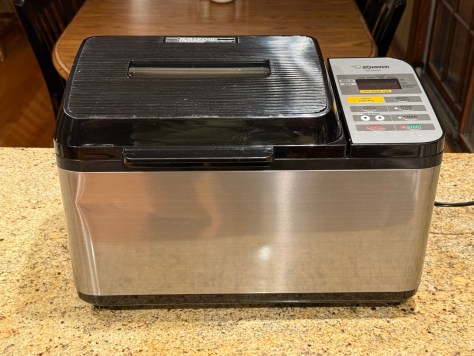
I have now written several post on making bread using a bread maker. I’m a gadget guy who has a couple of bread makers as I like to compare how different machines work. Along these lines my $14 thrifted bread maker works well as does my Zojirushi Virtuoso, which is considered a top of the line machine.
Today, I’ll make some bread in the Zojirushi machine and explore the differences between it and my $14 thrifted bargain.
Here is the recipe that I’m using today.
Remember to add the ingredients in the order listed. I’m using the whole wheat setting on the Zojirushi. The Zojirushi frequently wins top awards for the quality of the bread that it produces. It has a unique twin paddle system that makes a loaf shaped similar to the bread that you would buy at a bakery. It also has a second heating element in the lid to help with browning of the bread. You can create your own bread programs on the Zojirushi. Lastly, it has a pre-warm cycle that heats up all of the ingredients before it starts the kneading process. How important are these features? Let’s make some bread and find out.
I like to weigh my flour to get a more accurate measurement. You can weight all of your ingredients, but many of my recipes are in standard volume measurements and I’m usually too lazy to convert every single ingredient.
To 9 ounces of water I added 1.5 teaspoons of salt.
And 1.5 tablespoons of oil. I’m using olive oil here.
The recipe calls for 2 tablespoons of molasses, but I’m using honey. If you use the same measuring spoon that you used for the oil, the honey will easily slide out.
I thought I would try adding 1/8 teaspoon of ascorbic acid as this can help with rise and has some some mold fighting qualities. This step is completely optional.
Now its time to add the flour, which I did by weight. Half whole wheat and half bread flour, two cups each.
In went the two teaspoons of active dry yeast.
A bread maker is a set it and forget it gadget. However, since I’m using this recipe for the first time I wanted to make sure that the dough looks good. If there was a lot of flour remaining or if the dough ball looked “ratty” I would have added a tablespoon of water and repeat this step until I had a nice smooth ball like the one above. If the dough looked too wet and was not forming a clean ball I would add a tablespoon of flour and repeat after 30 seconds until it looked like the above.
Into the bread maker it went on the whole wheat setting.
The bread turned out well, it was soft with a good crumb.
Here are my conclusions on my $14 thrifted Regal machine versus my top of the line Zojirushi Virtuoso.
-Both can make a decent loaf of bread.
-The $14 thrifted machine has a vertical pan, so when you slice the bread you get a square slice that reminds me of square sandwich bread. The Zojirushi machine makes a long loaf that resembles bakery bread. Its somewhat unique double paddle pan creates a more traditional loaf than most other horizontal pan machines with a single paddle. Those slices can be quite tall. Note, if you cut those tall slices in half they fit just fine in a toaster.
-Both machines bake the bread well, but the Zojirushi has a finer and more even crumb.
-Some say that the double paddles on the Zojirushi kneads a better dough. However, I don’t see much of a difference.
-The top heating element on the Zojirushi does brown the top of the bread a bit better, but not enough to make it an important feature in my opinion. I have also used the Zojirushi Supreme which doesn’t have a top heater and it seems to brown the top of the bread well too.
-The Zojirushi allows you to program three additions “courses” (programs) where you can determine all aspects of the kneading, raising, and baking process. This is pretty cool if you are a baking nerd.
-The Zojirushi machines is much heavier and robust than my thrifted machine. It will likely last longer.
-Usually the paddles followed by the bread pan are the first things that need to be replaced on a bread maker. Zoljirushi will sell you these replacement parts, while most other companies won’t. However, they are quite expensive, close to the cost of a new off-brand bread maker.
-The Zojirushi sometimes makes a lopsided loaf. This doesn’t happen with the thrifted machine as the pan is vertical.
In conclusion: Yes, the Zojirushi Virtuosos makes the best loaf, but my $14 thrifted machine also does a fine job. If you are into making bread machine bread get the Zojirushi. However, it is quite expensive. I picked up mine used for much less than the retail price. If you want to save some money but still want a Zojirushi consider the Zojirushi Supreme which is basically the same machine as the Virtuoso, but without the top heater. Additionally, it has a few less “courses” (programs). However, the only additional program that is worth considering on the Virtuoso is the gluten free program. But you can program one of the memories in the Supreme to do the same thing.
With all of my praise for the Zojirushi I have to say that my thrifted machine makes fine bread and great dough. Unless you are a nerd like me it is hard to justify the additional expense of the Zojirushi machines. However, you do you.
I recently wrote a post encouraging the consideration of home baking using a bread maker. A big part of this effort is to offer people options as they feel ever pushed by inflation and the Trump tariff taxes.
Being raised in a one-income family of seven, I learned ways to stretch a dollar without feeling like I was being punished. With a bit of ingenuity, it is possible to have a good life without spending a lot of money. What could be a better mood lifter than homemade bread, pizza, and rolls?
If you have read my other posts, you know I love machines, especially kitchen gadgets. OK, I love power tools too. My rediscovered bread makers were high-end in their time, and I am accustomed to high bread standards. At the same time, it makes little sense to encourage potentially struggling readers to drop hundreds of dollars on a bread machine to “save money.” That is why it was interesting for me to see all of the used machines on the market for less than the cost of breakfast for two at a dive restaurant.
Taking a few precautionary steps can help you obtain a decent machine for next to nothing. I wanted to prove this to myself using my own hard-earned cash. I stopped by a local second-hand store and spied a Regal bread maker, likely from the 1990s. I checked it out in the store and decided that it was worth my $14. Today I’ll walk you through the process so you can also make an informed decision if you decide to take the used bread maker plunge.
First, do a visual inspection. Normal wear and tear is OK, but avoid machines that look dented or abused. This Regal machine was dusty, but it cleaned up nicely with a little TLC. The bread maker came with its original box and recipe guide, another plus! This suggests that the former owner treated the machine with care.
Check out the inside. Make sure that the machine has both its bread pan and its kneading paddle. Make sure that the bread pan can lock in place. This model’s pan had to be twisted in. Remove the bread pan and examine the baking chamber. Crumbs are normal, but avoid machines where the interior looks burnt or smells burnt. This machine was pretty clean.
This machine was made in Japan, so it is likely a quality build.
Check to see if the machine does what you need it to do. You mostly need a standard white bread program, a whole wheat program, and a dough program. This unit has a few other options too. I was able to plug in the machine at the store and test the display and buttons. Everything seemed to work.
Examine the unit for any hidden damage. In this machine the plastic pins that held the cover in place were broken. However, this did not impact the functioning of the machine.
Bread pans are expensive to replace and it is likely that an old model like this one wouldn’t have replacement parts anyway. Make sure that the non-stick coating on the pan looks good and that the paddle rotates freely.
I decided to make a small loaf just to see if the machine worked. The loaf baked properly, but it was a bit smaller than expected. However, that can be corrected with a little ingredient tweaking.
The texture was not quite as good as my expensive bread makers, but the crust was good, the bread was fully cooked, and it was delicious. This bread maker makes the older style vertical loaf, but that works if you cut the bread perpendicular to the pan (as above). It makes up to a 2 pound loaf, which is another plus at this price.
All in all, an amazing value for $14. This small purchase opens up a world of fantastic homemade breads of all types as well as dough perfect for rolls, pizza, and baguettes. It also features a few extra cycles for foods like quick breads, and sweet breads. A great purchase!
Check out your local thrift store or Facebook Marketplace to find your bread maker today! You could get stuck with a broken machine, but at this price… well, you have to sometimes take a few risks in life.
Let’s face it, not all of the meals that you make have to be cross-checked with the Department of Agriculture’s nutritional guidelines or some TikTok influencer’s biased opinion. Sometimes you just need to eat something that fills your stomach, or you need to use up the food in your fridge. That’s okay, life isn’t about being perfect.
I’m close to my kids, and they are close to me. All but one have launched into their own apartments, and it is clear that we miss each other. We have had plenty of times to get together, but my one daughter wanted to formalize another activity where we all could participate. She suggested that we have regularly scheduled rotating Sunday brunches. I was immediately on board. Naturally, all were welcome, including their significant dates (I’m not sure what the proper term is for a boyfriend or girlfriend in 2025).
The family brunch rotated to our house a week ago, and we made sure that there was plenty of food. We had freshly baked cinnamon rolls made by my daughter, an egg dish casserole, fresh fruit, juice, and all sorts of other goodies. When I was at the store, I spotted some precooked turkey sausage patties on sale, and so I picked those up too. However, I forgot about them in the fridge. The other day, my wife asked me, “So, what are we going to do with those sausage patties?” Hmm, sounds like an easy weekday dinner idea.
It was great to have the kids and their friends over for brunch, but I forgot to make the sausages!
I love having traditional breakfast meals for dinner. Heck, sometimes I eat dinner leftovers for breakfast. I have no shame. My kids are used to this flexibility and are fine with it. It was a Wednesday night, and it was my turn to make dinner. What to do? Hmm, I’ll make some biscuits and gravy for dinner! Being a weekday, I lazily used some tube biscuits, and I had to be somewhat creative with making the gravy, as precooked sausages don’t render a lot of fat. However, all worked out.
My son was afraid that he would still be hungry, so he took on the task of adding some scrambled eggs. Honestly, they were not needed, but it made him happy, and he even washed his pan, so I can’t complain.
Biscuits and gravy are a soul-satisfying dish. I probably had it for the first time at a Shoney’s on a trip down South. I instantly loved it as it was strangely familiar. It dawned on me that it was very similar to a no-meat Friday dish my mom used to make, called creamed eggs on toast. In that dish, the biscuit were replaced with toast, and the sausage was replaced with slices of hard-boiled eggs. Don’t knock it if you haven’t tried it!
The recipe is super simple and very inexpensive. It easily fed three of us, and both Will and I had the leftovers for lunch. The leftovers reheat in the microwave.
I suppose this would be called a struggle meal, but it doesn’t feel like one when you eat it. Refer to the photos for my step-by-step recipe.
Traditionally, fresh pork sausage is used. However, these were precooked, and when I browned them, they didn’t release much fat.After I browned them, I chopped them up. If these were traditional sausages, I would have just broken them apart in the pan. Oh, take off the skin if you are using links.Usually, there would be enough grease from the sausage, but these pre-cooked ones were pretty lean. I added a couple of tablespoons of butter to make up the difference.I mixed everything up and sprinkled 1/4 cup of AP flour over the sausage. I slowly poured in 2.5 cups of milk (whole milk is the best), constantly stirring, over medium heat. It will take a couple of minutes for the white sauce to thicken. Then I tested for salt, but it didn’t need any as the sausage was salty. The secret to good biscuits and gravy is having enough pepper. Start with around 1/2 of a teaspoon and add more until it tastes right. The white sauce should be peppery, but not excessively so.This is what the gravy should look like when it is ready to serve. Here it is served up on some tube refrigerated biscuits. Naturally, homemade biscuits would have elevated the dish even more. My son made the eggs, but they weren’t really needed. The overall results? Delicious! Yes, I’m expecting “heart attack on a plate” comments, but “ya gatta do what ya gatta do!”
This is another in my series on saving money on groceries while improving your dining experience.
As inflation and the Trump tariff taxes continue to push up prices, it makes sense to find ways to stretch your food dollars. Making your own bread is not only less expensive than store-bought bread, but it also tastes better and can be customized to your needs. Like thicker or thinner slices? No problem., Sick of the outrageous prices of gluten-free bread? Make your own. Desire a specialty bread for a special meal? Absolutely!
My wife made a run to the grocery store and was happy that Ezekiel Bread had been restocked. However, she wasn’t pleased when she realized that a small loaf was now ten dollars. She didn’t buy the loaf.
Bread is the staple of life, and just about every culture has some form of bread. Bread is considered a subsistence food that provides the calories, vitamins, minerals, protein, and fiber necessary for life.
When I was growing up, my mother bought “Silvercup” bread, which was one step above “Wonder Bread.” It was good for sandwiches, but likely not the best in terms of nutrition. We also bought bread from our neighborhood bakery. What a difference that bread was. I have fond memories of walking into that place and being welcomed by the scent of freshly baked bread. I remember, with fascination, the clerk taking a fresh loaf, pushing it through a slicing machine, and then deftly shoving it into a waxed bag. That bread was the best.
My grandmother made most of her family’s bread, and it was delicious. She made a light rye bread that was baked into a large, round loaf. She didn’t buy yeast; instead, she would seed a new batch of dough with a portion of the dough she had saved from the week before. I can’t imagine that she measured anything; she just knew what to do after baking thousands of loaves of bread by hand. Making bread was part of her life, and I’m sure it occupied at least one whole day of her week.
My mom would make yeasted bakery, but I don’t recall her making bread. Most of her yeast bakes consisted of various filled coffee cakes, which we called kolaches, not to be confused with those delicious fruit-filled cookies called Kolacky.
I’m not sure exactly when I made my first loaf of bread, but I started to make it regularly during my residency. I was divorced at that time, and one of the few things that I took from that marriage was a large Cuisinart food processor, as my ex had no use for it.
I love machines, and the Cuisinart is one of them. I was determined to learn how to utilize every aspect of its capabilities, including its ability to knead bread dough. I read somewhere that a flour company had a recipe book for “cool rise bread,” and I tracked down their address, which was in another state. This was before the internet, so that task was more complicated than typing in a query in Google. I wrote them a letter..
A few weeks later, I received a nice note from the flour company, saying that they were surprised to hear from me, as their flour was not sold in the Chicago market. However, they sent me the booklet and wished me well. I adapted their recipes for my food processor.
Cool-rise recipes were ideal for me at that time, as I could quickly mix and knead the dough in the food processor, then drop the dough into a couple of bread pans that I placed in the refrigerator, where they would slowly rise. Eight to 48 hours later, I would bake the bread at my convenience. Having fresh bakery fresh bread as a poor medical resident was a tremendous morale booster. Typically, I ate generic white bread that tasted like sawdust.
When the bread machine craze hit in the 1990s, I bought a machine that made one-pound loaves. I upgraded to a machine that made 2-pound loaves sometime in the early 2000s, and I still have that machine today. However, I eventually stopped using my bread machine, and I’m not sure why.
This bread machine is over 20 years old, and it still works!
As my kids got older, I would make bread for them as a treat; soon, they were helping me in the process. By then, I had graduated to a Bosch Universal Mixer, a tremendous mixer that could make six loaves of 100% whole wheat bread at a time. It was great. However, the Bosch method still required work, and I no longer need six loaves of bread.
My Bosch Universal Mixer can easily make six loaves of 100% whole wheat bread.I rarely need this much bread now.The bread made in the Bosch is fantastic, but it still requires some work.
During the pandemic, I was cleaning my basement and rediscovered my bread machine. Would it even power up after sitting dormant for years? The answer was yes!.
I do most of the household’s cooking and make a lot of food from scratch. I cook many combination foods, such as soups, stews, and casseroles. These types of foods lend themselves well to a bread product, and I’ll often whip up something ranging from cornbread to a savory muffin. However, nothing has quite the allure of the smell of freshly baked bread.
Humans have been making some form of bread for over 14,000 years, and it is possible to make bread with the simplest methods and ingredients. Some people love the physicality of kneading dough, but I’m not one of them. However, I love the taste of homemade yeast products, and that is where my old bread machine comes to my rescue. I can toss in a few inexpensive ingredients, press a button, and a few hours later, I have a fantastic loaf of warm bread.
There are hundreds of bread recipes that can be made in a bread machine. White, rye, wheat, fruited, nutted, egg-enriched, sweet, savory, you name it. I made a nice white loaf today. What did it cost me for a 2-pound loaf of fresh, delicious bread? Around seventy-eight cents, including the cost of the electricity.
Bread machines are no longer trendy, so you can often get a used one at a second-hand store for almost nothing. Just make sure that the pan and paddle are included and that it powers up when plugged in. They are very durable, as mine is still running strong, despite being over 20 years old. Most electronic gadgets left in a basement for years would be out of commission. Mine is not an isolated case, as there are internet reports of others who are still using their bread machines decades after purchase.
In fact, I recently searched for bread machines on Facebook Marketplace and found many used models in the $10-25 range. You can’t even go to McDonald’s for that amount of cash. If you are interested, this is what to look for:
-Get a machine that makes between a 1.5 and 2-pound loaf
-Most prefer a traditional horizontal pan, but a vertical pan also works.
-Make sure that the unit comes with the baking pan AND the paddle.
-Make sure it powers up when plugged in.
-You can find recipes on the internet, and you can likely download your particular machine’s manual/recipe guide from the manufacturer’s website.
Many new bread machines sell for under $100, but top-of-the-line machines, such as those from Zojirushi, cost hundreds. Zojirushi is considered the best, but most will do fine with a less expensive brand.
Machines come with multiple programs to make different types of bread. Most users will use only three types: standard (white) bread, whole wheat, and dough. The dough setting is a great option, as the machine will do all of the hard work of making the dough, and all you have to do is form it for baking. The dough setting is terrific for making pizza dough, rolls, coffee cakes, and braided breads, where you make the dough in the machine but bake it in your regular oven.
Most bread machines come with various programs to bake different types of bread, such as white and whole wheat. The controls may appear complicated, but they are very easy to learn, and in most cases, all you need to do is press a button.
Some additional program settings may be included such as sweet breads, and gluten-free bread. If your bread maker doesn’t have a particular specialty setting you can try using the standard white bread setting. Additionally, some machines allow you to create programs where you determine each step of the bread making process. This last option is for advanced users who develop their own recipes or who use unique bread flours that require unusual mixing, kneading, and backing times. Will you use the cake, yogurt, or jam settings that your machine may have? Probably not, but that’s your choice.
Although many ingredients can be used to make bread, here are the basic ones and why they are necessary:
Flour – There are many types of flour, but for simplicity, let’s focus on white flour. Most bread machine recipes instruct you to use bread flour, a flour with a 15% gluten content. When your machine kneads dough, the gluten proteins are altered, becoming stretchy and more flexible. This results in a delicious, chewy, and spongy bread. All-purpose (AP) flour is a versatile flour suitable for a wide range of applications. It typically has a gluten content of 12-13% so bread made with AP flour won’t be quite as chewy or structurally sound as bread made from bread flour. In an ideal world, use bread flour for optimal results. You can simulate bread flour by adding a couple of tablespoons of Vital Wheat Gluten to AP flour to your bread ingredients, or just forgo the vital wheat gluten and still make a delicious breadmaker loaf using only AP flour. I often do that as I always have AP flour on hand. Lastly, cake flour contains only 7-9% gluten, as you don’t want a chewy cake; the low gluten content assures a tender result.
AP flour is inexpensive. This bag will make five one-pound loaves of bread. I often use AP flour because it’s in my household stock.Bread flour is also inexpensive, and it makes a better loaf. If you make bread regularly, consider buying and using bread flour.
Yeast-yeast is a living organism that feeds on the sugars and starches in bread dough and produces carbon dioxide gas, or CO2, as a byproduct. It is the CO2 gas bubbles that cause bread to rise. The yeast is killed in the baking process. Yeast comes in various types. Some bread machines use Active Dry Yeast, while others require Bread Machine Yeast, which is also called Instant Yeast. Instant Yeast granules are smaller and dissolve faster than the granules of Active Dry Yeast.
My bread machine uses Active Dry Yeast that I can buy in bulk at Costco. Each loaf uses only around ten cents’ worth of yeast.
Sugar-any form of sugar can be used, white sugar, brown sugar, honey, and molasses. Small amounts of sugar are added to help jump-start the yeast’s growth.
Any sugary product can be used for bead making, but most people have white sugar on hand. The recipe below uses around five cents of sugar.
Salt-salt adds flavor and also controls yeast growth. Never mix salt with the yeast when you add your ingredients; put them in a separate spot in the machine’s bread pan.
Water– is needed to bind all of the ingredients together. Naturally, other liquids, such as milk, are sometimes used to achieve a different type of loaf.
Other ingredients-.Eggs, dried fruits, spices, cheese, meats, different types of flours, nuts, butter, cooking oil, powdered milk, you name it. Each addition requires a slightly different recipe and may require different rising and baking times. The good news is that others have already figured out all of this. If you have a new machine, read the manual/recipe booklet. If you purchased a used breadmaker, download its manual, which will include recipes ranging from white bread to pizza dough, specifically created for your machine.
A simple and inexpensive white bread recipe.
*You must add ingredients into the baking pan in the order written.
-1.5 cups warm water
-2 T cooking oil
-1 and 3/4 t salt
-4 cups or 500 gms bread flour (or AP flour)
-2 T sugar
-2 ¼ tsp bread maker yeast (I use regular Active Dry Yeast with good results)
I weigh my flour for better results. Five hundred grams is equivalent to 4 cups of flour. Add ingredients in the order listed. I keep the salt and the yeast in separate spots, as salt can kill yeast if it is too concentrated.Just press a button and the machine will mix and knead the dough in several cycles before baking it. A perfect loaf!Use a serrated bread knife when cutting soft breads. The knife on the top is a food service knife, and it wasn’t very expensive. Its slightly longer length works well to make short work out of making slices. Nothing is quite as wonderful as fresh, warm, crusty homemade bread!
Use your bread maker’s “normal” or “white loaf” setting. Mine makes a great loaf of white bread in 3.5 hours. Total cost of the loaf, including electricity? $0.78!
Allow the bread to cool at least 30 minutes before cutting. A serrated knife works best. Any will do, but I like a knife that is a bit longer. It is not necessary to buy an expensive serrated knife, as they are no different from a less expensive one. Serrated knives don’t cut the bread; they tear into it. I have also used a standard Chef’s knife. If it is sharp enough, it will slice bread.
Remember, that homemade bread has no preservatives or other agents to keep it looking fresh. If you don’t consume it in a couple of days, freeze it. You can purchase inexpensive bread bags on Amazon, as well as other types of containers, to store unused bread. If we have any left after a meal, we usually use a large Ziploc-style bag, as we have those on hand.
Homemade bread machine bread is delicious and almost effortless to make. Having a homemade slice of bread with dinner elevates the experience, and a lunch sandwich made with homemade bread is superior to any packaged product. If you see a machine at a thrift store, give it a try. If you want to buy new, there are many machines available in the sub-$100 range. Happy bread making!
Mike
Images are my own or screenshots used only for educational purposes.
My wife came home from Costco. Lately, when I go to Costco I wind up spending $300-$400. “What was the bill?” I asked “I only spent $100,” she said. “Awesome!” I replied. However it turns out that it was $100 for only 5 items.
I’m finding that I feel anxious when thinking about buying food, and I have noticed that I’m not only changing how we currently eat, but I’m also contemplating how I can further adapt our eating habits.
I have long given up regular trips to restaurants, and I have dramatically cut back on what I order when I go through a drive-through. Cuts of beef, from a steak to a pot roast, have become luxury items for special celebrations. Now, even ground beef is starting to feel out of reach. I just came back from the grocery store. I passed on ground beef and bought ground turkey instead.
My friend sent me this photo from Costco. imported beef at almost $350!
Inflation accelerated during the COVID-19 pandemic. We were informed that prices would need to increase due to supply chain issues and factory slowdowns resulting from worker illnesses. However, that is only part of the story. A 2023 report from the Fed noted that overall corporate profits were 11.3% in 2020, 19.2% in 2021, and 15.1% in 2022. In other words, corporations generated significantly more profit during the COVID-19 pandemic. They passed on any extra costs to the consumer and also saw an opportunity to add a “little more,” as consumers were conditioned to expect higher prices.
Corporations realize that if they create the right narrative or gradually increase prices, the populace will accept higher prices to a certain extent. A fundamental principle of economics is that when prices become too high, people stop buying. When this happens, a company will likely lower the cost of the item to encourage buying. When consumers are comfortable with the new, lower but still elevated price, the company will resume the increase. In this push/pull system, the overall price of the items continues to increase over time.
A few years back, I would buy a dozen eggs at Walmart for eighty-eight cents. They were an economical source of protein. Then the prices began to rise steadily. At one point, a dozen eggs were selling for almost $7. They were no longer a bargain, and I, along with others, curtailed my egg purchases. I went so far as to use an egg substitute when baking. When prices dropped to $4, I thought happy times had returned, yet I was still paying over four and a half times more than my original price. That is a 450% increase in a basic commodity.
We were told that eggs were more expensive due to the bird flu. Was that true? No, it wasn’t. The largest corporation in the egg business is Cal-Maine. They control 25% of the market pie. Their profits have soared during the bird flu, and guess what, their egg production was only slightly impacted. The bird flu was used as an excuse to raise prices. Did you notice that there was a shortage of eggs, but not a shortage of chicken? If bird flu were so damaging, we would have seen a shortage of chicken, too. I’m not saying that bird flu wasn’t real. However, I am saying that it was used, just like COVID, to raise prices well beyond where they needed to go.
Have you noticed that Hershey bars are more expensive? This is due to the increased prices of ingredients such as cocoa and sugar, correct? During a corporate call to shareholders, the CEO of Hershey informed stockholders that the increased prices not only covered inflation but also significantly increased profits. That is the same story as the eggs. Take a real situation and use it to create a plausible narrative that encourages consumers to spend more money.
Add tricks like shrinkflation and skimpflation, and the consumer gets even less for their cash.
Food companies can use these tactics because we no longer have a competitive market. A relatively small number of companies control our food supply. They no longer have to compete by offering value. Instead, when one company raises its prices, the others tend to follow.
My newish refrigerator has a water filter that has to be changed every 6 months. The filter is specific to the brand, and I’m unaware of 3rd party options. That filter contains activated charcoal to improve the water’s taste and possibly also includes a sediment filter. These filters should not be costly to manufacture, and objectively have not improved the quality of my city water. How much is this proprietary filter? Forty-nine dollars! That is $100 a year that I have to spend on something that I don’t need or want.
My buying habits are changing. I no longer want the fanciest fridge; A future one will be as basic as I can get. I want my 2014 car to last as long as possible. For me, there is no excitement in buying a new car for $60,000 to $80,000. Especially, since many new cars are plagued by factory recalls. By the way, some cars now require a monthly subscription to keep certain functions. You buy a brand new car, but you have to pay more money just to use its features.
Add to this corporate greed the new Trump tariff taxes that have been imposed on us. Please listen, tariffs are a tax imposed on consumers. In this case, they are no different than a state sales tax that you pay, except that this sales tax goes to the federal government. Tariffs are a means of increasing federal revenue through taxation of citizens. This is not my fantasy or opinion; this is a fact.
Let’s say I buy a pound of coffee for $10. In my area, a 1.75% state sales tax is applied to grocery purchases, so the total cost of a pound of coffee is $10.18. However, there is now a 50% tariff tax on products from Brazil, which is a major coffee producer. That increase will be passed on to the consumer, as corporations must generate profits for their shareholders. Now, my coffee will cost me $10 plus a 51.75% tax, or $15.18. Don’t believe me? Take a look at the increase in coffee prices at your local store. Guess what? The costs are likely to increase even further. Naturally, some companies will try to add a few bucks past that amount to make “a little extra.”
My primary concerns center on the items I use and consume on a daily basis, including food and other products. I’m changing my habits here too.
In 1999, I was treating several prominent scientists, as I live in a technology and research corridor. They warned me about the potential catastrophe that could happen as we entered the year 2000. Honestly, it spooked me, and, being a planner, I overreacted. I bought everything from long-term storage foods to diapers (my kids were young at the time). The 2000 collapse never occurred, and my wife was not very happy with my purchasing decisions, many of which had to be discarded in the end. Lesson learned. However, I’m still a preparer, and I do think it is rational to make behavioral changes now and to do some limited stockpiling. The latter won’t eliminate inflationary problems, but they may soften the blow a bit, at least for a while.
Sadly, some cash on hand is needed to do many of these things, and cash has become increasingly scarce for some as prices have gone up. However, if you select and implement some of these options, you may see benefits in the suggestions.
Major appliances
Virtually all major appliances source their parts from international manufacturers. This is true for companies that build appliances in the US. After all, we have had a global economy for the last 70 years. If you believe an appliance is nearing the end of its life, this may be the ideal time to purchase while old stock is still available. Additionally, check the reliability of a particular brand. New appliances don’t last as long as older models, but some are better than others.
Clothing
I’m fortunate to be retired, as my wardrobe is not only casual but also repetitive. If it is clean, I wear it. However, if you need clothing, you may want to explore options from sales to resale. I believe in a capsule wardrobe where a few pieces can be utilized in multiple ways. Use what you have, buy only what you need (not want). Opt for quality over designer brands or fast fashion. Basic colors and classic styles are the best approach. The goal is to look neat, but to NOT have people remember what you wore a week earlier. Basic, neat clothes will do just that.
Energy
All energy costs are high, and many are going up. Practice reducing your energy needs. Turn up the AC temperature and turn down the furnace temperature. Use LED lights and turn them off when you are not in a room. Plan errands so you can accomplish several in one trip instead of multiple trips. Consider unplugging devices, like a rarely used TV, as many of them consume almost as much power when they are “off” as when they are “on.” Cook using energy-efficient appliances like a slow cooker, Instant Pot, or toaster oven, as they are more energy-efficient than a traditional stove. If you use your oven try to make multiple dishes in it at the same time.
Small appliances can not only save you energy costs, they tenderize tough meats and make your cooking tasks easier.
Batteries
Batteries are expensive, and almost all of them are made overseas, so they will become even more costly. Consider buying items that can be recharged. Also consider purchasing rechargeable batteries. Most of my flashlights are USB rechargeable, and I also have AA and AAA batteries that I can recharge hundreds of times before they need to be replaced. Batteries will increase in price due to the Trump tariff taxes.
Food and Consumables
I suggest buying extras if you can afford to do so. A little extra here and there will temporarily save you money in the long run.
Cleaning solutions.
When COVID-19 hit, I found it very difficult to find many typical soaps and cleaning products, so I started concocting my own. I fill a 32-oz spray bottle with warm water and add a scant teaspoon of dishwashing soap or one ounce of all-purpose cleaner (such as Lysol or Mr. Clean) for an effective and gentle surface cleaner. I use a squirt of dish detergent to clean my toilets, and cheap powdered Comet to clean my sinks.
American-made cleaning solutions are often made from chemicals purchased abroad, so their prices are likely to increase. P&G is already implementing price changes that are likely to continue to rise. You may want to have extras of all cleaning products that you use, from dish soap to dishwasher and laundry detergent. We usually use dishwasher pods, but I bought a few boxes of dishwasher powder as it is relatively inexpensive and can be stretched if necessary. Additionally, I purchased extra laundry detergent. If you live a sedentary, dirt-free life like me, you may not need the most expensive laundry detergent. You can get by with a cheap detergent and a spray bottle of stain remover for those occasional spills and splashes.
During the COVID-19 pandemic, I couldn’t even find liquid hand soap, so I made do by using a foaming dispenser. Fill the foam dispenser with 20% liquid hand soap and 80% water to save money. You will get foam soap that works great and doesn’t drip all over your sink.
Paper Products
I love my paper products, but I’m making a conscious effort to reduce their use. A significant portion of paper pulp originates from Canada, and the Trump tariff taxes are particularly high on Canadian products. A few months back, I purchased extra dish towels, which I’m trying to use instead of paper towels. Old rags are also helpful. If you have old T-shirts, cut them up and give them a new cleaning life. I still use paper towels when the situation calls for it, but I use them more sparingly. I’m also reducing the number of paper plates that I use.
During the COVID-19 pandemic, I struggled to find toilet paper, so I installed a bidet. The fancy ones are pricey, but you can buy a basic one for under $50. This may sound crazy, but you can be much “cleaner” just using a bidet. Naturally, we still have TP, but we are using less of it. A bidet was something that I never thought about, and now that I have one, I can’t imagine not having one. They are that good.
Plastic Products
We appreciate the convenience of Ziploc-type bags and use them for everything from lunches to storing leftovers; however, we are trying to use them less frequently. They will be going up in price as their raw materials increase in cost. There are specific Rubbermaid-like containers for sandwiches, food storage, and just about everything else. If you are especially frugal, you will find that many lunchmeat packages can be reused as a sandwich container. Pro tip: Wash all containers by hand to prevent dishwasher lid shrinkage.
Food Products
All foods are increasing in price, but those strongly impacted by the Trump tariff taxes will be hit the hardest. It may be a good idea to stockpile non-perishable foods. I’m buying a few extras of the following types of foods:
-Beans, rice, lentils, etc.
All of these items have very long shelf lives if stored in a cool, dry place. We are trying to incorporate more of these products into our regular diet.
-Canned goods
We have switched to house brands and are purchasing more of the products we regularly use, such as canned tomatoes. Canned vegetables can be good bargains, but, like everything else, their price will increase over time. Canned food doesn’t require refrigeration, and stores best in a cool, dry place. Many canned foods, including meats, will stay usable for years in a sealed/undamaged can.
-Sugar
Today I bought a spare 4-pound bag of sugar, as we do a lot of baking from scratch. Sugar prices are on the rise and are expected to continue increasing. Sugar can last indefinitely if stored in a cool, dry place.
-Basic ingredients
I’m also buying extras of spices that I commonly use, as their prices are expected to increase. The same can be said of everyday items, such as cooking oil and olive oil. Since we cook a lot from scratch, I bought an extra tub of baking powder and cornstarch to have on hand.
Walmart, Aldi, and dollar stores often sell spices significantly lower than a typical grocery store. If you use a spice often you can buy it in larger quantities at warehouse clubs, like Costco.
-Meats
The price of beef is outrageous, so I’m finding that we are not only having meatless and low-meat meals, but we are also shifting our meat preferences away from beef, including hamburger. I’m just back from the grocery store, where I bought ground turkey, which was on sale instead of hamburger. I’m also experimenting with TVP, or textured vegetable protein, as a nutritious, high-protein additive to stretch meat.
Here I’m using soy chunks (TVP) instead of beef. The final product was pretty good!
-Do Price Checks
It used to be that if you bought a larger size of something, the overall price was cheaper. That is no longer the case. Check the price per ounce or price per item in the box to ensure that you are getting the best value. With that said, meat and other items can be substantially cheaper when purchased in family packs or larger bulk packages.
-Clip Coupons
I’m adding this as some people can save quite a bit with coupons. However, I really hate using coupons. Our standard grocery store offers values, coupons, digital coupons, sale prices, two-for-one deals, buy one and get 50% off the second item, and other promotions. I feel like I need a PhD in groceries to choose the right option. More than once, I found out that I did the wrong thing at checkout and had to pay full price. I would rather shop at a store that consistently offers lower prices.
-Shop discount stores
Consider shopping at discount grocery stores, like Aldi. These stores are smaller, making them easier to navigate. They have fewer options, so no decision fatigue, and their overall prices are lower. In my area, prices are significantly lower than those at a standard grocery store.
I love my local Aldi.
-Cook from scratch
Cooking from scratch is easy, less expensive, and yields superior results. I use appliances like a slow cooker and Instant Pot to make my cooking even simpler. You can find simple recipes using a basic cookbook (like Betty Crocker) or online.
I have a relative who exclusively uses convenience foods, including frozen dinners. She spends hundreds of dollars every week on her food, which is her right. However, I mostly buy from Aldi and purchase basic ingredients. I often cook for five, and I spend less per week on groceries than she does for one. The more prepared a food is, the more expensive it is.
The more you cook from scratch, the easier it become. Also, the food tastes better!
-Cook and buy intentionally
I prepare balanced meals, but they often consist of combination foods, such as soups, stews, and casseroles. These foods are meat stretchers. I also try to make enough food without having a lot of waste. I know that my son will eagerly eat leftovers for lunch, but only once or twice. If I’m making something like a pot of soup, I proportion it accordingly. If I have extra food beyond what I can use as leftovers, I’ll freeze it for future use.
-Substitute when needed
Some recipes require a lot of exotic spices or ingredients. If the recipe is too elaborate, I’ll move on. However, I have also learned the art of substitution. If I can approximate a spice blend that I’ll rarely use, I’ll mix my own. If a recipe calls for tomato paste and I only have a can of tomatoes, I’ll use that and adjust the liquid accordingly. If the recipe calls for buttermilk, I’ll add a little vinegar to milk and make my own. I do this often, and with a little trial and error, I usually produce a good product using reasonable substitutions.
-Consider “Meatless Monday”
Consider a meatless dinner once or twice a week. The options are endless and delicious.
Meatless meals can be satisfying and delicious!
-Use up stuff.
Americans waste 30-40% of the food that they purchase. That is money that you throw away. Consider checking out your perishables and creating new meals based on them, rather than just following your taste. Be creative and repurpose leftovers. Add leftover rice to a can of soup for lunch, or use last night’s leftover vegetables in today’s casserole. You get the idea.
-Limit Options
Instead of having endless choices, limit what you use and eat. I rotate between a couple of basic breakfasts every day, and most of them don’t involve meat. I eat a lot of peanut butter, often adding it to something like oatmeal, an apple, or toast for breakfast.
Some families have a roster of 10-20 dinners that they rotate. This makes grocery shopping and meal preparation simple and routine.
I’m a peanut butter fan and will often have it on an apple, banana, toast, or mix it into some oatmeal for breakfast.
-Use prepared foods sparingly
I do use some prepared foods, but I’m careful about what I use, not only because of the cost but also because of the additives. However, sometimes a can of condensed soup can make it easier for me when I’m throwing together a casserole, or I’ll use a cake mix for an impromptu dessert.
-Give yourself a break
Long ago, we started to have carry-out pizza every Friday for dinner. However, we have now switched to frozen pizza, and we buy our pizzas on sale. Is it the healthiest food? No, of course not. But it serves its purpose as an easy meal after a long week. Sometimes life is about compromises.
-Learn to bake
A lot of baking is elementary, and nothing tastes better than homemade baked goods. We do scratch baking, but also use mixes, which are inexpensive and yield a good result. This Sunday, I’m going to make lentil soup, and I’ll also make a homemade loaf of bread. I have an old breadmaker, and all I have to do is add some ingredients and press a button. You can often find used breadmakers at second-hand stores for next to nothing. Just make sure it has its baking pan and dough paddle, and that it powers up. Real, delicious warm bread for less than the cost of the store-bought stuff. Perfect to go with some soup.
Baking is fun and easy. Here I made some muffins from scratch, but I used a cake mix for an Angle Food Cake.
-Consider a freezer
OK, this may sound crazy, but a freezer can save you money. They are not very expensive, and you can often find used ones at very low prices. The chest style ones are the least convenient but the cheapest to buy and operate. A freezer uses very little electricity per year. I have had a 12-cubic-foot, non-defrosting freezer for at least 25 years. It is great to have when I find a good sale or buy in bulk. I am certain that my freezer has saved me a significant amount of money over its 25-year lifespan.
My little freezer has saved me a lot of money over the years. Freezers use very little electricity.
-Consider a vacuum sealer
You’ve seen me say this in post after post. No, I don’t have stock in a vacuum sealer company!
You can buy an off-brand for under $50, and bags/rolls can be purchased cheaply if you buy generic in bulk. I have used a vacuum sealer since the early 1990s and a chamber-type vacuum sealer since 2022. Vacuum sealing meats will keep them free from freezer burn, and meats can last for years in a freezer. I vacuum seal a lot of other stuff too, but that’s for another post.
Chamber sealers are more expensive, but they use dirt cheap bags and handle liquids well. As a vacuum sealer enthusiast, I purchased one. However, if you are getting started, consider buying a traditional external vacuum sealer (similar to a FoodSaver) on Amazon for $50-$100, as well as some bags or rolls. Using a vacuum sealer can save you money over time.
I use a chamber vacuum sealer, but they may be too much for a beginner. Consider a traditional external vacuum sealer.
I am not saying you have to do everything on this list; I’m just trying to motivate you to think about ways to stretch your dollar in these challenging times of inflation and enormous taxes. Use your critical thinking to generate your ideas. Ponder, “Do I need to buy this? How can I use something that I already have? And so on. We are in this together!
Food prices have been rising significantly and are expected to continue increasing with the new tariff taxes that we are all now paying. Since everything, from the aluminum in a soda can to the tomatoes on our salads, is imported, it is expected that the prices of most foods will increase further over time. Even US-sourced foods are skyrocketing in price. I was recently at the grocery store and spotted a beef brisket being sold for an astounding $75! I always thought of brisket as a tough, cheap cut of meat, but along with ribs and chicken wings, what was once cheap is now expensive.
Seventy-five dollars for a beef brisket!
I was on a road trip with my wife. We stopped for breakfast at McDonald’s. I got a breakfast meal, she got an Egg McMuffin, coffee, and a soda, and our bill was almost $20. Eating at McDonald’s was always a cheap way to feed my family when we didn’t want to cook. My kids eat less conservatively than Julie or me. If we were traveling as a family, a breakfast at McDonald’s could now cost us $60 to $70. I’m starting to think of Fast Food as a luxury option!
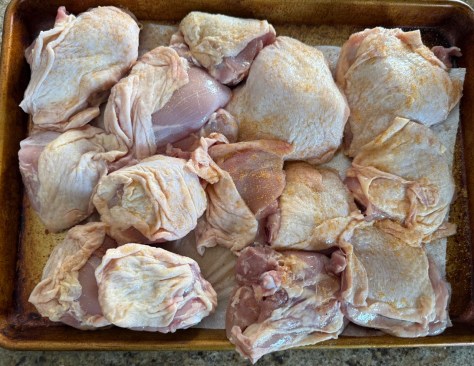
Groceries have become expensive, but it is still more cost-effective to cook at home. Chicken thighs are relatively inexpensive, especially when you buy them in bulk. I’ll often purchase them at Costco, as they are already portioned into smaller packs that are suitable for freezing. If I find a reasonable price elsewhere, I separate the chicken into meal-sized portions and freeze them using my vacuum sealer.
A vacuum sealer is the unsung hero of food preservation. Vacuum sealers can be a relatively inexpensive purchase and can dramatically reduce your food waste. I’ll separate meats into meal-sized portions, label the vacuum bags with the type of meat and the date, and then freeze them. This prevents waste from freezer burn.
If we only use part of a package of bacon, I’ll vacuum-seal the rest and store it in the refrigerator. Vacuum-sealed bacon will stay fresh much longer. I’ll do the same with a cut avocado to prevent it from turning brown.
Individual portions of a casserole or soup can be vacuum sealed and frozen. Need a quick lunch? You can reheat the food by the “boil in bag” method, or by venting and microwaving.
Being creative, you can extend the lives of many foods by vacuum sealing. A vacuum-sealed chunk of cheese won’t dry out and will stay mold-free. Strawberries (using a vacuum jar or a Mason Jar sealed with a vacuum-seal jar attachment) will stay fuzz-free much longer in the fridge. Fresh meats will also remain good longer in the refrigerator if vacuum sealed first. Sometimes, I’ll find meat on sale and I’ll keep it in the fridge to cook the next day. Life happens, and plans change. If I have to delay cooking, I’ll vacuum-seal the refrigerated meat to extend its shelf life longer.
The most significant expense associated with using a vacuum sealer is the cost of the bags. Brand-name bags are great, but they are expensive. However, you can find acceptable and much cheaper off-brand alternatives when buying in bulk on Amazon and other sites.
I typically use a different type of vacuum sealer, known as a chamber vacuum sealer. This type creates a stronger vacuum and easily handles liquid contents. Traditional external vacuum sealers require special techniques when sealing liquids. Another significant advantage of using a chamber vacuum sealer is the lower cost of the bags, which is comparable to that of a Ziploc bag. Again, buying them in bulk is the key.
You can get a decent traditional external vacuum sealer for under $100, with many costing under $60. Chamber sealers used to cost well over $1,000, but Chinese-made versions hit the market a few years ago, and I have seen chamber sealers in the sub-$300 range. The brand-named $1,000 sealers were designed for semi-professional use and were intended to last a consumer a lifetime. I can’t verify the longevity of the no-brand units, but they would likely last well enough for a homeowner if properly maintained. I have tried a few of them, and they seal just as well as the brand-named products.
I made this little video for a friend who was beginning to use a vacuum sealer. However, you might find it helpful as well.
Baked chicken is delicious, but can be boring if served too often. There are thousands of recipes that use chicken as an ingredient, stretching this meat while creating a delightful end result. Today’s recipe is for Chicken Paprikash, featuring chicken thighs in a creamy paprika sauce. Due to the richness of the dish, one decent-sized chicken thigh served over noodles is usually enough for most of my family members, with my son occasionally opting for two. You can substitute other chicken parts if you wish. Chicken legs are even less expensive than chicken thighs. I’m guessing that two good-sized legs would constitute a portion for a typical eater.
I use an electric pressure cooker (similar to an Instant Pot) to speed up my cooking process. However, you can also prepare the same recipe in a heavy pot/Dutch oven or even a heavy, high-sided frying pan with a lid. This dish can be prepared on the stovetop or by starting on the stovetop and then finishing it in the oven. There are also recipes for paprikash that can be made in a slow cooker. If you choose a different method, just Google for recipe times. For instance, “recipe for Chicken Paprikash in a Dutch oven.” Many of the recipes will be similar, but the times and possible amounts of liquids may vary. If you are using a manual stove-top pressure cooker (which operates at a higher pressure), you can reduce the pressure cooking time slightly (13 minutes instead of 15 minutes under pressure).
Chicken Paprikash Made In An Instant Pot- Electric Pressure Cooker.
Ingredients
-Oil
-3-4 pounds chicken thighs
-salt and pepper
-1 large onion chopped
-heaping teaspoon jar garlic
-¼ cup paprika
-1 heaping tablespoon tomato paste
-12 oz chicken broth, or water with a broth substitute like “Better Than Bullion.”
-1 cup sour cream
-½ cup half-and-half or heavy cream (optional)
Season the chicken with salt and pepper. Set the pressure cooker to “sear” and add a small amount of oil. Lightly brown the chicken in batches, avoiding overcrowding, as this will cause the chicken to steam instead of brown.
Remove the chicken and add new chicken pieces to brown until the job is completed. Set aside the browned chicken for now.
Add the chopped onion and let it soften in the pressure cooker (the cooker is still on sear/sauté). When soft, add the garlic and stir for around 30 seconds. Then add the paprika and lightly cook it to bring out its flavor. Avoid burning the paprika. Add the tomato paste. After around 20 seconds, add the broth to the mix and stir everything together.
Return the chicken to the pot and pressure cook on high for 15 minutes. Let the chicken “rest” for 10 minutes after cooking is done before releasing the pressure. This will keep the chicken juicy.
Remove the chicken to a serving platter. Put the sour cream in a bowl and add around ½ cup of the broth from the pressure cooker, stirring until everything is incorporated. Then mix this into the broth in the pot.
Optional: I sometimes add ½ cup of half-and-half or heavy cream if I have it on hand.
If you prefer a thicker sauce, mix a heaping tablespoon or two of cornstarch with around two tablespoons of cold water, then stream/mix this mixture into your boiling broth.
Adjust the salt and pepper to your taste in the sauce and pour it over the chicken.
Serve on a starch of your choice. Noodles work well. I had some dried spätzle that I cooked up.
A biscuit, bread, or muffin can complement the meal, making your dinner hearty and satisfying.
My measurements are approximate as I cook by feel. With many recipes, a slight variance doesn’t make much of a difference in the end product. For instance, using ¾ cup or 1 1/4 cups of sour cream will both yield a delicious paprikash. When you are starting your cooking journey, the most essential ingredients to measure are the spices (including salt), as too much can ruin a dish. Baking tends to require more exact measurements, but even with baking, some variance is allowed.
Chicken Paprikash utilizes many common food staples and doesn’t require exotic ingredients. Pat the chicken dry to reduce spattering when browning. I used some seasoned salt, but salt and pepper work too. Brown the chicken in batches, avoiding overcrowding.Sauté the onions in the electric pressure cooker until they soften, then add the garlic. Adding the garlic too early will cause it to burn.Add the paprika and cook it gently, avoiding burning. Add the tomato paste. Add the broth and mix until everything is combined.Return the chicken to the pot, secure the lid, and pressure cook for 15 minutes. After the cooking time is done, allow the chicken to rest in the cooker for 10 minutes before releasing the steam. In a pinch, you can release the steam immediately, but that may result in slightly drier chicken. Mix some of the hot liquid from the pressure cooker into the sour cream until smooth. Then pour this mixture back into the pressure cooker, which is once again set to “sear/brown.”With the pressure cooker still set to “sear/brown,” adjust the salt/pepper levels to your liking. Add salt only a little at a time (around 1/2 teaspoon), tasting in between each addition. You can always add salt, but you can’t remove it. If you want to add a thickener, such as cornstarch, the liquid must be boiling. 1-2 heaping tablespoons of cornstarch dissolved in approximately two tablespoons of cold water should suffice. Add this in a stream while stirring, and your sauce should thicken in a minute or two.Pour the sauce over the chicken to complete the dish. Reserve additional sauce to be added over the noodles. Served over some noodles, accompanied by a biscuit to complete the meal. Very filling and delicious!
The advantage of writing a non-commercial blog is that I can write whatever strikes my fancy. Often, this is based on what has caught my interest in the news or an article I’ve read, or sometimes something in my personal life.
Most recently, I have been struck by the runaway inflation that impacts every aspect of our lives, from purchases to repairs. Many of these costs are unavoidable, with few opportunities for cost reduction. However, I have been trying to exercise some options by doing things that I have never done before. For instance, I’m now negotiating for a lower price for a simple home repair. My plan is to do this reasonably, where both parties benefit. I receive a small discount, and the repair person gets the job. Additionally, I’ll call several shops when I need a car repair, such as replacing my brake pads. In the past, I would use my local dealership as it was convenient. Now, I’m willing to drive to a more distant shop and wait, which can result in hundreds of dollars of savings.
My parents raised five kids on a single salary. Naturally, the times and expectations were different in those days. Things were repaired instead of replaced, and we had only one car, which was typically used. I had few clothes; when I attended a Catholic grade school (grades 1-8), I wore a school “uniform” and had two pairs of navy blue pants and two light blue shirts. During the majority of my freshman year at a public high school, I had one pair of pants. I thought no one noticed until I got a second pair around three-quarters of the way through the school year. My lab partner remarked, “OMG, you have a second pair of pants!” He quickly realized what he had said and tried to retract his statement. I was embarrassed, but we went on with our lesson.
I knew money was an issue at home, but I never felt that we were in danger of not getting our true needs met. Food was always plentiful, thanks to my father’s passion for food and my mother’s expertise in stretching a food budget. My mom was a great cook, and my friends often wanted to eat at our house. Now, looking back, she was able to turn simple ingredients into marvelous meals. Much of this was achieved by cooking foods from scratch and occasionally using convenience foods, such as canned condensed soups, as an ingredient base, to expedite her meal-making process. I learned by watching.
I have had periods where I was objectively penniless. The eight years that I spent in medical school and residency were times of sacrifice. My first marriage ended while I was in medical school. By the time I started my residency, I was living in my own apartment, paying child support, and trying to live as frugally as possible. I was so poor that I survived on the change in my pocket, and I had to take drastic measures for even the most rudimentary tasks, such as buying and preparing food. I rarely ate in the hospital’s subsidized cafeteria as I found it too expensive.
I had roughly $20 for my weekly food budget (approximately $58 in 2025 money), so money was tight. In those days, grocery stores had “generic aisles” that featured basic foods with stenciled labels, such as “Green Beans” and “Flour.” This food was not on par with house brands; it was significantly lower quality. Additionally, I would search for (then) low-cost meats like turkey legs, hamburger with TVP added, and generic baloney, which was certainly something other than real baloney. I would often make enough food for two meals, and before eating, I would separate half of the food into a Rubbermaid container. That container would be my lunch for the next day. My system worked surprisingly well, and I believe that my lunches were often better than those of my richer colleagues, who were buying from the cafeteria.
Part of my ability to utilize my cooking system was my ease of cooking. I believe that this was due to learning by watching my mom cook, as well as my opinion that cooking was simply a matter of practical chemistry. Different methods often shared common roots. If I understood fermentation when making bread, I could apply that knowledge to other processes, such as making yogurt.
When Julie returned to the paid workforce, I took over a lot of the meal prep, but I did it with a twist. My kids became my co-participants, and we all worked on all aspects of food, from shopping to meal preparation to cleanup. I wanted to instill these fundamental skills in them, and I wanted those skills to become second nature.
Now that my kids are living independently, I hear them talk about shopping “the sales” and preparing food from scratch. My one daughter is in the habit of preparing recipes for a typical family of four, dividing that meal into four storage containers and feeding herself for four days on that initial preparation. She is a busy professional who enjoys spending time with her friends and engaging in activities. She doesn’t want to spend all of her time in the kitchen and realizes the cost issues of always eating out.
I have been retired for several years, but it is not uncommon for me to cook for groups of 3 to 6 adults. I have done my best to save for my senior years; when you retire, you spend money, but you don’t make money. I still cook many meals from scratch and use only a limited amount of prepared foods in my cooking. I’m not adverse to using some processed foods, and on occasion, I’ll make a frozen meal, but that is not the majority of the time, as those meals are of lower quality and much more expensive than what I can make myself.
I wanted to share some of the simple recipes that I use to take some of the mystery out of cooking. With a bit of practice and some basic tools, almost any type of meal prep is possible. This will be a random series that I add as my mood dictates.
Today’s recipe is:
Chicken Carcass Soup
I know that sounds horrific, so you can call it (depending on how you make it) “Chicken Soup” or “Cream of Chicken Soup.”
The Costco $5 roasted chicken is a bargain in terms of both convenience and cost. Additionally, it is delicious. I’m able to feed my family dinner with a chicken, but there is usually quite a bit of fragmented meat left on the bone. I developed this simple recipe to salvage this meat, and it has become a family favorite. I usually make the creamed version, but you can opt for basic chicken soup if you prefer. The recipe is very flexible; beyond some basic ingredients, you can be as creative as you wish.
-Refrigerate the chicken carcass with the remaining meat until used. I prepare the soup within a few days of eating the roasted chicken. You can also use your own roasted chicken carcass (not Costco) or just a cut-up fresh chicken. If you do the latter you can add the chicken to the pot as is or brown it first. Browning will add more flavor. I think the skin adds flavor, but you can use skinless if you prefer. Remember, pre-cut chicken is more expensive than a whole chicken. A carcass will yield a soup that is inexpensive to make. A boneless, skinless chicken pack will be more expensive and won’t taste as good.
-If using a carcass, remember that chicken is already thoroughly cooked, but you want to cook the vegetables. You can simmer the soup for an extended period to achieve a richer/deeper flavor.
-I often use a pressure cooker at high pressure for 15-20 minutes (quick release), but you can also use a big pot or Dutch oven. If you are using a pot, bring the contents to a boil and then immediately turn down the heat to a simmer. Cover the pot and cook for around 30 minutes or longer (slow simmer) for a richer flavor. A slow cooker also works for around 4 hours on high or 7-8 hours on low.
-To make the basic chicken soup, I’ll use (very roughly) ½ of a chopped onion, anywhere from 2-4 stalks of sliced celery, around 3-6 cut-up carrots, and some salt and pepper. The vegetables can be a bit past their prime. In a pinch, I have used dried celery and even dried onions, but they are not quite as good. If I’m feeling ambitious, I’ll slightly char the onion, which adds flavor and depth. I’ll always add a broth extender, usually “Better Than Bullion,” but in a pinch, a few bullion cubes also work. I’ll add anywhere between ½ to 1 teaspoon of salt and a similar amount of black pepper. I am always very sparing with salt, as bouillon contains a lot of it, as does the chicken. I adjust the salt after the soup is cooked. I’ll add water to cover the solids, about two-thirds of the way up the carcass. You need enough water to cook the bones and vegetables. However, too much will make a diluted soup. You can always add water at the end of the cooking process if your broth is too concentrated.
-You can add all sorts of additional vegetables if you wish. Add some chopped, overripe tomatoes (not moldy, of course), or a can of tomatoes. Add fresh, frozen, or canned peas, corn, green beans, carrots, or any other vegetable of your choice. If using canned vegetables, drain and add them at the end of the cooking process. However, avoid strong vegetables like broccoli or cauliflower. Some soups do use strong vegetables, such as cabbage, and those soups can be delicious. However, chicken soup is not one of them.
-If all you have is salt and pepper, that is fine. But to add additional depth and interest to the soup, it is easy to add some spices. You can add some or all of these, depending on what is in your spice cabinet. I usually add ½ tsp to a scant teaspoon of each spice. Here are some dried herbs that I add: oregano, basil, parsley, 1-2 bay leaves, and thyme. I’ll also add a little MSG. By the way, all of that stuff about MSG causing medical issues has been disproven. Lastly, I add around one heaping teaspoon of jar garlic, because I love garlic.
-I’ll often break the carcass in half (or more) to easily fit into the pot. Sometimes, I’ll use a trick from my sister-in-law and wrap the carcass in cheesecloth, which makes bone removal easy. Otherwise, I’ll just “tough it out” and use a colander to separate the solids from the liquids. Using my hands, I’ll pick the meat off the bones, discarding the bones, and then return the rest to the pot for “stage two.” I’ll let the soup cool down a bit before removing any bones manually.
-I always add a starch, which can be anything I have on hand. You can cook the starch in the broth or make it separately. Both work, but you have better control and a better product if you make the starch separately. What starch? Anything. Any type of pasta, including noodles and even spaghetti. Potatoes cut into chunks (if it is a thin-skinned potato, all you need to do is wash and cut), rice, or other grain. When it comes to rice, I usually add it to the soup bowl and pour the soup over it. Rice disintegrates over time if it sits in soup for too long, and will turn to mush if you freeze leftover soup. However, you do you.
-When you get more confident in your soup making, you can add a little “acid,” which brightens up the soup. A small amount of dry white wine, dry sherry, hot sauce, or even vinegar can transform a soup (just use one). Think ¼-½ cup wine/sherry, a few shots of hot sauce, or a tablespoon or less of white vinegar.
-I often make the soup in the morning and then let it cool. I’ll use a colander and separate the broth from the solids, and then pick out the bones from the meat and vegetables. The bones are discarded, and the rest is returned to the pot. Conversely, if I have some cheesecloth, it is easy to place the carcass in the cloth, remove the fabric after cooking, and pick off the meat to return to the soup.
-If you are making a simple chicken soup, add water (if needed) to the desired dilution (this is usually none or a cup or two, don’t go overboard), and adjust the salt level carefully, ½ teaspoon at a time. Add and taste until you are satisfied.
Cream option
This is the version that my kids go for.
The first part of this soup making is the same as above. However, don’t adjust the soup concentration as you will be diluting the soup with dairy products. I may use slightly less initial water when cooking the soup.
-Put roughly 1 cup of sour cream in a bowl and add about ½ cup of broth and stir it in. This will make it easier to incorporate the sour cream into the soup. Stir the sour cream mixture into the hot soup. Add approximately ½ to 1 cup of half-and-half or whole milk, and stir it in. You can adjust the sour cream and milk/half-and-half to your preference, as I’m just “guesstimating” the amounts. Adjust the salt level, add a little more pepper if desired, or a shot or two of hot sauce (we like Frank’s). We don’t like “hot” foods, so we just add enough to add warmth and interest.
If the soup is too thin, I’ll mix a heaping tablespoon or two of cornstarch with a few tablespoons of cold water and pour it into the boiling soup in a stream as I stir the soup. This will thicken it nicely. Sometimes I’ll add a sprinkle of powdered garlic (remember, I love garlic). The secret is to taste and adjust in increments.
We will serve the soup with a variety of bread products, ranging from tube refrigerator rolls to homemade savory muffins to crackers. It is all good.
We usually have enough soup to feed everyone, plus leftovers. The leftovers will often disappear, as they are great for lunch the next day. If there is still leftover soup, I’ll freeze individual portions in vacuum-seal bags that can be reheated by boiling.
One simple, cheap $5 chicken yields two full meals with leftovers for several lunches. How can you beat that? The results will taste better than any canned soup. How good is it? My kids get excited when I make it, as it is a taste of home.
Bon Appétit
Mike
I’ll break up the carcass so it fits in the pot. I’ll add carrots, celery, garlic, onion, and some salt and pepper. I’ll always add an extender like “Better than bullion.” I’ll add just enough water, usually enough to cover most but not all of the chicken. If cooking in a pot and not a pressure cooker, make sure the vegetables are in the water. If all you have is salt and pepper, that’s fine. However, I’ll add some spices that I have to enhance the flavor. I’ll usually add 1/2 to a scant teaspoon of each of the above. If you only have some of these spices on hand, that works too! When it comes to salt, I initially only add around one teaspoon. I’ll adjust the salt at the end of cooking. Since the chicken is already cooked, I’ll pressure cook for only 15-20 minutes. If I were using fresh chicken, I would pressure cook for around 25-30 minutes. If I were cooking in a regular pot (without a pressure cooker), I would bring the mixture to a boil and then reduce it to a simmer. I would cook for at least 60 minutes or longer (hours) to enrich the flavor. You can make your starch directly in the broth. I prefer to make it separately as I have more control over the finished product. My family prefers the cream version of chicken soup, which is achieved by adding around one cup of sour cream and some milk/half and half/heavy cream (your choice). I’ll usually thicken the soup with some corn starch dissolved in cold water and then streamed into the boiling soup. Always adjust your seasoning at the end of cooking. In this case, when the soup is ready to be served. Served up, soup is a complete meal. Here, I’m serving it with some oyster crackers, but bread, savory muffins, or many other options can also be used.
Most personality traits have two sides, one positive and the other negative. Those sides may be equal, vary over time, or one side may be significantly exaggerated compared to the other. For example, you can have a trait that has mostly negative consequences or mostly positive consequences. In contrast, another trait may be more balanced, being positive in some situations, while negative in others.
Let’s say your partner is a fun, impulsive, risk-taker. A person who consistently pushes the envelope. They like expensive experiences and things. They dress in designer clothes, love top-tier restaurants, and enjoy the excitement of embarking on spontaneous trips and adventures. They may be very exciting during the early stages of your relationship, and you might view their behavior very positively. However, in the long run, as you are trying to build a future, you may find their actions to be quite the opposite. Their trait has not changed, but the situation has.
A woman may find that dating a “bad boy” is exhilarating. A man may find that a beautiful “high-maintenance” woman gives him status. However, neither may be a good choice in the long run.
Some of my traits include being someone who can become completely absorbed in a topic and who tends to overthink and over prepare. I know that in the past, this trait has aggravated my wife, who saw my scenario-building as a problem, as I was too methodical, tended to have backups of important things, and would derive solutions for issues that “could” happen, rather than those that “did” happen. That was the downside of this behavior coin. However, she also reaped the benefits of this same trait. I was the one who thought to bring cash for coffee when we were on a walk, the one who made sure that the car had enough gas and that the oil had been changed. The one who had the tools and knowledge to fix things, the planner who ensured that the bills were paid, and the person who made sure we saved for the future. That was the upside of the same coin. A coin has two sides; you can’t choose one without accepting the other.
In the above example, my wife eventually realized that this was who I was. The good outweighed the bad. In turn, I tried to be respectful of her wishes and concerns. A balance was struck.
Some traits evolve. A situation can push us into a place of discomfort, and we can actively move ourselves away from a trait that is no longer serving us. However, that is an active process. I made my living helping people do just that, and I’m here to tell you that changing even a simple behavior can be an arduous task. I may be a psychiatrist, but I am first a human being. Like anyone, I need to assess my behaviors and make adjustments as necessary. My primary goal has always been to advance myself and those close to me positively.
Let’s say that my behavior trait says, “eat that piece of cake.” I have chronic weight problems, and so I may choose to override my wish for the greater good. However, what about a behavior that has served me well throughout my life, but now needs to be modified? Enter the behavior of me never asking for help.
I can tell you where this behavior originated, but for now, I’ll just say that both my two living siblings and I exhibit this trait. It is extremely difficult, and at times impossible, for us to ask for help when we need it.
In many ways, this trait has served me well. It has made me very independent, an excellent problem solver, and it has given me confidence that I can tackle most issues as well as the next person. Despite graduating from an awful high school, I had the confidence to attend college, then graduate school, and ultimately, medical school. This confidence propelled me to become chief resident, co-found a successful clinic, and tackle projects that many would have found daunting.
However, my inability to ask for help had a downside. I wasted a lot of physical and emotional energy on trivial things that would have been simpler for others to do.
My inability to ask for help was not the result of grandiosity; instead, it was due to fear of rejection. Fear that I would be laughed at or dismissed or shamed for needing help. That was the pathological side of that coin.
My dilemma was that my inability to ask for help had positive benefits, but it was also holding me back. If I were in psychotherapy, the therapist would add deliberate exercises to push me in a direction to modify my behavior. However, I wasn’t in psychotherapy. Yes, of course, I could structure the change myself, but that would be an awkward and slow process.
In life, we are presented with numerous situations that can lead us towards a direction of change. Unfortunately, many ignore most of those opportunities.
In my case, change came with trust. Trust that I wouldn’t be ridiculed or shamed if I asked for help. Trust that the person I asked for help would actually help me.
Because I was open to change, my transformation came naturally, although it occurred slowly. It began with asking for help from my wife, and then from my kids. Often, my wishes weren’t too complicated. Simple things, like asking my wife to pick something up for me when she went to the store, or when she offered to do something for me, accepting that offer instead of saying, “Thanks, but I can do it myself.” As I became more comfortable with those actions, I also grew more comfortable asking my kids to help me. Here again, I started with simple requests, such as asking for their help with household chores. Things expanded from there. Often, my requests were for things that I could do, but didn’t have time to do.
Things were different with my friend, Tom, who has talents and abilities that I lack. Tom has helped me many times and has been a great friend. In turn, I assist him with tasks where I have greater strength.
With family, there may be a specific expectation for cooperation. However, that is not the case with a friend. For me, allowing Tom to help me also has two sides. It makes me feel uncomfortable, as I’m usually the one who helps others in most situations. I also want him to know that I value him as a person more than as someone who can do things for me. Still, it also feels wonderful at the same time to have someone willing to go above and beyond for me. Allowing someone to help me gives both of us greater value. There is a stronger connection and a deeper meaning to the relationship. We are social animals, and anything that builds connections with others strengthens both parties.. When a helper helps another person, the world becomes just a bit better.
Our need for help goes beyond physical actions. For instance, it is unlikely that I would ask my sisters to do a physical project for me, but I may need their advice or simply their ear to listen to me when I’m having a bad day.
We live in a black and white society that has ever moved to the extreme. Let me use an ice cream example. I love ice cream. Having some after dinner makes me very happy. However, eating an entire carton makes me feel physically and emotionally unwell.
The same could be said of asking for help. Some people are always asking for help, even for things that are well within their abilities. For them, asking for help is a lazy way to avoid responsibility. This behavior does not promote anything healthy. It is an abuse.
As with most things, being balanced and thoughtful is the solution. Reviewing one’s actions and behaviors is often the key to progress. Asking for help is not a get-out-of-jail-free card for life’s responsibilities.
I know that I will continue to be as self-reliant as possible; that is who I am. However, my ability to ask for help has made my life better and has improved my connection with others. I’m grateful that I have been able to make this change.
Do you have problems asking for help, or the opposite, asking others to do jobs that you are wholly capable of doing yourself? Do you want to change this behavior? Do you have other traits that you would like to modify? Remember, every journey starts with a single step, but to get to your destination, you need to keep walking.
I woke up this morning with a question in my head. I turned to my phone, did a Google search, and found the answer in under a second. I’m surrounded by information. My Smartphone and laptop can provide me with news, weather, music, and videos, and my Smart TV offers hundreds of channels to entertain and educate me. Welcome to the modern era, where information is instantly available. However, the modern era is fragile; all it takes is a power outage to have these conveniences disappear.
If the power outage is limited to my block, my cell phone will work until I need to charge it. However, if the outage is more widespread, cell towers will also fail. In these situations, I would be left without communication or information. That could be a life-threatening situation. There have been recent disasters where knowing where emergency services were available could make the difference between life and death. But, how do you know where they are if you can’t access information?
A while back, I read an article on the most significant inventions of the last century. More important than the Internet or even television was radio. Radio brought news, weather, education, music, and entertainment to the world, and could access rural areas rapidly and effectively.
In 1941, when she was a toddler, my sister recalls hearing about the Japanese attack on Pearl Harbor via our family’s radio. She was in the kitchen with my mother, who was ironing, and remembers that my mother uttered a word that she had never heard her say before. Radio instantly brought that information to her, faster than any newspaper could have.
On September 11, 2001, I was working at a VA hospital on a unit without a TV. We heard that there had been an attack on Federal buildings, so I logged onto the Internet. In those days, the internet was primitive and completely overwhelmed by increased traffic, making it impossible to access. Luckily, I had a portable radio in my desk drawer and was able to keep the staff updated.
I love to camp in Violet, my homemade adventure van. I’m often boondocking in remote places that lack cell coverage. I carry an emergency communication device, which is used for sending a distress call. Thankfully, I have never had to use it. However, I still need to know local weather conditions and what’s happening in the world. Thankfully, I have never been in a place where I couldn’t receive a radio signal, so keeping informed has always been easy.
Our country has recently faced significant disasters. Forest fires, hurricanes, and floods are becoming more commonplace. These events cause prolonged power outages and damage infrastructure, including power lines and cell towers. Re-establishing these physical structures can take weeks or even months. However, a single emergency radio transmitter can send information to thousands of people. What is the weather going to be? Where is food and water being distributed? Medical care can be found where? Only those who can receive its signal are privy to this critical information.
We all need basic emergency supplies, such as a flashlight, a first aid kit, and shelf-stable food. However, having a portable radio is equally essential. In today’s post, I’ll outline what you need and aim to demystify the ins and outs of making a radio purchase. Some portable radios can receive many different bands, so I’ll also discuss and rate their importance.
Why a portable radio?
A portable radio will provide immediate information when all other sources fail. Radios are very efficient and will run a long time on a set of batteries or a single charge. Many of them are simple to operate and have a zero learning curve. Let’s first examine what to look for in a radio, then I’ll discuss the importance of various radio bands.
In general, portable radios come in two sizes: pocket-size and table-size. Pocket-sized radios are similar to the “transistor radios” from the 1960s. Most have the AM and FM bands, although you can find some FM-only radios and others with multiple bands. The reception and sound quality will generally be inferior to those of a table-sized radio. However, it still should be adequate. Some “transistor-sized” radios can be had for $10. Better ones will cost more.
This portable radio can be had for around $10. It runs off two AA batteries.
Mid-sized radios often provide better reception and sound quality. Their abilities and costs vary, but they may offer additional features. Some can receive many extra bands. You can find workable mid-sized radios for around $20, with others costing in the hundreds.
This mid-sized radio uses D batteries. Its simple “analog” design allows for anyone to use it easily. Some portable radios use rechargeable batteries. They can be more convenient, but you have to have a way to recharge them when needed.
Classic portable radios typically use batteries, such as AA, C, or D. Some older radios may use the more difficult-to-find 9-volt battery. The larger the battery, the longer the radio will play. Some radios that use D-size batteries can play for hundreds of hours before their batteries need to be changed. Batteries have the advantage of being easily replaceable. If you have an extra set, you can continue to receive information when the first set is depleted. However, you have to plan to have them on hand. Batteries can last a long time in a radio. However, some radios will use a tiny amount of electricity even when off. This can eventually discharge a battery. A discharged battery can leak, destroying the electronics in a radio. Ensure that any radio is turned off when not in use. If it is on but the volume is turned down, the batteries will drain and leak.
Many newer portable radios utilize internal rechargeable batteries that can be recharged via a USB port. Their advantage is that you don’t have to remember to buy batteries. However, you need to have a way to recharge them, and you should have a schedule where you recharge an unused radio every three months or so to ensure it is available in an emergency. The best option is to put a reminder on your phone’s calendar. Most don’t come with a charging brick, so you must use your phone’s charger to charge them.
Almost all new radios are internally digital, built on a microchip design. This is the case even if they look like an old-style analog set. Older analog radio models utilize components, such as transistors and capacitors, to enable the radio to function.
Using a digital “radio on a chip” enables cost-effective production and reasonable, if not outstanding, performance. Microchip-powered radios often have decent FM performance, with AM reception ranging from satisfactory to acceptable for less expensive models.
Old-style analog radios are more pleasant to use and can tune between broadcast frequencies, allowing for better reception of distant AM stations. This is less of an issue when local stations are down due to a disaster. You can still find a few traditional analog portable radios based on older designs that have remained in production.
I suggest buying a radio with a traditional analog look. In other words a radio with a conventional tuning dial and knobs. Radios with many buttons and digital displays can be more capable and may offer additional features, but they have a learning curve. The best emergency radio is the one anyone in the family can easily use.
As stated above, the bigger the batteries, the longer the radio will play without needing to be recharged or replaced. However, even radios with AA-size batteries will play for a long time. You can conserve battery life by keeping the radio’s volume low and limiting playtime. However, a radio playing can be a good moral boost, so I would advise having backup batteries or a way to recharge a rechargeable radio.
Many companies sell “do-all” emergency radios that can be charged via a crank and/or solar panel. However, the practicality of charging a radio in this way is limited, and the charging components are poorly made. I have heard stories of people crank charging their radios only to have the crank crack off in short order. I believe that you are equally served with a traditional portable radio.
This emergency radio may seem like a jack of all trades, but its components are cheap and could fail when you need them. However, such a radio is better than no radio.
Unknown Chinese brands now manufacture the majority of portable radios. I have tested several of them, and they were all adequate, with some outperforming others. You want a radio that has both AM and FM bands. In the next section, I’ll explain why, look at a variety of other radio bands, and describe their utility in an emergency.
The radio bands
I’ll rate these using an A-F scale, with A being most important and F being the least important..
The FM band
Importance level = A.
Having a radio with an FM band is a must. FM is a local band, and some rural areas now only have an FM outlet.. An FM radio signal can travel around 30-60 miles. However, it is more realistic to receive an FM signal no further than around 20-30 miles. The more powerful the transmitter and the higher it is on the horizon, the further it will travel. A high-powered station with an antenna on a skyscraper will be heard at a greater distance than a low-powered station that serves a small community. Static and lightning crashes do not impact FM. Our town has a college FM station that would be put into service during an emergency.
The AM band (also called MW or Medium Wave band)
Importance level = A.
Having a radio with an AM band is a must. Some radios are now sold only with FM, so avoid those. You double your chance of hearing broadcasts if you have both AM and FM. Additionally, AM signals travel much further than FM signals. A strong AM station can be heard from around 100 miles away during the daytime. At dusk and night, AM signals can travel much further, providing you with information even when a regional disaster destroys local infrastructure. Clear-channel/high-powered stations can be heard for hundreds of miles at night. Using a decent radio from my Chicago location, I can listen to stations from New York City, Atlanta, St. Louis, New Orleans, Montreal, Denver, the Twin Cities, Boston, and more. I can also receive stations from Wisconsin, Iowa, and Indiana during the daytime when I use a high-quality AM radio.
Additionally, some communities, including the one I live in, have low-powered emergency AM radio stations that can provide vital information specific to that community during a crisis. These stations can run on backup power systems and don’t require giant antenna masts, so they can be used even when more traditional stations fail.
Although digital, this CC radio is simple to operate. It offers fantastic AM/FM reception as well as weather band and the 2-meter ham band. However, it is around $200.This radio offers a lot of functionality in a small package, but its complicated digital interface would be challenging for a non-radio person to use in an emergency.
Weather Radio band
Importance level = B
The National Weather Service operates over 1,000 low-power radio stations that cover more than 90% of the US population. This service exists on radio frequencies above commercial FM broadcasts and requires a radio that has “weather band.” NOAA radio broadcasts emergency alerts and detailed weather information, including information for aeronautical and maritime users. Although very useful, the reports can be tedious, and most people can obtain all the basic weather information they need from commercial AM and FM broadcasts. You can find some radios, both expensive and inexpensive, that incorporate this band.
2-meter ham (amateur) radio
Importance level = B
This amateur radio service also resides above commercial FM and consists of local ham radio operators exchanging messages and emergency traffic. Ham radio serves as a backup communications network during emergencies, as hams relay information and help coordinate emergency services. If you listen to their chatter, you can gain an inside look at what’s going on behind the scenes. The downside is that you need more technical skills and specialized radio equipment to listen to these broadcasts.
Note that the majority of emergency communications during a crisis is handled by first responders and government agencies who use their emergency frequencies, not ham operators, who mostly handle health and welfare traffic. Emergency responders often utilize “trunked” transmissions and digital/encrypted communications, which necessitate specialized and expensive equipment.
Shortwave radio stations
Importance level = C
The large swatch of frequencies between medium wave (AM) and FM is called the shortwave or HF band and includes many different services. The two most pertinent services for disaster information are the long-range ham (amateur) radio frequencies and the international shortwave broadcast frequencies. You can find radios that cover some or all of the shortwave bands. Inexpensive radios will pick up strong stations, but expensive and sophisticated radios will do a significantly better job. Radios that include the shortwave band can range from $10 for a cheap pocket portable to thousands of dollars for a pro-level radio.
Amateur radio on shortwave is used for longer-distance communications, and hams use these frequencies to contact ham operators located further away, sometimes in other states or countries. Most of the time, they broadcast using a transmission method called SSB (single-sideband), and a special shortwave radio is required to decode SSB into intelligible audio. These special radios will list “SSB” in their description. There may be some use to listening to these transmissions, but it is less important than other information sources.
This radio costs over $200, but it is an extremely capable device that can receive signals on multiple bands. Additionally, it is rechargeable. However, its digital interface is so complicated that I had to read the instructions several times just to understand all of its controls, and I hold an “Amateur Extra” radio license! Although capable this should not be your emergency radio unless you are willing to spend time with it beforehand to learn its many functions. High-end radios can get expensive. This ham radio sells for almost $5000!This radio offers reasonable reception, and its simple analog dial makes it easy to use.
There are segments on the shortwave spectrum specifically allocated for international broadcasters. When I was a kid, I fixed an old shortwave radio that I found in our basement, and it was transformed by listening to English-language broadcasts from dozens of countries located all over the globe. However, most of these stations have gone silent, as it is cheaper to stream their programming online.
I recently used an inexpensive portable radio that had shortwave and did hear some stations in Spanish (South American countries still use shortwave for some local broadcasts). I also heard around eight different stations in English. However, the majority were religious in nature (fire and brimstone stuff), and one was right-wing political to the extreme. These English language stations could be repurposed for emergency communications for the general population in a significant national emergency, as their signals can travel thousands of miles. There is limited utility to having a radio that can tune the shortwave band.
Emergency responder frequencies
Importance level = C-
Although important, listening to these frequencies typically requires a specialized radio called a scanner. These transmissions often shift and share frequencies and can be digitized, making them very difficult to eavesdrop on. It is unlikely that you will be able to receive these transmissions.
Personal radio services
Importance level = C-
There are several personal radio services that ordinary citizens use for local communication. These include the FRS, GMRS, and CB radio services. To listen to these stations, you will need a radio capable of tuning in to those frequencies. In most cases, it is easiest to use a walkie-talkie or a dedicated radio designed explicitly for these transmissions.
Listening is likely of marginal value, but having a set of these radios (called transceivers as they transmit and receive) may help you communicate with your group during emergencies. FRS, or Family Radio Service radios, are very inexpensive and easy to operate. They are short-range devices, typically having a range of 1 to 2 miles, depending on the terrain. Because they operate on a higher frequency than CB radios, they are compact and have small antennas, making them pocket-portable.
Many FRS walkie-talkies are inexpensive and can serve as a means for families to communicate over short distances when cell phones are unavailable.
GMRS radios require a license to operate, are more powerful than FRS radios, and can utilize repeaters on some of their channels to extend their transmitting range. GMRS radio can have a range of 2-25 miles and even further if it is connected to a repeater. These radios cost more than FRS radios.
CB (Citizen Band) radio can still be heard if you are near an interstate, as truckers continue to use it. CB radio can be a valuable source of information, as truckers often discuss topics such as weather conditions, road closures, and other relevant information that may be helpful. CB radio frequencies are located in the shortwave band, and some radios with shortwave capabilities can intercept these transmissions. CB radio transmissions can travel up to 7 miles. However, most mobile stations (ie, truckers) have a range of only a few miles.
CB radios are still popular among some truckers and can provide information about local situations or conditions.
Aeronautical band
Importance level = D
This is the band that planes use to contact ground-based stations. Transmissions are typically brief, technical, and of limited use to the general public.
Long Wave
Importance level = F
Longwave frequencies lie below medium wave (AM stations). At one time, there were longwave commercial radio stations, especially in Europe. However, only a few remain, and none are located in North America. You can hear some location beacons on longwave as well as time signal stations (stations that only broadcast the time for synchronisation and scientific use). Many cheap multi-band radios have longwave, which is pretty useless in the US.
For as little as $10 and a couple of spare batteries, you can be better prepared for yourself and your family. If you don’t have a portable radio, buy one today.
Images are from Amazon and are being used for educational purposes only.
Long ago I realized that I didn’t like most formal exercise. I thought I disliked exercise in general because I wasn’t willing to do endless burpees. However, with reflection it turns out that I do like exercise when it is paired with other activities. I love to ride a bike, go on walks, and do day hikes. All of these things give me quite a bit of pleasure.
A day hike is somewhere in between a walk and a backpacking trip. For me, it involves going to a trail, often for the first time, and exploring my surrounding. I’m a photographer, and hiking gives me many opportunities to shoot photos.
By the way, you may wonder why a day hiker would need emergency supplies. There are many cases where people went on a simple day hike, often on a well used path, and got lost, injured, or died. It is easy to go off trail to “do your business,” and become disoriented, take the wrong fork in a trail, or face weather/trail problems. Everyone has to decide what level of risk that they comfortable with.
I remember going on a day hike with two of my kids when they were very young. I asked some hikers who were leaving the trail if the trail was clean and if it was an easy hike. They said yes. However, it turned out to be a three mile hike with fallen trees, washed out parts of the trail, and stream crossings. There were a number of twists and turns and side trials, and I got disoriented. Because of the nature of the path it was very difficult to turn back, so we forged ahead. I had to motivate my kids to keep going and kept telling them, “Every step brings us closer to the camper.” At one point towards the end I wasn’t sure to turn right or left, but I had a little compass on my watch band and a simple map from the visitor center. I used those tools to go the right way. To go the other direction would have taken me right back on the loop that we spent most of the morning trying to get off of. We had to share one little bottle of water and I brought along only one little packet of Fig Newtons because I thought we would only be gone for a half of an hour. I should have been more prepared, but the little compass on my watch band and the park map saved the day.
If I am hiking anything more than a short distance I always bring my backpack and supplies. I have designed my hiking backpack system to be light and efficient. Everyone should design a system that meets their needs, and mine is certainly not the most comprehensive. However, after years hiking these supplies work for me. Let’s take a look at my necessary hiking gear.
I can’t stress how important a decent pair of shoes is. I was recently visiting friends in Florida and packed a cheap pair of sandals to wear to the beach. We did a little walking, and I was rewarded with three blisters on my feet. When I first started to hike, I bought a pair of decent hiking boots that I thought fit me. I used those shoes for several seasons and wound up losing my big toenail several times. I couldn’t figure out what was wrong until I went to REI and they told me that I needed to size my shoes up. Since then, I have retained my toenails! I now like to wear trail runner-type shoes. A good brand makes all the difference in the world. If you are going to spend money on anything, spend it on your shoes. Good shoes wear out, so be prepared to replace them. Everyone has their brand preference. If possible, go to a place where you can try on several brands. Additionally, good socks are important. I like Darn Tough socks, which are made of a Marino wool blend. I am a big fan of trekking poles. They steady me on declines and over streams, and they allow my arms to help my legs when going up inclines. You don’t have to buy the most expensive ones, but avoid cheap poles. I have had these poles for years. My wife bought a cheap pair at a big box store, and they cracked in half. Check reviews to find a sturdy yet reasonably priced set of poles, or opt for a brand name. For a day hike, you don’t need to go ultra-light. I bought carbon fiber, but in retrospect, an aluminum pair would have worked out just fine. I like cork grips as they don’t get slippery with sweat. Having a pack is a must. I like the Osprey brand as they make quality packs at a reasonable price. Avoid those little back sacks that use strings instead of straps, as they will undoubtedly make any long hike miserable. You can purchase more affordable packs that may better suit your budget. However, I have read reviews of no-name packs where straps have ripped off or zippers have frozen, so caution is advised. I used to use a larger Osprey pack (this one is only 13 L), but I’ve found that I over-packed it, which weighed me down. Beyond backpacks, you can get sling packs, and some find that a big “fanny pack” (called a “bum bag” in the UK) works for them. This Osprey pack model is called “Daylite.”This is everything that I carry in my backpack. the pouch has a lot of individual “kits” in zip-lock bags.This is what I carry for navigation. I’m using my phone to take these photos, hence the sticky note phone substitute. I mostly rely on my phone, but I try to carry a paper map. You can get them at a park’s visitor center for free. I also take an inexpensive compass. I’ll double-check to ensure it still points correctly at the start of the season. There are several excellent hiking apps available for smartphones. I use All Trails Pro. I have a PLB (Personal Locator Beacon) that can send a distress call in the event of a life-threatening emergency. I purchased this around 4 years ago, but the price has increased considerably since then. Its advantage is that there is no monthly fee. I have also used a Garmin InReach device, which features maps and allows for text messaging. That device requires a subscription to work. Newer iPhones can now use satellites when out of cell service (US and Canada only), so that may be enough for some. Remember, a 911 call is NOT carrier-dependent. If your cell phone carrier doesn’t have a local tower, the call will bounce to a different carrier. However, sometimes there are no cell towers, such as in National Parks. That is when a satellite device of some sort may come in handy. Not in the photo is my emergency whistle. Three blasts followed by a pause and repeated is the distress call for hikers. If you scream, you will quickly become hoarse. Some backpacks have a whistle built into their straps; the Daylite does not.You never know if a hike will take longer than expected. I have had to rely on illumination to get back to my car. A headlamp is ideal and inexpensive. I also carry a tiny flashlight and extra battery as a backup. Additionally, my battery bank has a little flashlight on it. Of course, your phone also has a flashlight, but it is best to save its battery for navigation and communication.Protection from the sun is a must. I always wear a hat and try to use sunscreen. My eyes have become more sensitive as I’ve aged, so sunglasses are always part of my kit.I carry some simple first aid supplies that fit into a sandwich bag. You can go more minimal or extensive with such kits. I do have a more elaborate kit in my car. I have absolutely used many of these items on the trail, from mole skin to band-aids to ibuprofen. I have watched some YouTube hikers who say that you don’t need a knife. I don’t understand, as I use one all the time. Why three knives? I always carry the Leatherman in my pocket; it is my EDC knife. I have a small SAK knife on my keychain, which includes scissors and tweezers, and I leave the white knife in my backpack as a backup. It weighs nothing. When push comes to shove, I’ll grab the Leatherman in my pocket.I do carry a minimal fire-starting kit: a small Bic lighter, some fire tinder, including some cotton balls with Vaseline on them. I have never had to start an emergency fire. However, on a long hike, I may bring a cook kit. Usually, one of us will carry the pot/stove and the other the dehydrated food. Some sort of emergency shelter is another essential item. These are Mylar emergency sleeping bags. They are very compact. They are essentially large, sealed emergency blankets that are orange on one side and silver on the other. I have two because I’m often hiking with someone who is less compulsive than I am. Sometimes I’ll carry paracord too. Paracord has 100 and 1 different uses.I always bring more food than I think I’ll need. For most hikes, this would be in the form of snacks. If I’m going on a longer hike, I may bring “real” food or a Mountain House type meal. Yes, I usually bring enough snacks for my less prepared hiking partners.Water is incredibly important. I always pack more than I think I need, and I also have ways to get more if needed. I’ll sometimes sub out my flask for a Smart Water bottle. I also have several ways to purify stream water if needed. Lastly, I have some electrolyte tablets in my first aid kit.I have an expensive hiking puffer jacket and a raincoat. However, I can’t find them in my camper or house. I’m blaming my cat for hiding them. Better that than admitting that I put them/lost them somewhere! For now, this hoodie will do. I also bring some “just in case” emergency rain ponchos (a second for a hiking partner). If I suspect rain, I’ll bring an old, clunky plastic rain jacket that I have. It’s not as light or fancy as my lost raincoat, but it does the job.I always carry a charged battery bank. This one includes the charging cords. I have used my battery bank many times on a hike, as GPS hiking maps use a lot of energy. Don’t forget to bring a charging cord if your bank doesn’t have one built in. I also carry some duct tape. Another item with 100 and 1 uses. I have this cute little pack, but you can also roll a few feet onto a Bic lighter from a regular roll.
Additional items: I always carry an empty gallon Ziploc bag that has many uses. However, I mostly use it to carry out garbage. I’ll also carry a little travel pack of wet wipes to clean my hands or for an emergency potty run (so far I have never had to go number 2 on the trail). If you go “poo” frequently on the trail bring along an ultralight trowel. They are cheap and better than digging a cathole with a stick. Remember to bury any organic matter at least 6 inches deep and carry out any TP or similar wipe. Leave no trace! Another common thing I carry is a tiny bottle of hand sanitizer. Hand sanitizer is mostly alcohol and can be used to sanitize your hands, as wound antiseptic, or to start a fire. You can also get compressed towels that are the size of two TUMS tablets. There are usually 11 of them in a tiny tube and each one will expand to the size of a paper towel by adding 1 teaspoon of water to them (I think they are fun/cool). You can even buy a tiny bidet made for hikers (Culoclean) that attaches to a water bottle. However, wet wipes are multi-purpose and work best for me for many of these functions.